Policy Memo
Topline
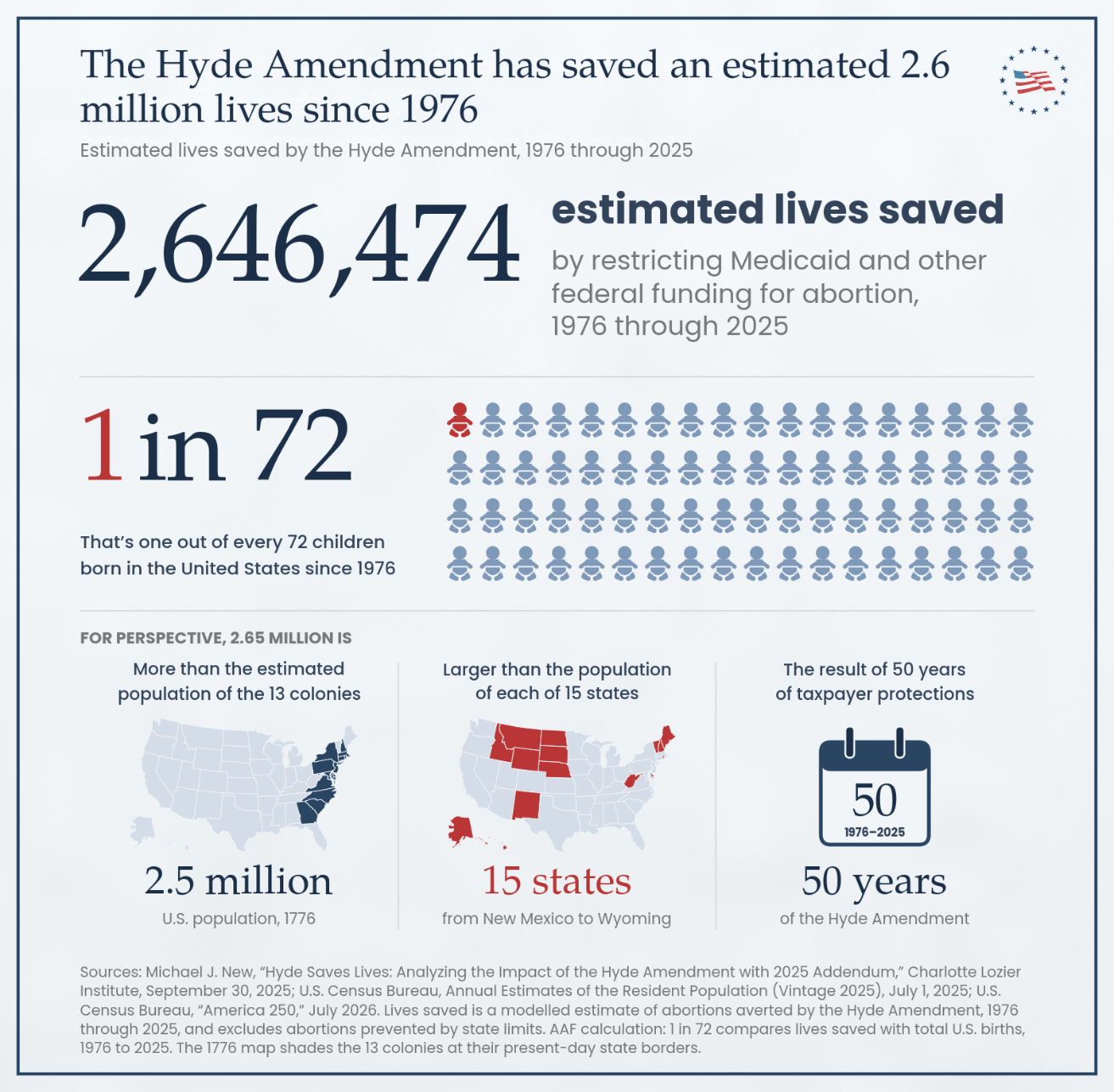
The Hyde Amendment has saved an estimated 2,646,474 lives, roughly equal to the entire U.S. population at the founding in 1776.
The Edwin Meese III Institute for the Rule of Law
Plymouth Institute for Free Enterprise
Fifty years ago, on September 30, 1976, Congress first attached a provision prohibiting the use of appropriated funds for most abortions to the bill funding the Departments of Labor and what was then called Health, Education, and Welfare. Introduced by Rep. Henry Hyde (R-IL), the so-called “Hyde Amendment” has been included in some form in the annual appropriations bills for those departments1 ever since. Hyde has saved an estimated 2,646,474 lives and, by our calculations, stopped $2.1 billion in taxpayer funding from going towards abortions since it was first enacted.
This report examines the history and development of the Hyde Amendment, its treatment by Congress and the courts, its impact over the past 50 years, its current limitations, and steps Congress can take to strengthen it.
English common law, which the American colonists claimed as their “birthright,”2 had made abortion unlawful since the beginning of the 13th century.3 In America, New York City first adopted an ordinance prohibiting midwives from performing abortions in 1716 and “[m]anuals for justices of the peace printed in the Colonies in the 18th century typically restated the common-law rules on abortion.”4 After Independence, states began prohibiting abortion by statute in the 1820s5 and, by 1910, all but one state had “criminalized abortion at all stages.”6
The American Medical Association launched a national campaign against abortion at its 1859 convention, endorsing a report that rejected the “mistaken and exploded dogma” that the unborn child has no “independent and actual existence…as a living being.”7 Courts followed the physicians’ lead. In an 1887 decision, for example, the Maryland Court of Appeals rejected the idea that “the life of an infant was not supposed to begin until it stirred in the mother’s womb.”8
Much had changed in American society and culture by the mid-20th century. Legislation to liberalize abortion laws was introduced in 45 states,9 and 17 of them took some kind of legislative action. Of these, 13 states10 adopted a reform statute developed by the American Law Institute that allowed abortions in several defined circumstances and, in 1970, the other four states—New York, Hawaii, Alaska, and Washington—legalized abortion for almost any reason during early pregnancy.11 By 1972, the number of abortions had increased by 200 percent in the 13 states that had modified their abortion laws and jumped more than 250 percent in the legalizing states.12 More than half of all abortions nationwide during this period occurred in New York state alone.13
Despite arguing that abortion was about choice, abortion advocates sought not only to legalize abortion, but to make taxpayers pay for it. Their litigation campaign began in New York state, where both state14 and federal15 courts held that excluding elective abortions from Medicaid coverage violated either state law or the U.S. Constitution’s guarantee of equal protection of the laws.
Then, in Roe v. Wade,16 the Supreme Court in January 1973 held that the Fourteenth Amendment protects a “right of privacy” that, in turn, “is broad enough to encompass a woman’s decision whether or not to terminate her pregnancy.”17 Abortion advocates quickly broadened their litigation strategy to argue that restrictions on the use of public resources for abortion also violated the right to abortion itself. By early 1976, federal courts in several states had concluded that restrictions in Medicaid or state programs were unconstitutional.18
Gallup polls during the 1970s found that a majority of Americans believed abortion should be legal “only under certain circumstances” and, even in the first trimester, defined this category of allowable circumstances narrowly.19 An even larger majority opposed forcing taxpayers to pay for abortions. It was no surprise, therefore, when efforts soon began in Congress to shield taxpayers from coerced abortion subsidies.
Congress looked very different during the 94th Congress (1975-76) than it does today. Democrats held large majorities in both the House (292-143) and Senate (61-39) and 18 states had one senator of each party, compared to just two states today. On June 24, 1976, Rep. Henry Hyde (R-IL) offered an amendment to H.R.14232, the Fiscal Year 1977 appropriations bill for the Departments of Labor and Health, Education, and Welfare, which stated: “None of the funds appropriated under this Act shall be used to pay for abortions or to promote or encourage abortions.” The House twice voted to pass Hyde’s amendment,20 with approximately 45 percent of voting Democrats and 74 percent of voting Republicans supporting it.
While the Senate initially voted 57-28 to strike the Hyde Amendment altogether, the final compromise included the following: “None of the funds contained in this Act shall be used to perform abortions except where the life of the mother would be endangered if the fetus were carried to term.” In the House and Senate, approximately 65 percent of voting Democrats and nearly 80 percent of voting Republicans supported the modified Hyde Amendment.21
Abortion advocates, however, were just getting started and forcing taxpayers to pay for abortion became an increasingly important part of their agenda. The 1977 National Women’s Conference, for example, produced a National Plan of Action that endorsed not only “reproductive freedom”22 in general, but also taxpayer funding of “all methods of family planning.”23 President Jimmy Carter created a National Advisory Committee for Women to advise him regarding “initiatives needed to promote full equality for American women…including recommendations of the 1977 National Women’s Conference.”24 At its first meeting, co-chairs Rep. Bella Abzug (D–NY) and Carmen Delgado Votaw urged the Carter Administration to completely eliminate the ban on Medicaid payments for abortion.25
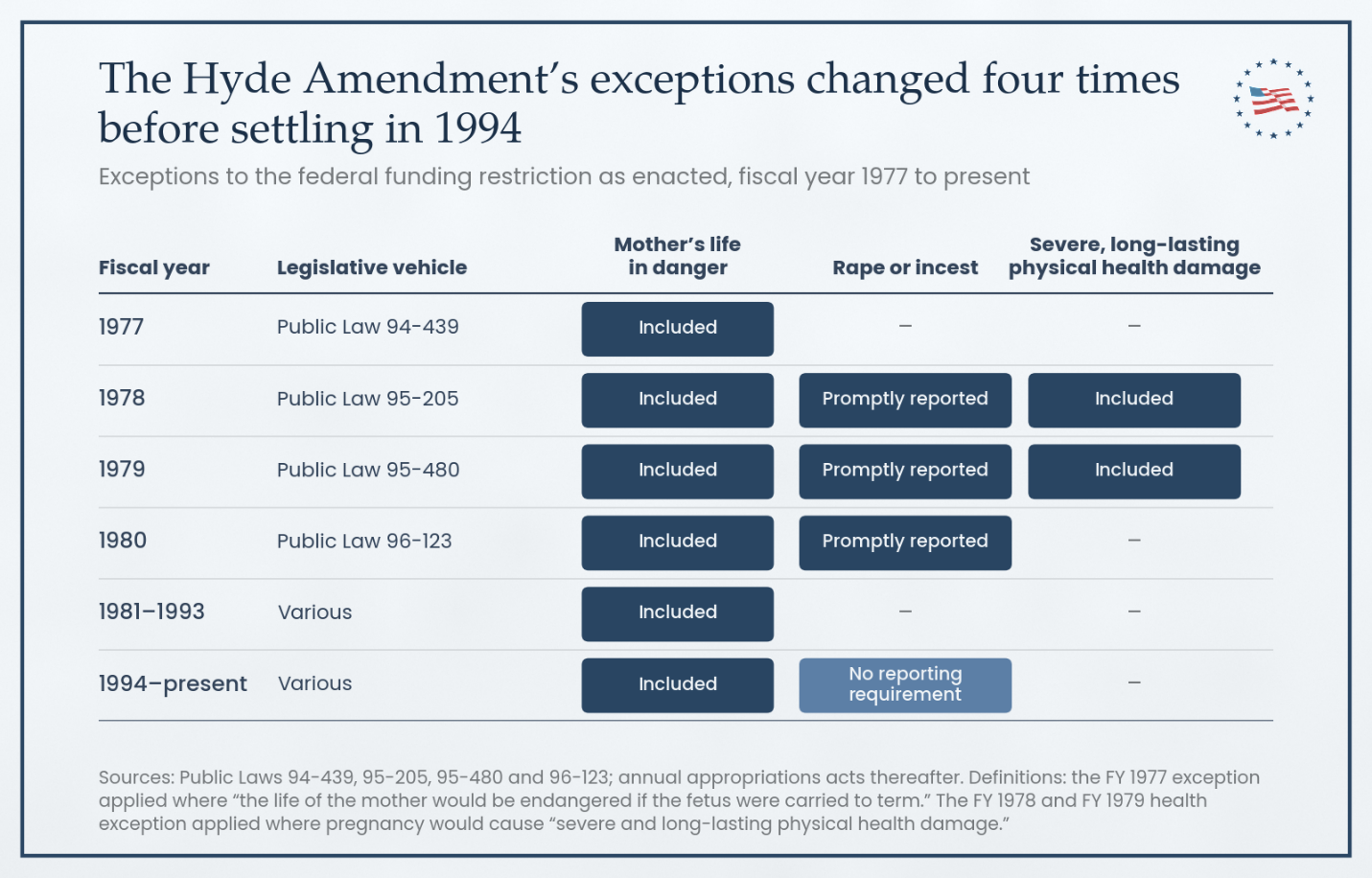
As a provision, often called a “rider,” limiting the use of appropriated funds rather than separate legislation, the Hyde Amendment must be included in the relevant appropriations bill each year. The House and Senate voted specifically on the Hyde Amendment language in its first several years but have not done so since 1994, when Congress last modified the Hyde language. The following table summarizes the exceptions to the Hyde Amendment’s prohibition on abortion funding at different times since it was first enacted.
As noted above, abortion advocates launched legal challenges to restrictions on forcing taxpayers to pay for abortions even before Roe v. Wade and that litigation continued after the Hyde Amendment’s enactment. The Supreme Court decided several cases involving these challenges, including one targeting the Hyde Amendment itself.
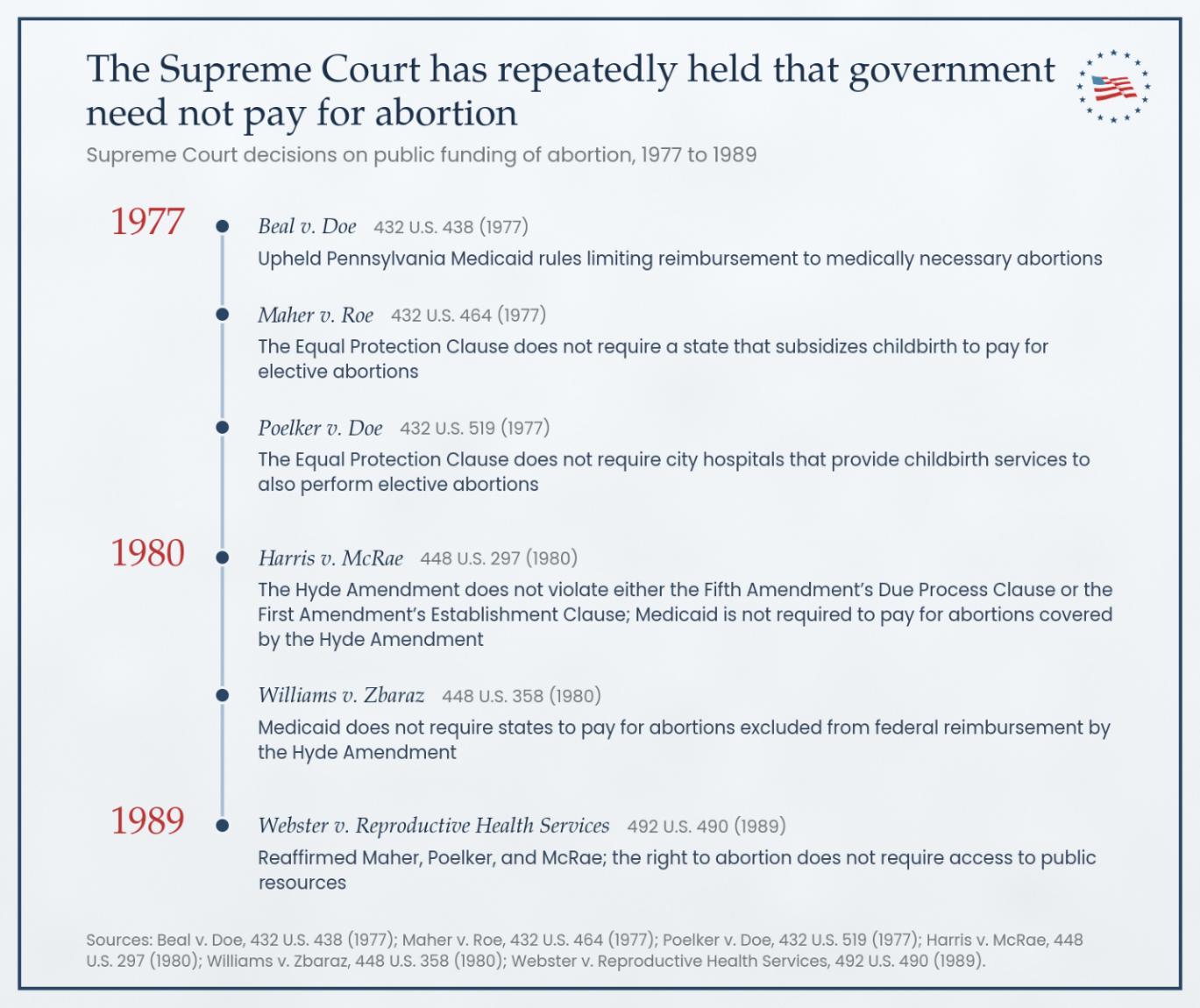
The Supreme Court’s consistent holding in these cases is that the Constitution prevents government from creating obstacles to the exercise of rights, but it does not require the government to remove limitations or obstacles, including financial ones, to that exercise. The Court has long followed this principle outside the abortion context as well, holding, for example, that the First Amendment protects lobbying activities, but does not require the government to subsidize lobbying through an income tax deduction for expenses.26
Perhaps more fundamentally, the Hyde Amendment protects Americans from being forced to subsidize what violates their deeply held religious and moral beliefs. This argument is sometimes phrased in terms of forcing individuals to be “complicit” in what they consider to be immoral or evil activity. The Supreme Court has held that the individual, not the courts, determines where the line of moral complicity lies; the Court’s only role, for purposes of legal challenges, is to determine whether the asserted belief is an “honest conviction.”27
Some might counter, as the government tried to do in these Supreme Court cases, that the individual’s view of complicity is too remote or attenuated. Whatever the limits of the complicity argument in other contexts, the Court has repeatedly distinguished abortion from other situations for a profound reason: it involves the “purposeful termination of a potential human life.”28 In fact, the Court held even in Roe v. Wade that abortion is “inherently different” than situations involving any other constitutional right for the same reason.29
The fact that the Hyde Amendment is constitutional today, however, does not mean it will remain so. Advocates for the Equal Rights Amendment (ERA), for example, have long made clear that, if it is added to the Constitution, they intend to use it to challenge abortion funding restrictions, including the Hyde Amendment.30 Feminist scholar Sabrina Miesowitz has argued that “passage of a federal Equal Rights Amendment would require a review of the Hyde Amendment and the U.S. Supreme Court cases upholding it.”31
This is neither a hypothetical nor an empty threat. About half the states have ERAs in their constitutions and abortion advocates say that these state ERAs are the “best”32 and most “realistic guides to possible interpretations of the federal ERA.”33 Courts in some of these states have already found that the ERA does, in fact, require taxpayer funding of abortion.34 In a 2020 report, the Center for American Progress cited court decisions interpreting and applying state ERAs, concluding that the ERA “could further buttress…existing constitutional protections” for abortion rights.35
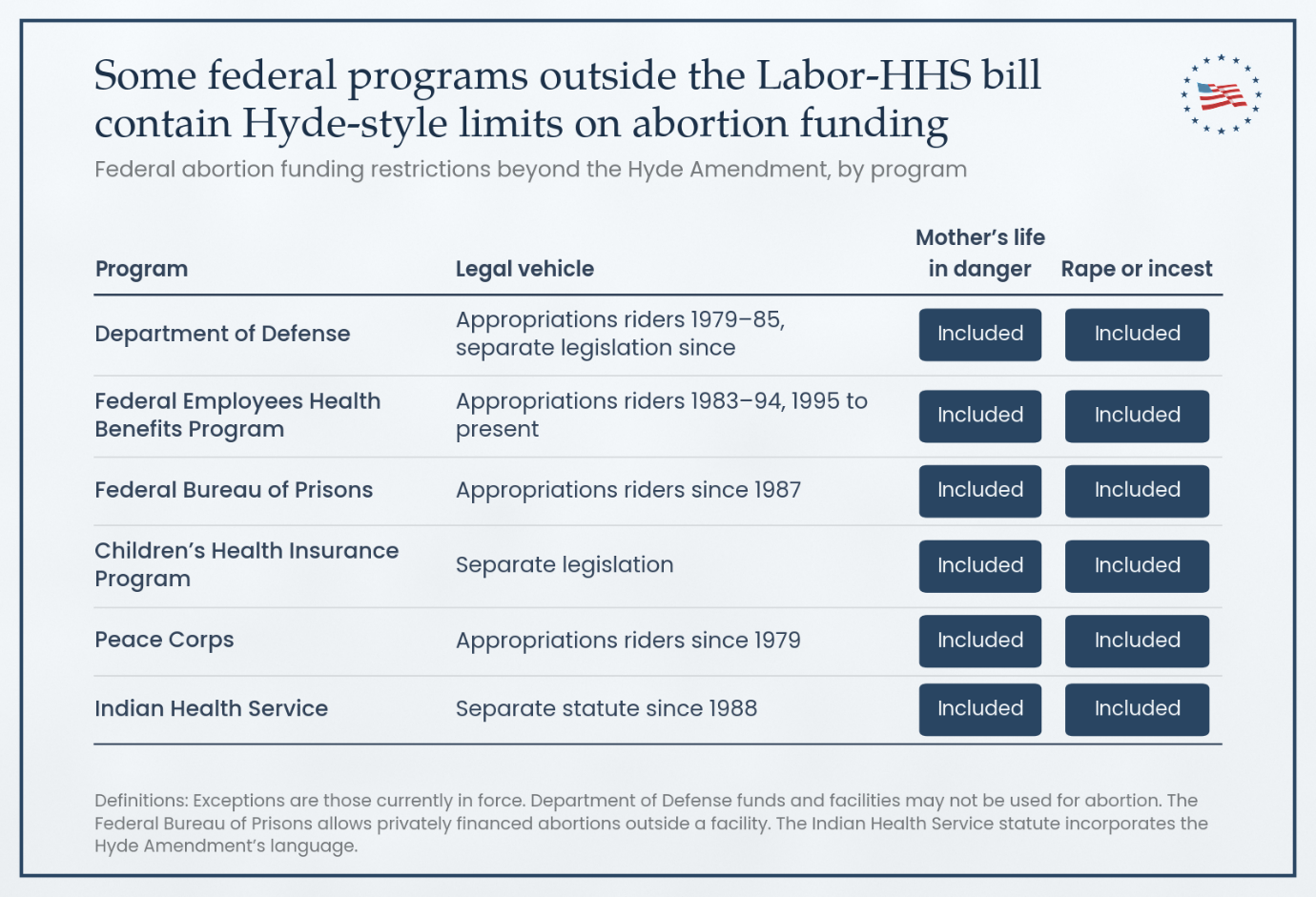
The Hyde Amendment is often broadly described as prohibiting taxpayer funding of abortion. As described above, however, it applies only to the departments whose appropriations bills include it. It has, however, given rise to similar funding restrictions that apply to departments, agencies, or programs outside the Labor/HHS/Education context, including the examples shown below. Most of these are, like the Hyde Amendment, appropriations provisions that must be re-enacted during every fiscal year.
The vast majority of abortions occur not for the reasons stated in the Hyde Amendment’s exceptions, but for reasons related to lifestyle choices. Studies show that, in America and around the world,36 the most common of multiple reasons women cite for seeking an abortion are avoiding interference with education or career (74 percent), financial considerations (73 percent), or the desire not to be a single mother (48 percent).37 Most Americans have long, and consistently, opposed abortion for such reasons. The Hyde Amendment, therefore, applies to the large majority of abortions, and to those that most taxpayers oppose, likely saving millions of lives during its first 50 years.
Lives Saved by Hyde. By restricting Medicaid and other federal funding, the Hyde Amendment reduces the number of abortions that would have occurred if such funding had been available. In an effort to quantify the number of lives saved by the Hyde Amendment, the Charlotte Lozier Institute reviewed more than 20 studies that examined the impact of Hyde restrictions on abortion and concluded that eliminating Medicaid abortion coverage reduces the abortion rate by approximately 1.52 abortions per 1,000 women of childbearing age. Applying this estimate across the United States (excluding time periods and areas in which state funds covered elective abortions), the Charlotte Lozier Institute estimates that the Hyde Amendment saved 2,646,474 lives through 2025.38
That translates into the Hyde Amendment saving the lives of one out of every 72 children born in the U.S. since 1977.39 Those estimated lives saved are also roughly equal to the population of the United States at its founding in 1776 and exceed the populations of 15 individual states today: New Mexico, Idaho, Nebraska, West Virginia, Hawaii, New Hampshire, Maine, Montana, Rhode Island, Delaware, South Dakota, North Dakota, Alaska, Vermont, and Wyoming.
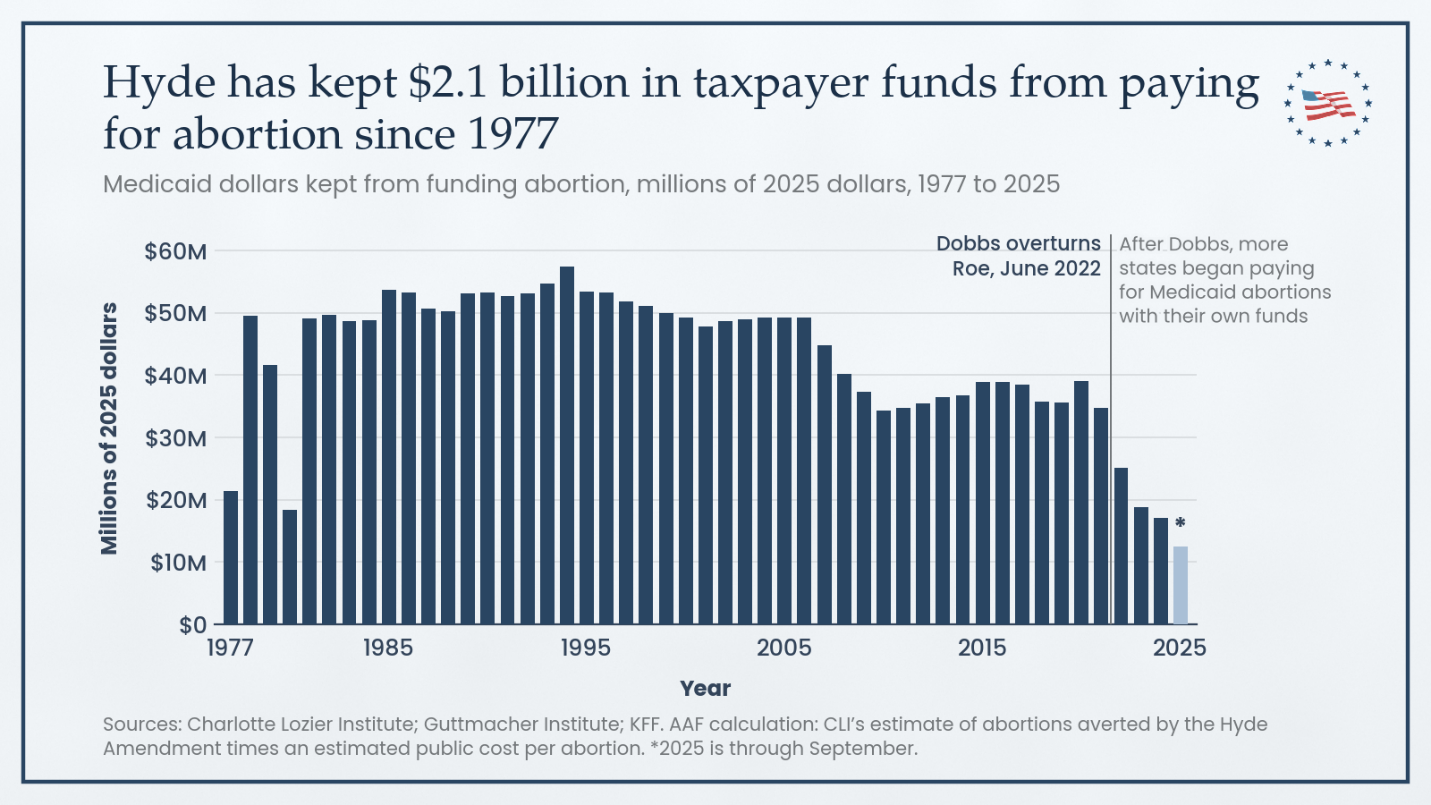
Taxpayer Funding of Abortion Prevented by Hyde. Multiplying the Charlotte Lozier Institute’s annual estimate of unborn lives saved by an estimated public cost per abortion, we estimate that Hyde has blocked $2.1 billion (in real 2025 dollars) in taxpayer funding for abortion since 1977.40 Without Hyde in place, an added federal funding match could push the true amount much higher.
The Hyde Amendment prevents much federal funding from being used for abortion but does not eliminate every pathway through which taxpayers can bear abortion-related costs.
Hyde Does Not Prevent Payment for Post-Abortion Complications. The Hyde Amendment does not prevent federal funds from paying for healthcare services resulting from an abortion, such as emergency room visits after taking the abortion pill, treatments for hemorrhage or infection, or other post-abortion hospitalizations, diagnostic tests, and other medically necessary care.41
A study that examined claims data from 39,747 abortions covered by California's Medicaid program in 2011-2012 found that three percent of all abortions were followed by a visit to the emergency department and 25 percent were followed by a visit to the original abortion site.42 Rates of post-abortion care were highest for medication abortions (4 percent visited emergency departments and 77 percent returned to the original abortion site), and women who traveled 100 miles or more for an abortion were more than 2.3 times as likely to visit the emergency department as those who traveled fewer than 25 miles. Costs were significantly higher when women visited emergency departments ($941 on average) than when they returned to the original abortion site ($536).
Administrative Interpretation Can Undermine Hyde. A pro-abortion administration can take steps to expand abortion access in spite of federal law. President Joe Biden, for example, issued Executive Orders 14076 and 1407943 following the Supreme Court’s decision overruling Roe v. Wade. They directed executive branch agencies to “protect and expand access to abortion” and “advance access to reproductive healthcare services.” 44
In 2022, the Biden Justice Department’s Office of Legal Counsel (OLC) issued an opinion concluding that appropriated funds subject to the Hyde Amendment could still be used “to provide transportation for women seeking abortions.”45 The opinion argued that the phrase “expended for any abortion” is “limited to funds directly expended for abortion procedures” but not “indirect expenses, such as transportation intended to facilitate an abortion.”46
In 2025, the Trump Justice Department’s OLC withdrew the earlier opinion, concluding that it had taken “an unduly narrow view of the text of the relevant appropriations rider” and was “inconsistent with the traditional tools of statutory interpretation employed by the Supreme Court and this Office.”47 The better interpretation of the Hyde Amendment, OLC stated, is that it “also encompass[es] other associated costs that, while not directly involved in the performance of the abortion, are still incurred with the ‘object, aim, or purpose of’ completing the procedure.”48
Federal Grants Can Flow to Organizations That Provide Abortions. While federal funding cannot pay for abortion services directly, organizations that provide abortions can receive federal grants, allegedly for other services. While organizations like Planned Parenthood affiliates can say they use federal funds only on non-abortion services, money is fungible and federal dollars spent on non-abortion services frees up other funds to use for abortions.49
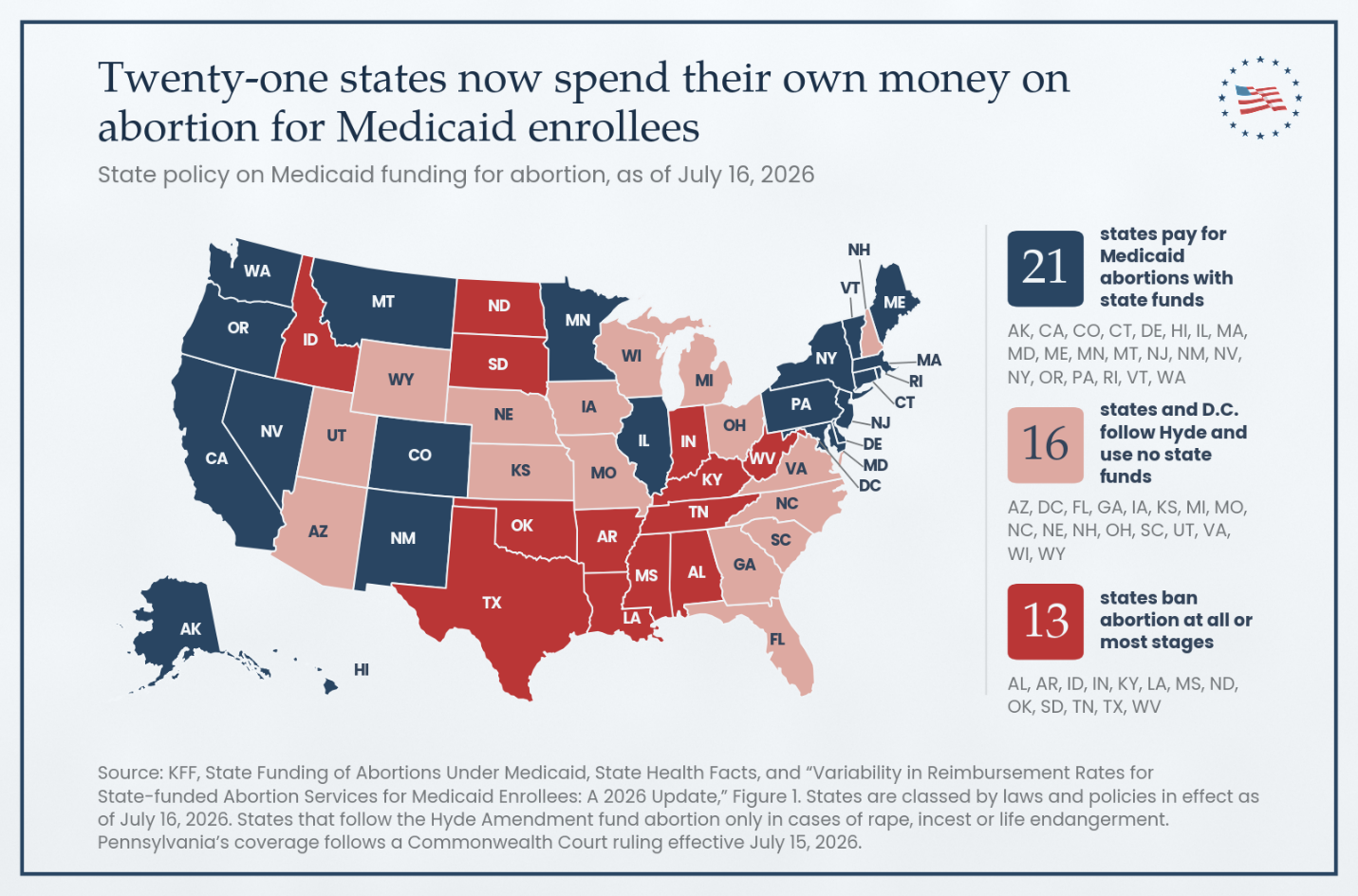
States Can Pay for Medicaid Abortions. Currently, 21 states use state-appropriated funds to pay for Hyde-excluded abortion services for Medicaid beneficiaries.50 .
Multiple studies have examined the impact of differences in Medicaid funding of abortions across states. A 1996 study in the Journal of Health Economics looked at abortion rates across states between 1974-1988 and estimated that eliminating public funding for abortion prevented between 19 percent and 25 percent of abortions among Medicaid-eligible women from taking place.51 A 2019 study in Louisiana found that 26 percent of Medicaid-eligible women who considered an abortion said that Medicaid not paying was a reason they decided to give birth.52 These studies are both consistent with a 2009 literature review by the Guttmacher Institute which found that “[a]pproximately one-fourth of women who would have Medicaid-funded abortions instead give birth when this funding is unavailable.”53
Most states that pay for elective Medicaid abortions do not consistently track and report state-funded abortion data. California maintains an open-access database documenting 1,224,820 abortions covered by Medi-Cal between 2014 and 2023, including 142,019 in 2023.54 Maryland reports the number and total cost of taxpayer-funded abortions, including 12,858 abortions at a total cost of $11.3 million in fiscal year 2025.55
The Guttmacher Institute once estimated the number of abortions paid for with public funds, but they have not done so for a decade. According to their last reporting, “States spent $71 million on about 157,000 abortion procedures for low-income women in FY 2015,” with the federal government contributing to the cost of only 160 of those procedures.56 Considering that California alone reported paying for 137,331 abortions in 2015, and represented about 30 percent of the total population eligible for state-funded abortions in 2015, the actual number of state-taxpayer-funded abortions is likely higher than the Guttmacher estimates. Using an illustrative extrapolation, we estimate that if all 21 states that pay for Medicaid abortions have abortion rates equal to the average of Maryland and California, then state taxpayers would have financed 353,000 abortions in 2023.57
Medicaid Infrastructure Supports States’ Abortion Funding. Administrative costs for health insurance are significant, accounting for an estimated eight percent of Medicaid costs and 12 percent of private health insurance costs.58 By allowing states to utilize Medicaid’s infrastructure—including its enrollment system, provider network, claims processor, eligibility determination, billing system, and payment system—the federal government saves states significant administrative costs they would otherwise incur if they had to administer separate insurance systems to pay for elective abortions.
In Maryland, for example, a woman who has Medicaid and receives an elective abortion uses her Medicaid insurance card, has an abortion performed by a Medicaid provider, the provider bills Maryland Medicaid’s fee-for-service program, and the state uses separate funds to reimburse the provider at a rate equal to the lesser of the provider’s customary charge or the maximum rates allowed under Maryland Medicaid’s physician fee schedule.
This latter provision, in which a state uses Medicaid’s negotiated fees as its payment for abortion procedures, can reduce not just administrative costs, but also the negotiated price of the procedure. This is because providers that want to participate in Medicaid due to its broad patient population may end up accepting significantly lower rates for certain procedures than they would otherwise charge as stand-alone services. A 2020 study found that Medicaid physician fee schedules for abortions covered only 37 percent to 41 percent of the amount charged to self-pay patients for the same procedures.59
The federal government has a growing problem with waste, fraud, and abuse. While federal Medicaid spending is rapidly expanding and a growing number of states are providing abortions to Medicaid recipients, a lack of transparency and accountability raises concerns about the integrity of federal taxpayers’ dollars. Specifically:
With little tracking or investigation into the financing of abortion and abortion-related services provided to Medicaid recipients, federal taxpayers cannot be assured they are not funding abortions prohibited by Hyde.
Require CMS data collection. Congress or an Administration should require CMS to make a complete national accounting of all abortions provided to Medicaid recipients, including the abortion procedure by type (Hyde-eligible or Hyde-excluded), provider, related healthcare services, reimbursement rate, amount paid by the state, amount paid by the federal government, and whether the procedure was covered under fee-for-service or a managed care organization. This should include currently unreported abortions provided through managed care organizations.
Require Post-Payment Integrity Reviews of Hyde Compliance. Congress or an Administration should require CMS to establish an automated Hyde-compliance flag within its existing payment error rate reviews, state program-integrity reviews, managed care organization audits, Medicaid claims data validation, and improper payment measurements. These audits should examine whether Medicaid abortions were properly classified as Hyde-eligible or Hyde-prohibited and whether Hyde-prohibited services are wrongly classified as federally covered procedures.
Require Taxpayer Recovery for Hyde Violations. Requiring regular data collection and payment integrity reviews will identify Hyde violations. Congress should require that all Hyde-prohibited expenses wrongfully billed to and paid by the federal government be fully repaid by the states with interest. Congress should also impose financial penalties on states—such as a reduction in Medicaid funding—if they fail to comply with Hyde reporting requirements.
Over its first 50 years, the Hyde Amendment has, by restricting federal funding of most abortions, saved an estimated 2,646,474 lives through 2025. It has survived repeated legal challenges, preventing more than $2 billion of taxpayers’ money from financing what violates their deeply held religious and moral beliefs. At the same time, increased state financing of abortions has reduced Hyde’s impact while a lack of Medicaid transparency and accountability raises questions about the integrity of Hyde’s protections. Congress and an Administration should defend Hyde’s protections by strengthening transparency, accountability, and enforcement to ensure that federal funds are not used in violation of its protections.