Policy Memo
U.S. Strategic Interests in Our Israeli Alliance
Topline
The United States faces a defining question in the Middle East: whether to treat its alliance with Israel as a strategic asset or an embarrassing liability. Some critics argue that American support for Israel inflames the Arab and Muslim world and undermines U.S. national interests. The evidence tells a sharply different story.
EXECUTIVE SUMMARY: The United States faces a defining question in the Middle East: whether to treat its alliance with Israel as a strategic asset or an embarrassing liability. Some critics argue that American support for Israel inflames the Arab and Muslim world and undermines U.S. national interests. The evidence tells a sharply different story.
This paper argues that by any realist standard, U.S. support for Israel advances core American national interests in physical security, economic prosperity, alliance management, regional stability, international standing, and morality. Far from being a liability, the U.S. alliance with Israel is of immense security, economic, and strategic benefit to the United States.
The Realist Case for U.S.-Israel Relations
Introduction: U.S. Support for Israel Aligns with Foreign Policy “Realism” and U.S. National Interests
Critics of U.S. support for Israel argue that this support runs contrary to a “realist” foreign policy and subordinates U.S. national interests to those of another country. John Mearsheimer and Stephen Walt argue exactly this in their 2007 book The Israel Lobby and U.S. Foreign Policy.1 They falsely claim that "unwavering U.S. support for Israel" has "inflamed Arab and Islamic opinion and jeopardized U.S. security" and that the U.S. has “set aside its own security in order to advance the interests of another state."
A rigorous examination of the evidence refutes this view. American support for Israel advances American national interests, and a realist approach demands that support if the United States wishes to protect American lives and its economic well-being.
Defining Realism and National Interests
Classical realism, as defined by the Stanford Encyclopedia of Philosophy, holds that "the principal actors in the international arena are states, which are concerned with their own security, act in pursuit of their own national interests, and struggle for power." Importantly, classical realism does not reject moral judgment but rather opposes "abstract moral discourse that does not take into account political realities."2
A classical realist approach evaluates policies based on how effectively they maximize national interests. Because realism takes “into account political realities,” those may include moral considerations. Six core U.S. national interests are most relevant to the Middle East:
- Physical Security: Protecting U.S. territory and citizens from foreign attack, a core component of national security.3
- Economic Prosperity: Maintaining energy security, open shipping lanes, and strong global supply chains.4
- Alliance Management: Rewarding allies and punishing enemies to effectuate pro-U.S. policies.
- Regional Stability: Deterring conflict and economic upheaval through strength and credible commitments.5
- International Standing: Advancing U.S. influence and reputation strategically.
- Moral Principles: Upholding democratic values, human rights, and justice.6
The sections below examine each interest in turn.
1. Physical Security: Israel's Opponents Threaten America
The Palestinian Arab Leadership
The Palestinian Authority (PA)7 and Hamas8 consistently incite their populations against the United States. Both organizations pay salaries to terrorists who have killed and harmed American citizens.9 The Palestinian Arab leadership has historically supported enemies of the United States. The list spans Nazi Germany, the Soviet Union, Iran, and Saddam Hussein’s Iraq. Palestinian Arab officials praised Osama bin Laden and condemned his killing by U.S. forces. 10 On September 11, 2001, Palestinian Arabs celebrated in the streets as the Twin Towers fell.11
Polling data confirm widespread anti-American sentiment: Palestinian Arabs express some of the highest levels of animosity toward the United States of any population surveyed globally.12
The Sunni Islamist Axis
Turkey, despite its NATO membership, is governed by a regime making clear overtures to Islamists (i.e., radical Muslims). A former U.S. National Security Advisor identified Turkey as a prime source of funding that contributes to the spread of extremist Islamist ideology.13 Turkey has cooperated with Russia, China,14 Iran,15 ISIS,16 al-Qaeda,17 and Hamas18. Under the autocracy of Recep Tayyip Erdogan, Turkey has threatened and fired upon U.S. troops assisting Kurdish forces,19 threatened to close the U.S. air base at Incirlik, which houses American nuclear weapons,20 and acted with violence against American citizens, including within the United States.21 Turkey also acts belligerently toward other U.S. allies, including Greece, Cyprus, and Kurdish groups.
Qatar, meanwhile, is the prime sponsor of the Sunni Muslim Brotherhood, the progenitor of all modern Sunni Islamist terror groups.22 Qatar funds terrorism and anti-American sentiment throughout the world, including on U.S. college campuses.23 It corruptly exploits U.S. laws to expand its influence with American elites and the public at large.24 It directly harbors and supports most of the remaining Hamas leadership while presenting itself to Western governments as a peacemaker.25
This contradiction became impossible to ignore during Israel's post-October 7 campaign. Qatar cynically played both sides, negotiating with Hamas for hostages while still allowing Hamas to maintain its headquarters in Doha.26 Only after Israel struck Hamas leaders sheltering in Qatar did Doha finally push Hamas toward releasing hostages and accepting a ceasefire.
Al-Qaeda, ISIS, and the Muslim Brotherhood are emblematic of Sunni Islamism that has killed and injured thousands of Americans and continues to threaten U.S. interests worldwide.
The Shia Islamist Axis: Iran and Its Proxies
The clerics of the Islamic regime of Iran (“Iran”) who orchestrated the seizure of the American embassy in 1979 and held Americans hostage for 444 days are the ideological forebears of those who bankrolled the Hamas massacre forty-four years later. For more than forty years, Iran has been the world's leading state sponsor of terrorism, with the United States as a primary target.27 In April 1983, an Iran-backed suicide bomber from Hezbollah, an Iranian proxy, destroyed the U.S. Embassy in Beirut, killing 63 people, including 17 Americans. Months later, Hezbollah operatives, directed and equipped by Iran’s Islamic Revolutionary Guard Corps, drove a truck bomb into the U.S. Marine barracks at Beirut International Airport, killing 241 American service members and 58 French paratroopers in a single morning. The bombings of the Khobar Towers, the U.S. embassies in East Africa, and the U.S.S. Cole followed over the next two decades, all with Iranian fingerprints.
A U.S. federal court has held that Iran “provided assistance, including training, to the 9/11 hijackers” who killed almost 3,000 Americans on September 11, 2001. 28
During the 2000s, Iranian-backed Islamist groups killed between 600 and 1,500 U.S. soldiers,29 many of whom were torn apart by Explosively Formed Penetrators (EFPs) in Iraq.30 Thousands more were wounded, and Americans have been taken hostage, some of them tortured.
Iran has even threatened U.S. presidents and other senior officials with assassination.31 Iran threatened and insulted President Obama, despite his outreach to the regime.32 Iran’s then Supreme Leader, Ayatollah Ali Khamenei, declared in a televised address on November 1, 2023: "When you chant 'Death to America!' it is not just a slogan—it is a policy." 33The regime also periodically organizes mass rallies to express hatred and rage against the United States.34
A plethora of Iranian-sponsored groups continue to endanger U.S. security. Hezbollah, based in Lebanon, killed hundreds of Americans before 9/11, including through torture. Yemen’s Houthis persistently attack shipping, disrupting global maritime traffic, especially oil and natural gas shipments. Hezbollah Al-Hejaz operates in Saudi Arabia's oil-rich Eastern Province and was responsible for the Khobar Towers blast in Saudi Arabia that murdered 19 American airmen.35
The most serious long-term threat to the United States and its allies is Iran’s pursuit of nuclear weapons and intercontinental ballistic missiles.
The regime's religious ideology makes it uniquely eager to instigate nuclear conflict.36 The Islamic Republic is built on the doctrine of velayat-e faqih (“guardianship of the jurist”), articulated by Ayatollah Khomeini, which holds that in the Hidden Imam’s absence, qualified Islamic jurists should exercise both religious and political authority. This Hidden Imam is identified with the Mahdi, a messianic figure who will reappear at the end of time to defeat injustice, restore true Islam, and inaugurate a universal reign of justice before the Last Judgment. Some prominent Iranian figures, including the current Supreme Leader, Mojtaba Khamenei, have used apocalyptic language about the Mahdi and at times implied that global chaos and conflict are part of the divine script that will culminate in his return.37 Such beliefs can motivate radicalized regime leaders to wage war, including nuclear war, against their enemies.38
By 2025, according to Rafael Grossi, Director General of The International Atomic Energy Agency, Iran was dangerously close to acquiring a nuclear weapon. It had already “dramatically” enriched uranium to 60 percent purity, the most arduous part of the process.39
In June 2025, following repeated attacks by Iranian proxies, Israel and the U.S. launched a decisive campaign against Iran. Israel struck first in the 12-Day War, and the United States stepped in to deliver the coup de grâce. In twelve days, Israeli forces destroyed Iranian air defenses, missiles, nuclear weapons sites, and aircraft, and annihilated military commanders and nuclear scientists. Israel's establishment of air superiority enabled U.S. B-2 bombers to destroy the deeply buried Fordow nuclear facility using Massive Ordnance Penetrator bombs. According to Pentagon estimates, these combined operations set Iran's nuclear program back approximately two years.40
Yet even after these major setbacks, the Iranian regime remained determined to obtain a nuclear weapon and to expand its ballistic missile program. It also refused to abandon its support of terrorism. Iran rebuffed diplomatic efforts and bragged about its ability to produce nuclear weapons.41
The ballistic missile development threat, according to President Trump,42 Secretary of State Rubio,43 Secretary of War Hegseth,44 and CIA Director Ratcliffe,45 was especially serious, prompting the United States and Israel to launch a second joint operation against Iran's Islamic regime and its nuclear program on February 28, 2026. This broader campaign targeted Iran’s navy, offensive missile capacity, and security apparatus. Yet Iran still refused to relinquish its enriched uranium, abandon its ballistic missile program, or end its financing of international terrorism. Even during a nominal ceasefire, the regime continued attacking ships traversing the Strait of Hormuz and launching missiles at neighboring Arab nations.
The Islamist Threat Exists Independent of Israel
It is tempting to attribute Islamist hostility toward the United States to American support for Israel, but the historical record does not support this. Both Shia and Sunni Islamist ideologies seek global dominance for their religious vision, requiring non-Muslims and dissenting Muslims (those who do not share their Islamist interpretation of Islam) to submit to their rule. The ideas underpinning this worldview predate the modern State of Israel by more than a millennium.
In the early 1800s, prior to the birth of the modern Islamist movement, and shortly after its founding, the U.S. was forced to wage war against the radical Muslim Barbary pirates. Although these pirates were not in pursuit of a modern “Islamist” program to build an Islamist state or a global movement, they were naval mujahideen or warriors engaged in al-jihad fi’l-bahr (holy war at sea). This meant that the pirates justified their hostilities against the U.S. because Americans were not Muslims and thus, under radical Islam, could be enslaved or slaughtered by believing Muslims.46
The Muslim Brotherhood, the forerunner of modern Islamist organizations,47 was founded in the 1920s not in opposition to Israel (which had not yet been reestablished), but to build a state governed by Sharia law across the recently dissolved Ottoman Caliphate.
Al-Qaeda, ISIS, the MB, and Iran have many grievances against the United States besides its support for Israel.
Beyond religious differences, Islamists reject core Western values, including freedom of conscience, freedom of speech, freedom of religion, democratic self-government, and equality under the law regardless of gender or faith. These values fundamentally conflict with radical Islam. The stark difference in fundamental values explains why Iran has designated the United States as the "Great Satan" and Israel merely the "Little Satan." America’s conflict with jihadist enemies, beginning with the Barbary Wars, predates the modern State of Israel by more than 140 years, demonstrating that Islamist hostility toward the United States has ideological roots entirely independent of the Israeli-Palestinian Arab conflict.
Israeli Intelligence and Military Contributions
Israel provides crucial intelligence and warfighting capabilities that have protected American lives for decades.48 The value of these contributions dwarfs what other U.S. allies provide.
Israel’s military extends America’s security reach far beyond what U.S. hard power alone could achieve in the region, including naval operations. This enhances U.S. security while saving American taxpayers significant financial resources.
In the words of Alexander Haig, a retired general who served as White House chief of staff for Presidents Nixon and Ford and as Secretary of State under President Ronald Reagan:
Israel is the largest U.S. aircraft carrier, which does not require American soldiers on board, cannot be sunk and is deployed in a most critical region—between Europe-Asia-Africa and between the Mediterranean-Red Sea-Indian Ocean-Persian Gulf—sparing the U.S. the need to manufacture, deploy and maintain a few more real aircraft carriers and additional ground divisions.49
At the time he made this statement, Gen. Haig was focused on Israel’s assistance to the U.S. in combating the Soviet Union and its allies. In its wars of the 1950s, 1960s and 1970s, Israel fought Egypt, Iraq, and Syria, all major Soviet proxies. During this time, “the Middle East served as a combat testing ground for Soviet military doctrine and advanced weaponry, with the experience amassed by Israel in its wars against the Egyptian, Syrian, and Iraqi armies – trained by Soviet advisers and equipped with Soviet weapons – providing the US military with operational lessons; information about new Israeli technologies to neutralize the Soviet weaponry; and direct access to Soviet weapons systems captured by Israel.”50
Another example of Israel’s assistance to the U.S. during this period occurred in 1970.51 That year, the Nixon administration reached out to Israel to discuss a crisis in Jordan, where Soviet-aligned Palestinian Arab militias and the Syrian regime were threatening Jordan’s U.S.-allied monarchy. Israel agreed to move several army regiments to the Jordan River to send a warning to Damascus. The Israeli air force was also put on alert. These Israeli actions helped deter Syrian aggression.
Today, Israel still operates as “the largest U.S. aircraft carrier” in the Middle East. A flagship Ford-class aircraft carrier costs roughly $13 billion to build and millions of dollars per day to operate.52 “For decades, the United States has maintained prepositioned military stockpiles in Israel under the War Reserve Stockpile Ammunition-Israel program, which is intended for potential American use during regional contingencies and provides the U.S. with forward-positioned supplies in a strategically important theater without the costs associated with a large permanent military presence.”53 The United States. has also stationed aircraft in Israel. During the second Iran conflict, the U.S. Air Force deployed fifth-generation F-22 Raptor stealth fighters to Israel’s Ovda Air Base, and large KC-46 and KC-135 aerial tankers at Israel’s Ben Gurion International Airport.54
Major John Spencer (U.S. Army, Ret.), Chair of War Studies at the Madison Policy Forum and Executive Director of the Urban Warfare Institute, has identified ten major ways Israel has directly improved U.S. military capabilities.55 These include Countering IEDs, Active Protection Systems, Israeli enhancements to the F-35, targeting pods and precision rockets, the Israeli Emergency Bandage, armored bulldozers for urban warfare, military working dogs, counter-tunneling technologies, Iron Beam anti-drone systems, and AI-powered warfare research and development.
Spencer has also described the benefits the U.S. receives from Israeli work on missile defense systems:
The United States and Israel jointly fund and develop systems such as Iron Dome, David’s Sling, and Arrow. These are cooperative programs in which American companies manufacture major components, American engineers participate in development, and American military organizations benefit directly from the resulting technologies and operational knowledge. RTX (formerly Raytheon Technologies) partners with Rafael on missile defense technologies. Boeing manufactures major components for Arrow interceptors. Tamir interceptors used by Iron Dome are produced at American factories and through joint ventures. These programs sustain manufacturing jobs and generate unique technologies that protect both countries.56
Spencer has also detailed the extensive Israeli contributions to the F-35 fighter aircraft:
Israel is the largest international operator of the F-35 fighter aircraft, purchasing the jets from Lockheed Martin's production facility in Fort Worth, Texas. Each aircraft supports a supply chain spread across more than forty-five states. Israel also purchases American helicopters, precision-guided munitions, communications systems, radar equipment, engines, and other military technology.
The relationship extends beyond simple purchases. Israeli firms participate in the production and development of systems such as the F-35, with Israel Aerospace Industries manufacturing wings for the global fleet and Israeli companies contributing technologies used throughout the program. The result is a deeply integrated defense-industrial partnership that benefits both countries.
Israel is also the first nation to employ the F-35 extensively in combat. Because the United States permits Israel to test and integrate unique capabilities on its F-35I fleet, lessons learned from real-world combat operations help shape tactics, software updates, electronic warfare capabilities, and future improvements to the F-35s that American pilots have now flown in Venezuela, Iran, and other theaters.57
Retired Ambassador Yoram Ettinger of Israel has further expanded on the benefits to the United States of its alliance with Israel:
Israel has become the largest research and development center, outside the US, for the US’ defense and aerospace industries (e.g., Lockheed-Martin, Boeing, RTX-Raytheon, General Dynamics, Northrop Grumman and Caterpillar), which employ 2.5 million people. This Israeli connection has saved the US defense and aerospace industries hundreds of years of research and development (10-20 years each in the case of the F-35, F-16 and F-15), which equals to mega-billions of dollars. It has upgraded the competitiveness of the US companies in the global market, raising US exports, beefing up the US employment base and generating more (corporate and individual) income tax revenues to the US Treasury.
Israel has made significant contributions to the US defense and aerospace industries by enhancing the US’ research and development, effectiveness, sales and employment involved in the F-35 (manufacturer and subcontractors employ 290,000 people), F-16 (47,500 people) and F-15 (25,000-50,000 people) combat aircraft programs, in addition to the Apache and Blackhawk combat helicopter programs, as well as the C-130 programs.” 58
Israel also provides invaluable intelligence. Gen. George J. Keegan Jr., former head of U.S. Air Force intelligence, stated that America's military defense capability "owes more to the Israeli intelligence input than it does to any single source of intelligence," worth more than "five CIAs."59 He estimated that throughout 1974-1990 alone, Israel provided the U.S. with $50-80 billion in intelligence, research and development savings, and captured Soviet weapons systems, potentially more than four times the $18.3 billion in military grants.60 Senator Daniel Inouye (D-HI), who chaired both the Senate Intelligence Committee and the Senate Appropriations Committee, said that the scope of Israeli intelligence shared with the U.S. exceeded the intelligence provided by all NATO countries combined. 61 In July 2003, Brig. General Michael Vane, Deputy Chief of Staff at the U.S. Army Training and Doctrine Command, stated that Israel’s counter-terrorism experience shaped the U.S. war on terrorism.62
In 2026, former CIA Director Mike Pompeo said “The relationship between the United States and Israel is incredibly valuable to both partners. As CIA director, I saw firsthand how many American lives were saved thanks to Israeli intelligence.”63
A telling example occurred during the hunt for Osama bin Laden, the al-Qaeda leader who orchestrated the 9/11 attacks. Former CIA Director John Brennan has said that the United States spent years preparing for the raid in Pakistan that killed bin Laden, "and the thousands of bits of pieces of intelligence do include some which were provided by the Israelis as a result of their intelligence operations.”64
In 2026, during the second Iran conflict, Israel provided intelligence to the U.S. about a possible Iranian plot to assassinate President Donald Trump while he was in Turkey.65
2. Economic Prosperity: Israel as Strategic Investment
Technology and Innovation Transfer
The $3.8 billion in annual U.S. military aid to Israel represents one of the highest returns on investment of any U.S. foreign assistance.66 Israel now spends almost all of its military aid on U.S. goods. Under the 2016 Memorandum of Understanding, procurement from American sources increases to 100 percent by fiscal year 2028.67 This directly strengthens American defense supply chains while also employing tens of thousands of Americans. Yet the economic return to the United States extends well beyond these obvious benefits.
The breadth of Israeli innovation shared with the United States is remarkable. Its contributions to the U.S. defense sector are unique. Israeli engineers developed techniques to detect and repair stress fractures in aging F-16s, cutting maintenance downtime from six months to two weeks. Israel shared this technology with the U.S., and the U.S. Air Force subsequently adopted it.68 Israeli battlefield experience with explosive-neutralizing robots has directly improved American systems manufactured at Northrop Grumman’s Tennessee plant. Israel’s battlefield endorsement boosts the system’s foreign sales, and weekly conference calls between the two counterparts drive continuous improvements.69
More broadly, Israeli partnerships have advanced U.S. capabilities across cyber systems, robotics, rocket and missile defenses, battlefield ISR (Intelligence, Surveillance, Reconnaissance), advanced munitions, passive and active defenses for armored vehicles, mini-satellites, information technology, water conservation and management, high-tech agriculture, medical research and development, clean technology and renewable energy, and societal resilience systems.
As the Washington Institute has noted, few allies have contributed as consistently to American technological competitiveness.70
Energy Security
Israel's strategic position along key Mediterranean and Red Sea trade routes has long made it a valuable partner for protecting global energy flows.
That value has grown since 2010, when the discovery of the Leviathan gas field containing nearly 22 trillion cubic feet of natural gas, set Israel on course to become a significant energy exporter within a few years.71 The Tamar and Dalit fields began production in 2013. Israeli gas now supplies Egypt and Jordan and has the potential to reach European markets, reducing dependence on Russian supply.
Of course, many Arab nations are themselves major energy producers. The Arab oil embargo of the United States in the 1970s, imposed due to U.S. support of Israel, demonstrated how suppliers might weaponize energy. Since then, the economic threats from Arab oil producers have proven largely theoretical.
This reflects two realities. First, Gulf oil-producing states recognize that Israel has been helpful to their security and do not regard it as a threat to their existence.72 Second, the United States has achieved energy independence.73 The U.S. produces more oil now than its two leading competitors, Saudi Arabia and Russia, combined.74 The recent closure of the Strait of Hormuz demonstrates this changed reality. Although oil prices surged past $100 per barrel, alternative sources of production and transportation muted the impact relative to the Arab embargo.
The Foreign Assistance Accounting Myth
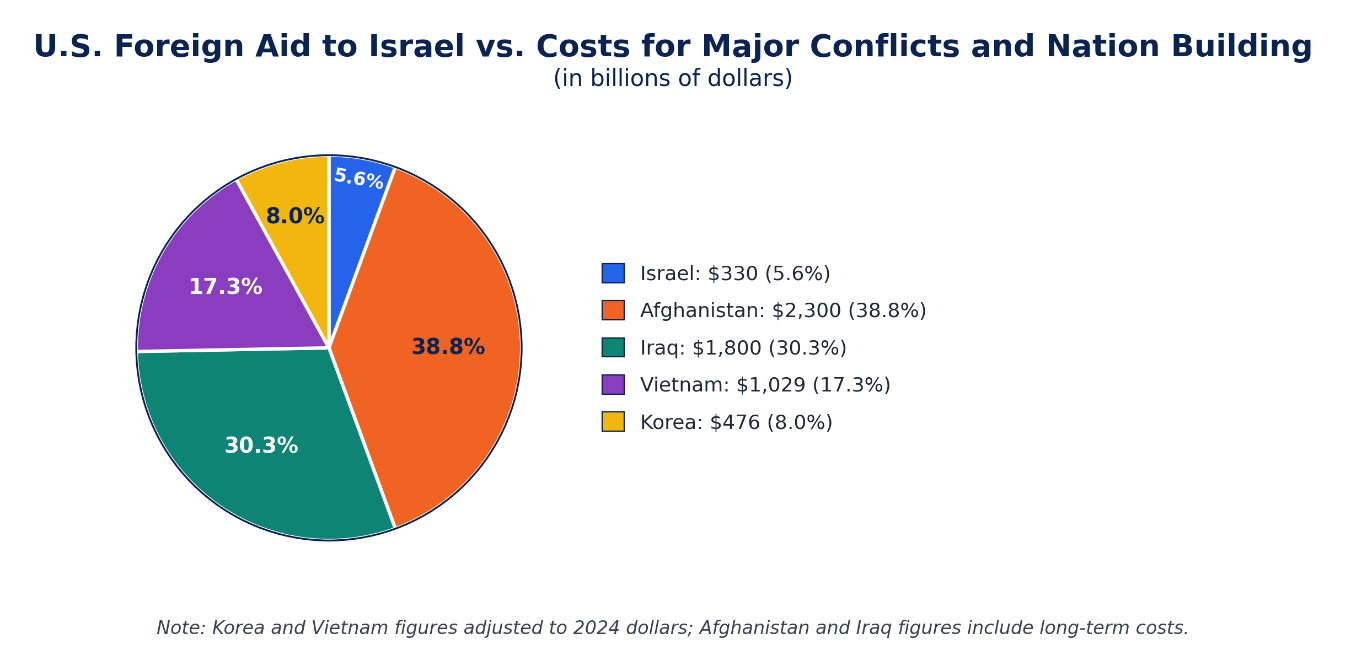
Critics claim the $3.8 billion in annual military aid to Israel represents inordinate U.S. generosity. In total, Israel has received $330 billion (adjusted for inflation) in economic and military assistance from the U.S. since 1946.75
However, this myth is simply not true. The arbitrary construction of budget categories gives the illusion that Israel is the primary recipient of foreign aid. The United States spends tens of billions of dollars building and maintaining bases and stationing troops in allied countries, to defend them from harm, and it has spent trillions more on wars and nation-building. None of that spending is classified as “foreign assistance.”
Part of U.S. assistance to Israel originated as compensation for Israel’s 1979 peace treaty with Egypt.76 The U.S. pushed for peace not only for its own sake, but also to strengthen the U.S. relationship with Egypt. In the agreement, Israel returned the oil wells in the Sinai. At the time of the peace agreement, those wells could have provided all of Israel's petroleum needs and probably yielded enough for export.77
In reality, the U.S. aid to Israel is just a small fraction of total U.S. foreign aid which is distributed across nearly two dozen departments and agencies.
Foreign Aid/Assistance
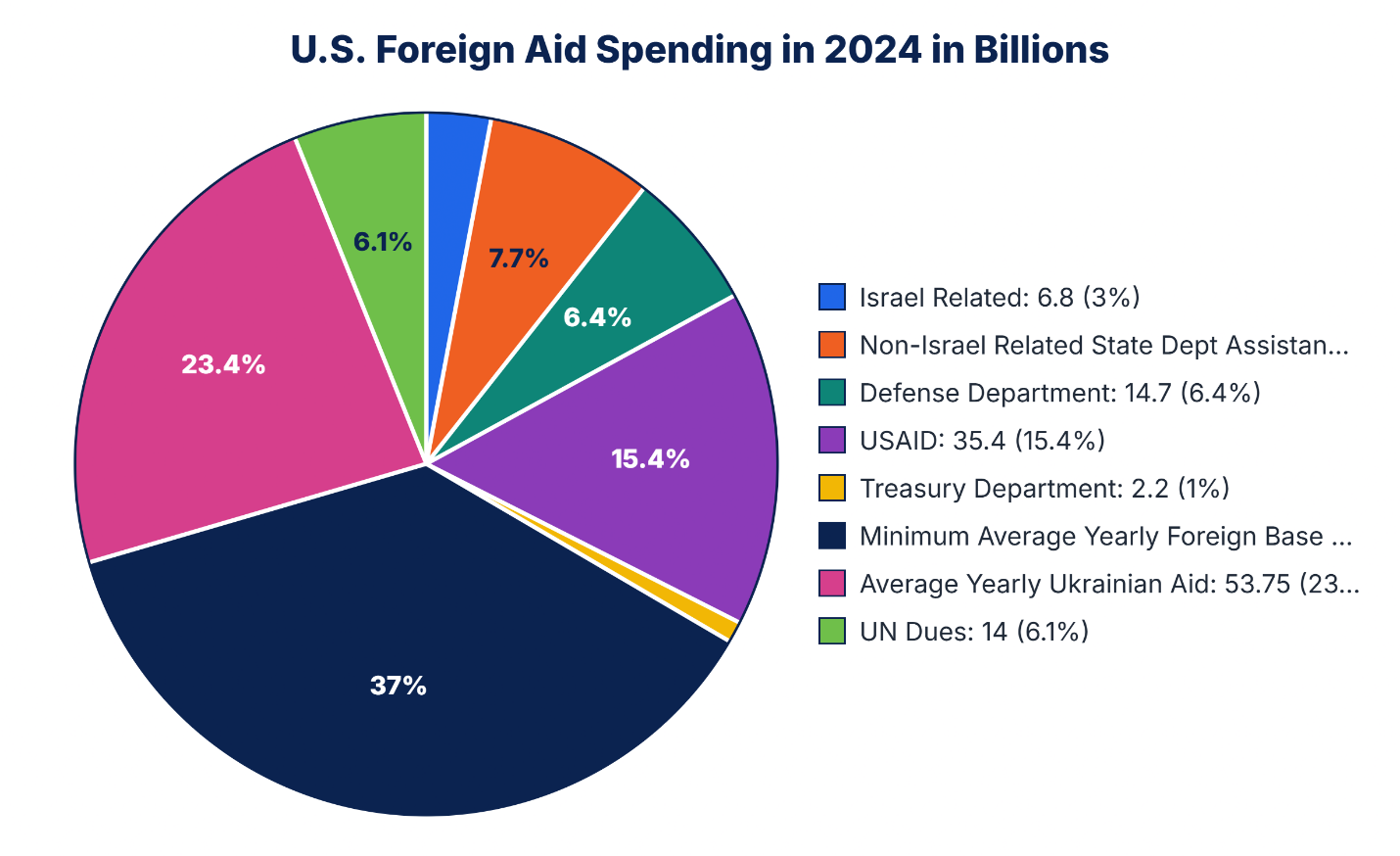
U.S. foreign aid obligations for 2024, the most recent full year available, include the following:78
- Total U.S. foreign aid obligations of $82 billion.
- Of this total, $55.3 billion of the $82 billion was economic aid with the remaining $27 billion was military aid.
- Total U.S. foreign aid to Israel was $6.3 billion in State Department foreign assistance, plus $500 million in Defense Department aid.
- The total foreign aid/assistance in the State Department: $23.9 billion.
- The total foreign aid in the Defense Department: $14.7 billion.
- The total foreign aid for USAID: $35.4 billion.
- The total foreign aid in Treasury: $2.2 billion.
Troops & Bases: The above foreign aid does not include U.S. troop deployments and bases in 70 allied nations. These bases and postings cost $85 billion to $100 billion annually.79 Although definite amounts are hard to come by, estimates suggest the U.S. spends $5 billion to $27 billion a year in Japan, $3 billion to $15 billion in South Korea, and $5 billion to $21 billion in Germany.80
Ukraine: This does not include U.S. aid to Ukraine in response to the Russian invasion of 2022. As of March 31, 2026, the U.S. Congress has made available $195 billion in spending related to the war in Ukraine, according to the U.S. Special Inspector General for Operation Atlantic Resolve. In late 2024, the United States also provided the Ukrainian government with a $20 billion loan, not included in the $195 billion figure, 81 This works out to an average of $53.75 billion a year ($195 billion plus $20 billion divided by four).
The United Nations: Nor does it include the nearly $13 billion a year the United States has provided to a largely hostile United Nations.82
Chart A:
Wars & Nation-Building: Afghanistan, Iraq, Korea & Vietnam: It also does not include the money the U.S. has spent on wars and nation-building. Since 2001, the U.S, has spent more than $2.3 trillion in Afghanistan83 and another $1.8 trillion in Iraq.84 The Vietnam War cost more than $1 trillion in inflation adjusted dollars.85 The Korean War and nation-building cost at least $476 billion (not including the costs of Korea bases).86
Chart B:
Persian Gulf War & Kuwait: It also does not include the money spent on the Persian Gulf War of 1991 to free Kuwait from Iraqi conquest, which was followed by more than three decades of American troop deployments to protect Kuwait. The first Gulf War cost $151 billion,87 although 80% of it was paid by U.S. allies.88 The United States has had bases in Kuwait since the war. The U.S. currently stations 13,500 troops in Kuwait,89 at an estimated cost of $3 billion to $7 billion a year (presumably about half to the cost of troops in South Korea).90 Adding up all these costs, the total U.S. spending for the Persian Gulf War and to protect Kuwait is probably very close to the total cost of U.S. aid to Israel.
Conclusion: The average of slightly under $4 billion in annual economic and military aid in inflation- adjusted dollars provided to Israel since 1946 through 2024 – $330 billion in total – to counter common threats yields advantages unmatched by other U.S. foreign aid.91 Unlike the U.S. bases and troops stationed in foreign nations, relatively few U.S. troops are stationed in harm’s way defending Israel. This stands in stark contrast to the more than 100,000 American troops based in Japan, Germany, and South Korea. And unlike much other foreign aid, U.S. assistance to Israel flows back to the U.S. economy through defense purchases, generates substantial intelligence and technology returns, and accelerates U.S. military technological breakthroughs.
Wasteful Palestinian Aid
The contrast with U.S. aid to Palestinian entities, including the PA, UNRWA, and various NGOs, is instructive. Since 2007, the State Department has provided the PA with nearly $1 billion for civilian security,92 and the United States has given more than $7.3 billion to UNRWA since 1950.93 Since 1994, the United States has provided more than $5.2 billion in aid to Palestinian Arabs through USAID.94
Despite massive aid over decades, Palestinian Arabs remain strongly supportive of terrorism against Israel and U.S. allies, deeply anti-American, hostile toward Jews and non-Sunni Muslims, and oppressive toward Christians in PA- and Hamas-controlled areas. The PA is increasingly corrupt and anti-democratic, and it refuses to tolerate Western concepts such as freedom of speech, women’s rights, toleration of religious minorities, and sexual freedoms. The PA continues to fund "pay for slay" payments to terrorists who have killed Americans and operates schools that teach incitement. In short, the PA has made no meaningful progress toward democratic governance or peaceful coexistence. Aid to the PA has inadvertently supported terrorism and violence, fueling repeated conflicts that endanger Israel and many U.S.-allied Sunni nations and disrupt crucial global oil and natural gas routes. This pattern is not unique to security assistance: reconstruction and humanitarian aid intended for Gaza and the West Bank have repeatedly been diverted toward militant infrastructure or absorbed into the same patronage networks that sustain PA and Hamas rule, with limited independent oversight to prevent it.
Rather than building durable institutions, U.S. aid to Palestinian Arab entities has entrenched the incentives for continued conflict. When Palestinian Arab leadership initiates a war, and their forces are defeated, international and U.S. reconstruction funding simply resets the cycle.
3. Alliance Management: Rewarding Friends and Punishing Enemies
Alliance credibility is itself a form of strategic power. A nation that rewards friends and punishes enemies builds a reputation that deters future challenges and attracts future cooperation. A nation that abandons its allies, or treats friendship as a liability, erodes that reputation globally by signaling to enemies that pressure works and to allies that American commitments are negotiable.
Distancing the U.S. from Israel would reward the Palestinian Arab leaders’ continued rejection of peace and their anti-U.S. attitudes. It would also embolden others to pursue policies at odds with U.S. interests.
Israel has been a steadfast U.S. ally. Israel
- Backs the U.S. approximately 90% of the time at the United Nations.95
- Fights the same terrorists and rogue states as the U.S.: Iran, Saddam Hussein’s Iraq, Hezbollah, al-Qaeda, Hamas, the Houthis, and ISIS.
- In 1970, at President Nixon's request, mobilized troops to intimidate Syrian forces invading Jordan, prompting Syrian retreat.96
- In 1981, destroyed Iraq's nuclear reactor, preventing nuclear confrontation in 1991 and earning later thanks from Vice President Dick Cheney.97
- In 1991, refrained from responding to Iraqi Scud missile attacks to preserve the international anti-Iraq coalition of the First Gulf War.
- In 2007, destroyed Syria's nuclear reactor, potentially preventing nuclear incidents during the 2011 Syrian civil war.
- In 2010, partnered with the U.S. in the Stuxnet cyberattack, which damaged centrifuges at Iran's Natanz enrichment facility and set back its nuclear weapons timeline by an estimated one to two years.
- In 2018, conducted a raid in Tehran that seized Iran's secret nuclear archive, providing the U.S. and the international community with extensive documentation of Iran's nuclear weapons program and preserving evidence of years of nuclear-related research and development.98
- In 2025 and 2026, destroyed the air defenses of Iran’s Islamist regime and partnered with the U.S. to degrade or destroy Iran’s nuclear weapons program, ballistic missile program, drones, military units, leadership, and navy.
No other U.S. partner in the region has contributed at this level, with this consistency, over so long a period.
The PA, by contrast, has supported U.S. adversaries at nearly every turn, even while continuing to receive American funding (for example, through “pay for slay” payments to Hamas members). The difference between what the U.S. receives from Israel and what it receives from Palestinian Arab entities could not be starker.
4. Balancing Power to Stabilize the Middle East
In a region as crucial as the Middle East, the United States has a major national interest in preventing destabilization. More support, fiscal or otherwise, for Palestinian Arab entities or other Islamist forces spurs them to act more aggressively against Israel, leading to frequent conflicts. In contrast, more U.S. support for Israel enables our ally to protect itself and deter Islamist aggression. Deterrence of conflict through a regional balance of power is best achieved through U.S. support of Israel, rather than dispensing aid concurrently to Palestinian Arab entities or other Islamist forces.
Recent Middle Eastern history bears this out. Post-1973, Egypt, the largest Arab nation and a major regional power, realized that Israel’s military, increasingly backed by the United States, was too strong to defeat, having lost wars to Israel in 1956, 1967, and 1973. So, in 1979, Egyptian President Anwar Sadat signed a cold peace treaty with the Jewish state and became a U.S. ally. This led to a nearly fifty-year period without a full regional war between a major Muslim state and Israel.99
The post-Oslo period also illustrates this pattern. After 1993, the Clinton administration began providing heavy financial assistance to the Palestinian Arab entities. Rather than producing a durable peace, the newly formed PA refused multiple Israeli peace offers and instead initiated terror campaigns that resulted in thousands of new deaths.
This can also be seen during the Obama administration when the U.S. provided substantial monies to Iran. During implementation of the Joint Comprehensive Plan of Action, the U.S. allowed the Iranian regime to access $150 billion100 of frozen foreign reserves along with physically delivering $1.7 billion in cash (on top of the up to $20 billion the Obama administration provided for simply negotiating with the U.S. under the Joint Plan of Action101). This helped fund Iranian-sponsored terrorism via Hezbollah, the Houthis, and Hamas and supercharged Iran’s missile and nuclear weapons programs. Eventually, in part due to the Obama administration’s funding of the Iranian regime, Iranian-funded Hamas launched its October 7, 2023, massacre, which led to the current hostilities.
5. International Standing: Does the U.S. Support for Israel Harm Its Popularity?
The argument that U.S. support for Israel damages American popularity in the Arab and Muslim world rests on a flawed premise: that Arab hostility toward the United States is primarily a response to American policy rather than a product of dynamics that exist independent of anything Washington does, the “Palestinian Arab cause,” or Israel.
The Myth of Palestinian Centrality
Scholar Barry Rubin has written: "Arab and Muslim hatred of the United States is not just, or even mainly, a response to actual U.S. policies—policies that, if anything, have been remarkably pro-Arab and pro-Muslim over the years. Rather, such animus is largely the product of self-interested manipulation by various groups within Arab society."102
Historian Efraim Karsh found that while the "Palestine question" serves as a pan-Arab rallying cry, "neither the Arab states nor Palestinian leaders have truly wanted the 'liberation of Palestine.'"103 He concludes, "Any notion claiming a link between finding a resolution to the Israeli-Palestinian conflict and attaining regional peace and stability is both false and misleading." He also argues that “Arab antisemitism has nothing to do with the Palestinian Arab cause. It predates the emergence of the modern Jewish state. The "Arab street" has never driven Arab regimes to war with Israel; rather, Arab masses have been "goaded into violence by their unelected rulers so as to divert attention from their own marginalization and repression."104
Contemporary Regional Dynamics
Diplomat Dennis Ross, who served four presidential administrations, notes that events have disproved the notion that "you can't transform the region, or America's position in the region, unless you solve the Palestinian issue."105 He correctly argues that most Sunni Arab states see Israel as "a bulwark against both the Iranians and Islamic State."106 While cooperation remains largely private given public sensitivities, "the scope of what Israel is now doing with a number of Arab states on security is unprecedented."
The Historical Record of Anti-Israel Policies
Several U.S. administrations adopted anti-Israel policies over the years, expecting Arab gratitude and assistance.107 All were disappointed:
Eisenhower Administration (1950s): During the Eisenhower administration, the U.S. sought to distance itself from Israel to improve U.S.-Arab relations.108 Result: Relations with much of the Arab world worsened, and the Soviets gained regional influence through Egypt. Michael Doran's book "Ike's Gamble" documents how Eisenhower eventually realized his mistake.109
Carter Administration (1977-1981): During the Carter administration, the U.S. negotiated a peace treaty between Israel and the Arab Republic of Egypt, then the largest Arab nation at war with Israel. But Carter also strenuously pushed Israel to make overtures and compromises to the Palestinian Arabs and other Arab and Muslim nations, despite their continuing hostility. Result: Carter’s approach contributed to global upheaval. Distancing from Israel paradoxically made Arab leaders think that the U.S. was a poor and unreliable ally, and they also despised Carter for his weakness, especially as his policies unfolded in Iran. In that non-Arab Shia Muslim nation, Carter’s pressure on the Shah of Iran resulted in the Shah’s overthrow by the viciously antisemitic and anti-American Islamic regime, which became a leading sponsor of terrorism worldwide, and a bitter foe of the Sunni Arab states. Former Secretary of State Henry Kissinger famously criticized the Carter administration for having, simultaneously, "the worst relations with our allies, the worst relations with our adversaries, and the most serious upheavals in the developing world since the end of the Second World War."110
Bush (I) Administration (1989-1993): During the Bush administration, the U.S. became increasingly hostile toward Israel. The administration pushed for Israel to conduct new outreach to Palestinian Arab entities, especially the Palestine Liberation Organization (PLO), the organization that established the PA.111 The administration threatened to halt loan guarantees to Israel needed to absorb large numbers of Soviet Jews who fled to Israel after the Soviet Union collapsed.112 And it demanded that Israel refrain from responding to Iraqi dictator Saddam Hussein’s Scud missile attacks against Israel, for fear of fracturing the U.S. coalition with Sunni Arab states.113 Result: The PLO, despite the outreach, continued to conduct terrorism. In May 1990, the PLO attacked the beaches near Tel Aviv, aiming to raid hotels and the U.S. Embassy.114 This was the final straw for the Bush administration, which suspended its dialogue with the PLO and refocused its attention on efforts to persuade other Palestinian Arabs to talk directly with the Israelis. The PLO also supported anti-American dictator Saddam Hussein in Iraq when he conquered Kuwait. After the war, Kuwait expelled most of its Palestinian Arab population.
Obama Administration (2009-2017): During the Obama administration, the U.S. distanced itself verbally from Israel, dramatically increased aid to the PA and UNRWA, criticized Israeli settlements, and pre-emptively endorsed Palestinian Arab statehood.115 The administration also catered to the Iranian regime with the JCPOA. Results: The PA viewed U.S. concessions as inadequate.116 Palestinian Arab and Arab support for Americans reached an all-time low.117 The PA formed a coalition government with Hamas. "Pay for slay" funding increased, leading to murder and injury of Americans.118 The Middle East became more violent and dangerous, setting the stage for the October 7th pogrom and the war it ignited. Throughout Obama's presidency, despite his unprecedented support for Palestinian Arabs, Egypt was angry over U.S. Muslim Brotherhood policy,119 Iran continued calling the U.S. the "Great Satan,"120 Al-Qaeda and the Muslim Brotherhood maintained ideological opposition,121 ISIS ran riot through the Middle East, and Saudi Arabia criticized U.S. policies on Syria, Egypt, and Iran.122
The Strong Horse Doctrine
As al-Qaeda leader Osama bin Laden once observed, in the Middle East, people favor the "strong horse" over the "weak horse."123 In other words, Middle Eastern societies respect strong persons and nations more than weak persons and nations, even when the strong party is unfriendly and the weak party seeks to appease them. The same idea is often summarized this way: In the Middle East, "power is respected; weakness is not."124
If the United States suddenly chose to oppose Israel after more than 60 years of what is widely regarded as a strong friendship, this would signal weakness to the rest of the Middle East. According to the "strong horse" theory, such weakness would only increase Middle Eastern opposition to America. This is precisely what occurred during the administrations that distanced themselves from Israel.
6. Moral Considerations
Contrary to conventional wisdom, morality does play a role in classical realism. As mentioned before, the Stanford Encyclopedia of Philosophy states “The classical realists do not reject the possibility of moral judgment in international politics. Rather, they are critical of moralism — abstract moral discourse that does not take into account political realities.”125
Per this definition, a “classical realist” would be focused on the nation’s development of policies that most effectively maximize its “national interest(s),” which could include “moral judgment(s).”
Human Rights and Democracy Favor Israel
Israel is the only democratic state in the Middle East that protects religious, ethnic, gender, and sexual minorities.126 None of the Arab states currently meet these standards. A new Palestinian Arab state would almost certainly lack any commitment to democracy or human rights.
Consider the current conditions in the PA-controlled parts of Judea and Samaria and in Hamas-controlled Gaza.
Judea & Samaria under the PA are not free. Under PA governance, elections are rare and suspect, women face discrimination, Christians are persecuted,127 homosexuals are murdered, people are imprisoned without trial and tortured, the press is not free, and terrorists who murder Americans are paid and celebrated.128 Civilians often live in squalor as leadership siphons off international aid for its own uses, including terrorist endeavors.
Gaza under Hamas rule is even worse.129 Christians are sometimes tortured, kidnapped, or murdered for spreading their faith. Hamas openly and directly supports brutal terrorist activity against Gaza residents and against Israel. Hamas uses Gazans as human shields, stationing terrorists and weapons caches in or near mosques, homes, hospitals, and schools.
The Arabs generally, and the Palestinian Arabs specifically, already have their own states. The Arabs currently dominate 21 separate states in the Middle East. That includes the Kingdom of Jordan, where it has long been acknowledged that a majority of the population is made up of Palestinian Arabs.130 The fact that the ruling Hashemite dynasty is from Saudi Arabia is immaterial, as none of the Arab states has a truly functioning democracy, and neither would any new Palestinian entity. Moreover, the current King of Jordan is married to a Palestinian Arab, and their son, the crown prince, is heir to the throne.
Meanwhile, other ethnic or religious groups, including the substantial Muslim Kurdish population divided among Iran, Iraq, Syria, and Turkey, have no independent states.
Refuting the "Genocide, Apartheid" and Other Myths
Claims of Israeli "genocide, apartheid, starvation, Nazi-like behavior" are defamatory.
Israel is not committing genocide in Israel, Judea, Samaria or Gaza.131 Genocide is an internationally recognized crime in which one party acts with the intent to destroy, in whole or in part, a national, ethnic, racial, or religious group.132 There is absolutely no evidence that Israel intends to destroy the Palestinian Arabs, in whole or in part.133 As Prime Minister Netanyahu has said, if Israel wanted to commit genocide, “it would have taken exactly one afternoon.”134 Meanwhile, the Palestinian Arab population in Israel, Judea, Samaria, and Gaza continues to grow.
Israel is not an apartheid state.135 The apartheid charge collapses against the basic facts of Israeli civic life. Israel is a democracy where its Christian, Druze, Jewish, and Muslim citizens are all fully equal under the law. This includes the right to vote, speak freely, and practice their religious faith. Israeli Arabs comprise more than 10% of the Israeli parliament. Significant numbers of Arabs attend Israeli universities, serve as judges, or practice medicine in Israeli hospitals. Access to public health care, public education, freedom of speech, and protection of legal rights are enjoyed by all Israeli citizens, regardless of race and religion. The few restrictions on some Arab Israelis exist based on documented and ongoing terrorist threats, not racial classification. Apartheid, as it actually existed in South Africa, bore no resemblance to this.
Israel is feeding, not starving, Palestinian Arabs. During the Gaza conflict post-2023, Israel was accused of deliberately starving Palestinian Arabs. But throughout the conflict, Israel was delivering massive food aid to Gaza.136 Photographic and video evidence presented as proof of mass starvation has been independently debunked: some images were identified as AI-generated, others depicted individuals with pre-existing medical conditions unrelated to food access. Israel worked with a nonprofit, the Gaza Humanitarian Foundation (GHF), to distribute millions of meals.137 Meanwhile, the UN and other anti-Israel groups did everything possible to impede the GHF’s work, allowing Hamas to steal more food and sell it to Gazan civilians.138 Moreover, Hamas would sometimes shoot to kill Gazans who were trying to pick up the food. 139 In the international footage of food deliveries, many of the Gazans picking up the food looked healthy, if not overweight.
In July of 2026, the UN debunked the idea of child starvation in Gaza, as it found that “malnutrition is not only significantly below the critical values—it is exceptionally low in regional comparison.”140
The Israel Defense Forces adhere to the highest ethics in warfare.
The Israel Defense Forces (IDF) have often been praised for their high ethical standards:
According to key preliminary findings on the 2014 Gaza conflict that the High-Level Military Group submitted to the UN Human Rights Council’s Commission of Inquiry:
We agree with the Chairman of the US Joint Chiefs of Staff, General Martin Dempsey, who following the Pentagon’s fact-finding mission to Israel, went on record last November as saying that in the 2014 Gaza conflict, “Israel went to extraordinary lengths to limit collateral damage and civilian casualties”. Our overall findings are that during Operation Protective Edge last summer, in the air, on the ground and at sea, Israel not only met a reasonable international standard of observance of the laws of armed conflict, but in many cases significantly exceeded that standard. We saw clear evidence of this from the upper to the lower levels of command. A measure of the seriousness with which Israel took its moral duties and its responsibilities under the laws of armed conflict is that in some cases Israel’s scrupulous adherence to the laws of war cost Israeli soldiers’ and civilians’ lives..141
In 2024, in response to the current conflict, Major John Spencer (U.S. Army, Ret.), Chair of War Studies at the Madison Policy Forum and Executive Director of the Urban Warfare Institute, wrote:
In their criticism, Israel's opponents are erasing a remarkable, historic new standard Israel has set. In my long career studying and advising on urban warfare for the U.S. military, I've never known an army to take such measures to attend to the enemy's civilian population, especially while simultaneously combating the enemy in the very same buildings. In fact, by my analysis, Israel has implemented more precautions to prevent civilian harm than any military in history—above and beyond what international law requires, and more than the U.S. did in its wars in Iraq and Afghanistan.142
Col. Richard Kemp (Ret.), the former commander of British forces in Afghanistan, praised the IDF for their moral actions in the 2014 war:
The Israel Defense Force, the IDF, does more to safeguard the rights of civilians in a combat zone than any other army in the history of warfare… After repeated warnings from Israel to stop, the Israeli Air Force finally conducted precision strikes to halt the rocket-fire. And the IDF advanced into Gaza to destroy a network of terror tunnels that Hamas had constructed to attack Israeli communities near the Gaza border. The IDF took extraordinary measures to give Gaza civilians notice of targeted areas, dropping millions of leaflets, broadcasting radio messages, sending texts and making tens of thousands of phone calls. Let me repeat that. The Israelis called Gazans on their cell phones and told them to leave their residences and move to safety. Never in the history of warfare has an army phoned its enemy and told them where they are going to drop their bombs. Many IDF missions that could have taken out Hamas military capabilities were aborted to prevent civilian casualties, increasing the risk to Israeli citizens and soldiers.143
During the more recent conflict, he reiterated his commendation of IDF behavior.144
Israel’s “remarkable, historic” standard for protecting hostile civilians has come with deadly consequences for some Israelis. Israeli ambassador to the United States, Yechiel Leiter, has observed that his son, who died fighting Hamas in 2023, would be alive today if Israel really did what it is often accused of doing in Gaza.
My own son was killed because we do not kill innocent civilians. He went in on foot into Gaza and led the troops at the beginning of the war, and was killed when he went into a Hamas booby trap.145
Peace vs. Violence
Israel's democratic population consistently and overwhelmingly favors peace with its neighbors in poll after poll. Every war Israel has fought has been defensive. The rights of racial and religious minorities are respected. Dissent is abundant and protected.
Contrast this with Israel’s neighbors across the Middle East. The Middle East and North Africa generally register the worst civil liberties scores of any region146, Israel excepted. Dictators rule through force, often resorting to violence. Polls show significant hostility toward non-Muslims along with broad approval of suicide bombings. Religious toleration is minimal or nonexistent. Nearly the entire Jewish population across the region was forced to flee following the establishment of the modern Jewish state. Christian populations, too, face extinction through persecution, including mass killing.147 Once-robust Christian communities in Syria and Iraq have disappeared. Women are treated poorly across the Middle East (except in Israel).
Given the conditions in Gaza and PA-controlled portions of Judea and Samaria described above, another Arab state created by carving up the Jewish homeland would be yet another unpeaceful, undemocratic state. This new state would be dangerous both to its citizens and its neighbors.
Religious and Ethical Considerations
Strategic and moral arguments for U.S. support of Israel are reinforced, for a substantial portion of the American public, by religious conviction and ethics. Many religious Christians and Jews hold dear God’s promise to Abraham (the Patriarch of the Jewish people): “I will bless those who bless you and curse those who curse you. And through you, all peoples of the world will be blessed.” For them, supporting Israel is a tangible way to participate in this promise. Whatever secular observers may think, this segment of American society is substantial and influential in Congress.
Conclusion
This analysis demonstrates that U.S. support for Israel advances core American national interests across security, economic, alliance management, regional stability, international standing, and moral dimensions. Far from being a liability, Israel provides the U.S. with intelligence that saves American lives, military technology that improves American warfighting capability, and a democratic anchor in a region devoid of democratic values. Israel fights the same adversaries as the U.S., backs American positions at the United Nations, and has acted at critical moments directly in support of U.S. national interests. Israel is a bulwark against Islamist terrorism threatening American interests, a threat that would exist even absent the conflict between Israel and the Palestinian Arabs.
The conventional wisdom holds that U.S. support for Israel harms American interests. This conventional wisdom is wrong. Support for Israel is exactly what a rigorous, realist analysis demands. In the Middle East, as elsewhere, the United States is strongest when it stands unambiguously behind its most capable and reliable allies. Israel is one of those allies. American policy should reflect it.
References
- John J. Mearsheimer and Stephen M. Walt, The Israel Lobby and U.S. Foreign Policy (New York: Farrar, Straus and Giroux, 2007). ↩
- W. Julian Korab-Karpowicz, "Political Realism in International Relations," in The Stanford Encyclopedia of Philosophy, ed. Edward N. Zalta, https://plato.stanford.edu/entries/realism-intl-relations/. ↩
- "Why American Leadership Still Matters," American Enterprise Institute, https://www.aei.org/publication/why-american-leadership-still-matters/ ↩
- "Strategic Reversal: United States, Iran and the Middle East," Stratfor, http://www.stratfor.com/analysis/strategic-reversal-united-states-iran-and-middle-east ↩
- "Strategic Reversal." ↩
- “The First Principles Of Ronald Reagan’s Foreign Policy,” Eurasia Review, November 2, 2011, https://www.eurasiareview.com/02112011-the-first-principles-of-ronald-reagan%E2%80%99s-foreign-policy-oped/ ↩
- “Islamism and Hatred of the West,” Palestinian Media Watch, https://palwatch.org/all/68-190 ↩
- “Hamas Terror Organization Charter Targets Christians and US Service Organizations,” Fox News, https://www.foxnews.com/world/hamas-terror-organization-charter-targets-christians-us-service-organizations. ↩
- “The Palestinian Authority Continues to Teach Hate and to Reward Terror,” Council on Foreign Relations, https://www.cfr.org/articles/palestinian-authority-continues-teach-hate-and-reward-terror-0. ↩
- “Fatah Military Wing Calls Bin Laden killing "Catastrophe",” Palestinian Media Watch, https://palwatch.org/page/2726. ↩
- “Hate on 9/11: Footage of Palestinians Celebrating the Attacks Aired on CNN, MSNBC, FOX News,” Stand With Us YouTube video, https://www.youtube.com/watch?v=rqv0ArwDeoY ↩
- "Pew Survey: Palestinian Arabs Dislike America More Than Any Other Group," Algemeiner, February 24, 2014, https://www.algemeiner.com/2014/02/24/pew-survey-palestinian-arabs-dislike-america-more-than-any-other-group/; Palestinian Center for Policy and Survey Research, “Palestinian Public Opinion Poll," Palestinian Center for Policy and Survey Research, http://www.pcpsr.org/sites/default/files/German%20poll%20Feb%202016%20English.pdf ↩
- "US National Security Adviser: Qatar and Turkey Are New Sponsors of Radical Ideology," The National “s, https://www.thenationalnews.com/world/the-americas/us-national-security-adviser-qatar-and-turkey-are-new-sponsors-of-radical-ideology-1.683989. ↩
- “Turkey’s Cooperation with Russia and China Is a Major Reason It Shouldn’t Receive the F-35 Jet,”Foundation for Defense of Democracies, July 9, 2026, https://www.fdd.org/analysis/2026/07/09/turkeys-cooperation-with-russia-and-china-is-a-major-reason-it-shouldnt-receive-the-f-35-jet/ . ↩
- “Iran and Turkey to Collaborate in Technology Sharing,” American Enterprise Institute,https://www.aei.org/commentary/iran-and-turkey-to-collaborate-in-technology-sharing/. ↩
- “Turkey’s Quiet Relationship with ISIS,” Jerusalem Strategic Tribune, https://jstribune.com/ciddi-turkeys-quiet-relationship-with-isis/. ↩
- “After Victory in Syria, Turkish al-Qaeda Network Takes Aim at Israel, Arab Regimes, and Europe,”Middle East Forum, https://www.meforum.org/mef-online/after-victory-in-syria-turkish-al-qaeda-network-takes-aim-at-israel-arab-regimes-and-europe. ↩
- “US Treasury Sanctions Turkish Hamas Financiers as Erdogan Presses for F-35s,” Foundation for Defense of Democracies, July 27, 2026, https://www.fdd.org/analysis/2026/07/27/us-treasury-sanctions-turkish-hamas-financiers-as-erdogan-presses-for-f-35s/. ↩
- “Turkey Threatens U.S. Forces in Syria, as Putin Presses for Safe Zones,” Foreign Policy, May 3, 2017, https://foreignpolicy.com/2017/05/03/turkey-threatens-u-s-forces-in-syria-as-putin-presses-for-safe-zones/. ↩
- “Turkey Questions U.S.-led Coalition Presence at Incirlik Air Base,” Reuters, https://www.reuters.com/article/us-mideast-crisis-syria-turkey-usa-idUSKBN14P0XR/. ↩
- “Trump Praises Erdogan Despite Incidents of Violence Against Protesters,” VOA News, https://www.voanews.com/a/donald-trump-praises-recep-tayyip-erdogan-violence-protesters/4039055.html. ↩
- Counter Extremism Project, "Muslim Brotherhood in Qatar," April 2019, https://www.counterextremism.com/sites/default/files/mb_pdf/MB%20Branch_Qatar_043019.pdf ; "The West Must End Its Silence on the Muslim Brotherhood," Telegraph, August 9, 2025, https://www.telegraph.co.uk/news/2025/08/09/the-west-must-end-its-silence-on-the-muslim-brotherhood/. ↩
- “Mapping Qatar’s $400 Billion Footprint in the United States,” Foundation for Defense of Democracies, June 3, 2026, https://www.fdd.org/analysis/2026/06/03/mapping-qatars-400-billion-footprint-in-the-united-states/. ↩
- U.S. Attorney’s Office, Southern District of New York, “Former U.S. Senator Robert Menendez Sentenced To 11 Years In Prison For Bribery, Foreign Agent, And Obstruction Offenses,” press release, January 29, 2025, https://www.justice.gov/usao-sdny/pr/former-us-senator-robert-menendez-sentenced-11-years-prison-bribery-foreign-agent-and. ↩
- "Reckoning Needed Between Terror-Sponsoring Qatar and United States," Foundation for Defense of Democracies, July 13, 2025, https://www.fdd.org/analysis/2025/07/13/reckoning-needed-between-terror-sponsoring-qatar-and-united-states/. ; "Qatar's Support for Anti-US Terrorist Activity and Attacks," Middle East Media Research Institute, https://www.memri.org/reports/qatars-support-anti-us-terrorist-activity-and-attacks; "Explosion in Foreign Funding for American Universities," The Free Press, https://www.thefp.com/p/explosion-in-foreign-funding-for-american-universities; "10 Things to Know About Hamas and Qatar," Foundation for Defense of Democracies, December 19, 2023, https://www.fdd.org/analysis/2023/12/19/10-things-to-know-about-hamas-and-qatar/. ↩
- “It Is Time for Qatar to Choose a Side: The United States or Terror Groups,” Jewish Institute for National Security of America, https://jinsa.org/time-for-qatar-to-choose-a-side/. ↩
- “Iranian and Iranian-Backed Attacks Against Americans (1979-Present),” Foundation for Defense of Democracies, June 19, 2025,https://www.fdd.org/analysis/2025/06/19/iranian-and-iranian-backed-attacks-against-americans-1979-present/. ↩
- “Iran ordered to pay billions to relatives of 9/11 victims,” ABC News, https://abcnews.com/International/iran-ordered-pay-billions-relatives-911-victims/story?id=54862664. ↩
- Victor Davis Hansen, “America's Biggest Ally Isn't In NATO | Victor Davis Hanson,” The Daily Signal, YouTube video, https://www.youtube.com/watch?v=4g0jLVxR988. ↩
- "Iranian and Iranian-Backed Attacks Against Americans, 1979-Present," Foundation for Defense of Democracies, June 19, 2025, https://www.fdd.org/analysis/2025/06/19/iranian-and-iranian-backed-attacks-against-americans-1979-present/. ↩
- "Iran Trump Assassination Plans," USA Today, September 25, 2024, https://www.usatoday.com/story/news/politics/elections/2024/09/25/iran-trump-assassination-plans/75380196007/; "Iran Trump Fatwa," Newsweek, https://www.newsweek.com/iran-trump-fatwa-iran-40-million-2097043; "FBI: Iran Plotting to Kill Trump Officials," Associated Press, https://apnews.com/article/iran-fbi-justice-department-iran-83cff84a7d65901a058ad6f41a564bdb. ↩
- "Iranian Leader Tweets Graphic of Obama with Gun to Head," USA Today, July 25, 2015, https://www.usatoday.com/story/news/world/2015/07/25/iranian-leader-tweets-graphic-obama-gun-head/30667081/;@Hassanvand, post on X, February 11, 2015,, https://x.com/Hassanvand/status/565504930249998336; "Iran Racism Toward Obama," CNN, https://www.cnn.com/2014/12/31/opinion/rubin-iran-racism/index.html; "Iran Racism Toward Obama," CNN, https://www.cnn.com/2014/12/31/opinion/rubin-iran-racism/index.html. ↩
- "Iran Supreme Leader Ayatollah Ali Khamenei : ‘Death to America’ Not Slogan, It is a Policy," MEMRI TV, https://www.memri.org/tv/iran-supreme-leader-ayatollah-ali-khamenei-death-america-not-slogan-policy-west-protests. ↩
- "Iranians Vilify Trump in Annual Rally," Wall Street Journal, February 10, 2017, https://www.wsj.com/articles/iranians-vilify-trump-in-annual-rally-1486750972; "Iran Quds Day Anti-Israel Rallies," Radio Free Europe/Radio Liberty, https://www.rferl.org/a/iran-quds-day-anti-israel-rallies/27832998.html; "Iranians Mark Anniversary of Islamic Revolution," Boston Globe, February 11, 2018, https://www.bostonglobe.com/news/world/2018/02/11/hundreds-thousands-iranians-mark-anniversary-islamic-revolution/2a6Fz8XGm76iVpFU0zP4IK/story.html ↩
- Bruce Riedel, “Remembering the Khobar Towers bombing,” Brookings, https://www.brookings.edu/articles/remembering-the-khobar-towers-bombing/. ↩
- "Iranian Regime's Religious Ideology," Independent Media Review and Analysis , https://www.imra.org.il/story.php?id=66868. ↩
- “The Iranian Regime Under Mojtaba Khamenei,” Middle East Media Research Institute, https://www.memri.org/reports/iranian-regime-under-mojtaba-khamenei-religious-apocalyptic-radicalization-violent-takeover. ↩
- “Mutually assured destruction is incentive, not deterrence, for Tehran, renowned scholar says,” January 29, 2007, Ynetnews, https://www.ynetnews.com/articles/0,7340,L-3358555,00.html. ↩
- Alexander Cornwell, “Iran dramatically accelerating uranium enrichment to near bomb grade, IAEA says,” Reuters, https://www.reuters.com/world/middle-east/iran-dramatically-increasing-enrichment-near-bomb-grade-iaea-chief-2024-12-06/. ↩
- "Iran's Nuclear Program Knocked Back Closer to 2 Years," ABC News, https://abcnews.go.com/Politics/irans-nuclear-program-knocked-back-closer-2-years/story?id=123426615. ↩
- “Iran Claimed to Have Enough Uranium for 11 Nuclear Bombs, US Envoy Witkoff Says,”New York Post, March 3, 2026, https://nypost.com/2026/03/03/us-news/iran-claimed-to-have-enough-uranium-for-11-nuclear-bombs-during-geneva-talks-us-envoy-witkoff-says/. ↩
- “FULL SPEECH: Trump addresses United Nations General Assembly,” ABC News, YouTube Video,https://www.youtube.com/watch?v=80kzfZ3ZEQE ↩
- “Rubio Says ‘Purpose’ of U.S. Operations Is to ‘Destroy’ Iran’s Missile Capabilities,” NBC News, YouTube video,https://www.youtube.com/watch?v=Q1o915KAZrg&t=223s. ↩
- “WATCH: Hegseth Insists the Iran Conflict Is 'Not Iraq' and Is 'Not Endless',” PBS News,https://www.pbs.org/newshour/world/hegseth-insists-the-iran-conflict-is-not-iraq-and-is-not-endless. ↩
- “Gabbard, Ratcliffe Dodge Questions About Trump’s Iran War Planning,” The Hill,https://thehill.com/homenews/5790422-gabbard-ratcliffe-iran-threat/. ↩
- Christopher Hitchens, “Jefferson Versus the Muslim Pirates,” City Journal, Spring 2007, https://www.city-journal.org/article/jefferson-versus-the-muslim-pirates. ↩
- “10 Things to Know About the Muslim Brotherhood,” Foundation for Defense of Democracies, June 9, 2025, https://www.fdd.org/analysis/2025/06/09/10-things-to-know-about-the-muslim-brotherhood/. ↩
- "US-Israel Alliance," Gatestone Institute, http://www.gatestoneinstitute.org/4466/us-israel-alliance. ↩
- “‘Foreign Aid’ to Israel a Billion-dollar Bonanza for the US,” Jewish Exponent, https://www.jewishexponent.com/foreign-aid-to-israel-a-billion-dollar-bonanza-for-the-us/. ↩
- “Israel’s Intelligence Contribution to US Security: The Cold War Years,” Begin-Sadat Center for Strategic Studies, https://besacenter.org/israel-intelligence-cold-war/. ↩
- "Jordan Asked Israeli Help vs. Syria Troops," New York Post, January 3, 2001, https://nypost.com/2001/01/03/jordan-asked-israeli-help-vs-syria-troops/. ↩
- “The REAL COST of the Most High-Tech Aircraft Carrier,” The Daily Navy. YouTube video, https://www.youtube.com/watch?v=Qs30Sfffhw0&t=192s. ↩
- John Spencer, "What Does America Get for $3.8 Billion?," SpencerGuard (Substack), https://spencergu”ard.substack.com/p/what-does-america-get-for-38-billion. ↩
- Paul Iddon, “Israel Living Up To Reputation As Unsinkable American Aircraft Carrier,” Forbes, June 30, 2026, https://www.forbes.com/sites/pauliddon/2026/06/30/israel-living-up-to-reputation-as-unsinkable-american-aircraft-carrier/. ↩
- John Spencer (@SpencerGuard), post on X, August 28, 2025,, https://x.com/SpencerGuard/status/1961084009083003366. ↩
- Spencer, "What Does America Get." ↩
- Spencer, "What Does America Get." ↩
- Yoram Ettinger, “Secret Weapon of US’ Commercial and Defense High Tech: Israel!,” The Ettinger Report, June 4, 2026, https://theettingerreport.com/secret-weapon-of-us-commercial-and-defense-high-tech-israel/. ↩
- "Better Than 5 CIA's," New York Times, March 9, 1986, http://www.nytimes.com/1986/03/09/books/better-than-5-cia-s.html. ↩
- David Meir-Levi, "U.S. Aid to Israel: Why It's a Must," FrontPage Magazine, 2011, http://www.frontpagemag.com/2011/david-meir-levi/u-s-aid-to-israel-why-its-a-must/. ↩
- “Israeli Intelligence,” Foreign Policy Association, https://fpa.org/israeli-intelligence/. ↩
- “U.S. Investment in – not Foreign Aid to – Israel,” Jewish Policy Center, March 31, 2016, https://www.jewishpolicycenter.org/2016/03/31/u-s-investment-in-not-foreign-aid-to-israel/. ↩
- @mikepompeo), post on X,, : June 20, 2026, https://x.com/mikepompeo/status/2068363288757281180. ↩
- "Former CIA Chief Claims Israel Helped US Locate Osama bin Laden," Express Tribune, https://tribune.com.pk/story/2275390/former-cia-chief-claims-israel-helped-us-locate-osama-bin-laden. ↩
- “Fears Over New Luxury Jet Forced Trump Back to an Old Air Force One After Israeli Warning”,Wall Street Journal, https://www.wsj.com/politics/national-security/trump-air-force-one-israel-iran-intelligence-7b51d456. ↩
- Yoram Ettinger, "High Return on US Investment in Israel," The Ettinger Report, http://www.theettingerreport.com/US-Israel/High-return-on-US-investment-in-Israel.aspx. ↩
- Jeremy M. Sharp, U.S. Foreign Aid to Israel, CRS Report RL33222 (Washington, DC: Congressional Research Service, August 7 , 2019), https://www.congress.gov/crs_external_products/RL/PDF/RL33222/RL33222.35.pdf; "U.S. Security Assistance to Israel: The 10-Year MOU," AIPAC, April 28, 2026, https://www.aipac.org/memos/10-year-mou. ↩
- "Ultrasound Keeps Israeli Fighter Jets Safe," Times of Israel, http://www.timesofisrael.com/ultrasound-keeps-israeli-fighter-jets-safe/. ↩
- "US Investment in – Not Foreign Aid to – Israel," The Ettinger Report, http://theettingerreport.com/US-Israel/US-investment-in-%E2%80%93-not-foreign-aid-to-%E2%80%93-Israel.aspx. ↩
- Michael Eisenstadt and David Pollock, “Asset Test: How the United States Benefits from Its Alliance with Israel," Washington Institute for Near East Policy, http://www.washingtoninstitute.org/policy-analysis/view/asset-test-how-the-united-states-benefits-from-its-alliance-with-israel. ↩
- "Can Israel's Natural Gas Reserves Pump Up Regional Peace?" Christian Science Monitor, April 17, 2014, http://www.csmonitor.com/World/Middle-East/2014/0417/Can-Israel-s-natural-gas-reserves-pump-up-regional-peace. ↩
- "Shared Interests Have Brought Israel and Arab World Closer," Economist, http://www.economist.com/news/middle-east-and-africa/21654070-shared-interests-have-brought-israel-and-arab-world-closer-now-new; "3 Things the US Gets Wrong About Israel and the Middle East," US News and World Report, December 1, 2015, http://www.usnews.com/news/the-report/articles/2015/12/01/3-things-the-us-gets-wrong-about-israel-and-the-middle-east. ↩
- Ken Rapoza, "So Long Middle Eastern Oil, Hello American," Forbes, November 12, 2012, http://www.forbes.com/sites/kenrapoza/2012/11/12/so-long-middle-eastern-oil-hello-american/; Why the US Is Walking Away from the Middle East," Business Insider, November 2013, http://www.businessinsider.com/why-the-us-is-walking-away-from-the-middle-east-2013-11. ↩
- “Oil Production by Country,” Worldometer, https://www.worldometers.info/oil/oil-production-by-country/. ↩
- “U.S. Aid to Israel in Four Charts,” Council on Foreign Relations, https://www.cfr.org/articles/us-aid-israel-four-charts. ↩
- “The Middle East: A Substantial Piece of Peace”, Time, https://time.com/archive/6851537/the-middle-east-a-substantial-piece-of-peace/. ↩
- “Israel Gives Up an Oilfield to Egypt In Biggest Sacrifice for Treaty Yet”, New York Times, November 26, 1979,https://www.nytimes.com/1979/11/26/archives/israel-gives-up-an-oilfield-to-egypt-in-biggest-sacrifice-for.html. ↩
- U.S. Department of State and USAID, ForeignAssistance.gov, https://foreignassistance.gov/. ↩
- US Government Accountability Office, Burden Sharing: Benefits and Costs Associated with the U.S. Military Presence in Japan and South Korea, GAO-21-425 (Washington, DC, March 2021), https://www.gao.gov/assets/gao-21-425.pdf ; "Dispelling the Myth That Israel Is the Largest Beneficiary of US Military Aid," Begin-Sadat Center for Strategic Studies, https://besacenter.org/perspectives-papers/dispelling-myth-israel-largest-beneficiary-us-military aid/ . ↩
- GAO, Burden Sharing; "Dispelling the Myth." ↩
- "How Much US Aid Is Going to Ukraine?" Council on Foreign Relations, https://www.cfr.org/article/how-much-us-aid-going-ukraine. ↩
- “Rightsize US Funding to the UN," American Enterprise Institute, March 2025, https://aei.org/wp-content/uploads/2025/03/WP-Rightsize-US-Funding-to-the-UN-1.pdf. ↩
- "Afghanistan Was a Loss, Not a Better Peace," United States Institute of Peace, November 2022, https://www.usip.org/publications/2022/11/afghanistan-was-loss-better-peace. ↩
- "Wars in Iraq and Syria Cost Half a Million Lives, Nearly $3T," Military Times, March 17, 2023, https://www.militarytimes.com/news/your-military/2023/03/17/wars-in-iraq-and-syria-cost-half-a-million-lives-nearly-3t-report/. ↩
- "Vietnam War Facts, Definition, Costs, and Timeline," The Balance, https://www.thebalancemoney.com/vietnam-war-facts-definition-costs-and-timeline-4154921. ↩
- "Cost of the Korean War," Korean War Educator, https://thekwe.org/topics/p_cost_war.htm. ↩
- “Iran War Costs Hit $37.5 billion. How it Compares with Past American Wars,” WCVB News,https://www.wcvb.com/article/us-iran-war-costs-hit-375-billion/73286401 . ↩
- “Splitting the Check: When Allies Helped Pay for Middle East War,” NBC News,https://www.nbcnews.com/storyline/isis-terror/splitting-check-when-allies-helped-pay-middle-east-war-n203756. ↩
- “Where are US Forces in Middle East? A Breakdown of Assets,” News Nation, https://www.newsnationnow.com/us-news/military/us-forces-in-middle-east-bases/. ↩
- GAO, Burden Sharing; "Dispelling the Myth." ↩
- "US Aid to Israel in Four Charts,. ↩
- “Is U.S. Aid to the Palestinian Authority Fueling Terror?,”, Jerusalem Center for Security and Foreign Affairs , https://jcfa.org/is-u-s-aid-to-the-palestinian-authority-fueling-terror/. ↩
- Congressional Research Service, UN Relief and Works Agency for Palestine Refugees in the Near East (UNRWA): Background and U.S. Funding Trends, IF12863, https://www.congress.gov/crs-product/IF12863. ↩
- "How Much Aid Does the US Give Palestinians, and What's It For?," Times of Israel, https://www.timesofisrael.com/how-much-aid-does-the-us-give-palestinians-and-whats-it-for/. ↩
- "UN Voting Record," Jewish Virtual Library, http://www.jewishvirtuallibrary.org/jsource/UN/votetoc.html. ↩
- “Jordan Asked Israeli Help vs. Syria Troops," New York Post, January 3, 2001, https://nypost.com/2001/01/03/jordan-asked-israeli-help-vs-syria-troops/. ↩
- "Cheney Thanks Israel for 1981 Reactor Strike," Jewish World Review, July 2000, http://www.jewishworldreview.com/0700/cheney.jews.asp. ↩
- Spencer, “What Does America Get.” ↩
- "Can Israel Save the US from Its Mistake? With Guest Dan Schueftan," Israel Update, YouTube video, 13:25, https://www.youtube.com/watch?v=z4s0JR2Lf7M. ↩
- Jeffrey Goldberg, “‘Look ... It’s My Name on This’: Obama Defends the Iran Nuclear Deal,” Atlantic, May 2015, https://www.theatlantic.com/international/archive/2015/05/obama-interview-iran-isis-israel/393782/. ↩
- "Fueling Terror: The Dangers of Ransom Payments to Iran," Foundation for Defense of Democracies, September 8, 2016, https://www.fdd.org/analysis/2016/09/08/fueling-terror-the-dangers-of- ransom-payments-to-iran/ ; "Reports: U.S. Unfreezes $8 Billion in Iranian Assets," Washington Free Beacon, https://freebeacon.com/national-security/reports-u-s-unfreezes-8-billion-in-iranian-assets/ . ↩
- Barry Rubin, "The Real Roots of Arab Anti-Americanism," Foreign Affairs, 81, no. 6 (November/December 2002), http://www.foreignaffairs.com/articles/58434/barry-rubin/the-real-roots-of-arab-anti-americanism. ↩
- Efraim Karsh, "The Myth of Palestinian Centrality," Middle East Forum, http://www.meforum.org/4750/the-myth-of-palestinian-centrality. ↩
- Id. ↩
- "Dennis Ross: Next US Administration Will Want to Improve Ties with Israel," Jerusalem Post, http://www.jpost.com/Israel-News/Politics-And-Diplomacy/Dennis-Ross-Next-US-administration-will-want-to-improve-ties-with-Israel-448356. ↩
- “Misreading the Middle East, Again,” Washington Institute for Near East Policy, https://www.washingtoninstitute.org/policy-analysis/misreading-middle-east-again. ↩
- "Misreading the Middle East, Again." ↩
- "The Arab Lobby," Middle East Forum, http://www.meforum.org/2773/arab-lobby. ↩
- Michael Doran, Ike's Gamble: America's Rise to Dominance in the Middle East, (New York: Free Press, 2016). ↩
- “Disparaging Presidential Quotes,” History Matters, George Mason University, https://historymatters.gmu.edu/text/puzzle14ans.html#:~:text=1.,imbecile%20and%20a%20bum.%20.%20. ↩
- U.S. Department of State, Office of the Historian, “The Madrid Conference, 1991,” https://history.state.gov/milestones/1989-1992/madrid-conference. ↩
- “Bush Rejects Israel Loan Guarantees,” New York Times, March 18, 1992, https://www.nytimes.com/1992/03/18/world/bush-rejects-israel-loan-guarantees.html. ↩
- “Shamir Tells of Shock That Bush Left Hussein in Power,” Los Angeles Times, January 15, 1995, https://www.latimes.com/archives/la-xpm-1995-01-15-mn-20314-story.html. ↩
- “Yasser Arafat,” Jewish Virtual Library, https://jewishvirtuallibrary.org/yasser-arafat#legacy. ↩
- Victor Davis Hanson, "America's New Anti-Strategy," National Review, http://www.nationalreview.com/article/375215/americas-new-anti-strategy-victor-davis-hanson; Jim Zanotti, U.S. Foreign Aid to the Palestinians, CRS Report RS22967 (Washington, DC: Congressional Research Service), https://fas.org/sgp/crs/mideast/RS22967.pdf. ↩
- "'Ally' Wasn't Worth the Read," Commentary, https://www.commentarymagazine.com/articles/ally-wasnt/. ↩
- Michael B. Oren, "Barack Obama's Muslim World Outreach: Consequences," Foreign Policy, June 19, 2015, http://foreignpolicy.com/2015/06/19/barack-obama-muslim-world-outreach-consequences-israel-ambassador-michael-oren/; Truly Democratic and Anti-American," Jerusalem Post, http://www.jpost.com/Opinion/Op-Ed-Contributors/Truly-democratic-and-anti-American. ↩
- "US Congressmen Vow Action for Palestinian Terror Victims," JNS, September 13, 2016, http://www.jns.org/latest-articles/2016/9/13/us-congressmen-vow-action-for-palestinian-terror-victims. ↩
- “As Morsi Trial About to Open anti-US Sentiment Running High in Egypt,” Fox News, https://www.foxnews.com/world/as-morsi-trial-begins-anti-us-sentiment-running-high-in-egypt. ↩
- “The Frightening Truth of Why Iran Wants the Bomb,” Telegraph, http://www.telegraph.co.uk/comment/personal-view/3624382/The-frightening-truth-of-why-Iran-wants-a-bomb.html. ↩
- "The Evils of the Muslim Brotherhood: The Evidence," Investigative Project on Terrorism, http://www.investigativeproject.org/3641/the-evils-of-the-muslim-brotherhood-evidence. ↩
- "Angry Over Syian War, Saudis Fault U.S. Policy," New York Times, October 26, 2013, http://www.nytimes.com/2013/10/26/world/middleeast/saudis-faulting-american-policy-on-middle-east.html. ↩
- Ross Douthat, "After Bin Laden," New York Times, May 2, 2011, http://www.nytimes.com/2011/05/02/opinion/02douthat.html. ↩
- "Response to Ron Paul: Did U.S. Policy Make Today's Islamist Iran Hate America?" GLORIA Center, http://www.gloria-center.org/2012/01/%E2%80%9Cresponse-to-ron-paul-did-u-s-policy-make-today%E2%80%99s-islamist-iran-hate-america/ ↩
- W. Julian Korab-Karpowicz, "Political Realism in International Relations," in The Stanford Encyclopedia of Philosophy, ed. Edward N. Zalta, https://plato.stanford.edu/entries/realism-intl-relations/. ↩
- U.S. Department of State, 2024 Country Reports on Human Rights Practices: Israel, West Bank and Gaza, https://www.state.gov/reports/2024-country-reports-on-human-rights-practices/israel-west-bank-and-gaza; “Israel,” Freedom House, https://freedomhouse.org/country/israel. ↩
- “Middle Eastern Christians: Battered, Violated, and Abused, Do They Have Any Chance of Survival?,” Jerusalem Center for Security and Foreign Affairs, https://jcfa.org/article/middle-eastern-christians-battered/. ↩
- “West Bank,” Freedom House, https://freedomhouse.org/country/west-bank; Henry Jackson Society, “Confronting Human Rights Abuses in the Palestinian Authority: An Essential Step for Progress in the Region,” May 2016, https://henryjacksonsociety.org/wp-content/uploads/2016/05/Palestinian-Human-Rights_online.pdf. ↩
- “Gaza,” Freedom House, https://freedomhouse.org/country/gaza-strip. ↩
- Mudar Zahran, “Jordan Is Palestinian,” Middle East Quarterly, (Winter 2012),https://www.meforum.org/middle-east-quarterly/jordan-is-palestinian; Jeremy Sharp, “Jordan: Background and U.S. Relations,” CRS, https://www.congress.gov/crs-product/RL33546 ↩
- John Spencer, “I’m a War Scholar. There Is No Genocide in Gaza,” https://x.com/SpencerGuard/status/1948010761957052628; Gerald Posner, “Debunking the Lie of the Century,” Jewish Journal, https://jewishjournal.com/commentary/opinion/391259/genocide-for-dummies/; Jikeli, Gunther and Karpe, Philippe, Three Accusations against Israel: Apartheid, Settler Colonialism, and Genocide under Legal and Historical Scrutiny (September 17, 2026). Available at SSRN: https://ssrn.com/abstract=7501120 or http://dx.doi.org/10.2139/ssrn.7501120. ↩
- “What Is Genocide?”, The United States Holocaust Museum, https://www.ushmm.org/genocide-prevention/learn-about-genocide-and-other-mass-atrocities/what-is-genocide. ↩
- “Israel is Not Conducting a Genocide in Gaza,” Spectator, https://spectator.com/article/israel-is-not-conducting-a-genocide-in-gaza/?edition=us; “No, Israel Is Not Committing Genocide in Gaza,” New York Times, July 22, 2025,https://www.nytimes.com/2025/07/22/opinion/no-israel-is-not-committing-genocide-in-gaza.html . ↩
- “Netanyahu: 'If We Wanted to Commit Genocide, It Would Have Taken Exactly One Afternoon,'" Times of Israel, https://www.timesofisrael.com/netanyahu-if-we-wanted-to-commit-genocide-it-would-have-taken-exactly-one-afternoon/. ↩
- “A Black South African on Israel and Apartheid,” PragerU, https://www.youtube.com/watch?v=AcEL-NlxBk0; Jikeli, Gunther and Karpe, Philippe, Three Accusations against Israel: Apartheid, Settler Colonialism, and Genocide under Legal and Historical Scrutiny (September 17, 2026). Available at SSRN: https://ssrn.com/abstract=7501120 or http://dx.doi.org/10.2139/ssrn.7501120 ↩
- “The Famine That Wasn't: How the UN, Media and Hamas Waged a War of Disinformation,” Gatestone Institute, https://www.gatestoneinstitute.org/21872/gaza-famine-hoax?s=09; “Study Finds Food Aid to Gaza Exceeds International Standards,” Foundation for Defense of Democracies, June 5, 2024, https://www.fdd.org/analysis/2024/06/05/study-finds-food-aid-to-gaza-exceeds-international-standards/. ↩
- "New Executive Chairman of US-Backed Aid for Gaza Hits Back at Criticism," ABC News, https://abcnews.com/International/new-executive-chairman-us-backed-aid-gaza-hits/story?id=122593546; Johnnie Moore (@JohnnieM), post on X, September 2, 2025, https://x.com/JohnnieM/status/1962876098577883337. ↩
- “Three Big Lies About the Israel-Hamas War,” Wall Street Journal, https://www.wsj.com/opinion/three-big-lies-about-the-israel-hamas-war-17288572. ↩
- “'They Shoot People Deliberately': Gazans Testify That Hamas Intentionally Targets Aid Sites," Jerusalem Post, https://www.jpost.com/middle-east/article-859614. ↩
- “United Nations Report Debunks Propaganda of Child Starvation in Gaza,” Middle East Forum, https://www.meforum.org/mef-observer/united-nations-report-debunks-propaganda-of-child-starvation-in-gaza. ↩
- "Key Findings of the High Level International Military Group on the Gaza Conflict," UN Watch, June 12, 2015, http://blog.unwatch.org/index.php/2015/06/12/key-findings-of-the-high-level-international-military-group-on-the-gaza-conflict/. ↩
- John Spencer, “Israel Has Created a New Standard for Urban Warfare. Why Will No One Admit It?,” Newsweek, https://www.newsweek.com/israel-has-created-new-standard-urban-warfare-why-will-no-one-admit-it-opinion-1883286. ↩
- Richard Kemp, “The World’s Most Moral Army,” PragerU Video,https://mizrachi.org/uncategorized/the-worlds-most-moral-army/. ↩
- IDF: Most Moral Army or Baby Killers? - Col. Richard Kemp,” Bridges for Peace Video, https://www.youtube.com/watch?v=fUoviTcQHHo. ↩
- Ambassador Yechiel Leichter, CNN Interview, Embassy of Israel to the USA Youtube Video, https://x.com/IsraelinUSA/status/1960823391528608116?s=31 ↩
- “Countries & Regions,” in Freedom in the World 2021: Democracy Under Siege, Freedom House, https://freedomhouse.org/report/freedom-world/2021/democracy-under-siege/countries-and-regions. ↩
- Lela Gilbert, “Are Christians Disappearing in the Middle East?’, Hudson Institute, https://www.hudson.org/religious-freedom/are-christians-disappearing-middle-east-lela-gilbert. ↩