
Policy Memo
Topline
The extension of Israeli civilian law (sovereignty) over portions of Judea and Samaria (often incorrectly referred to as the West Bank) aligns with international law, historical precedent, demographic reality, and the strategic interests of the United States.
EXECUTIVE SUMMARY: The extension of Israeli civilian law (sovereignty) over portions of Judea and Samaria (often incorrectly referred to as the West Bank) aligns with international law, historical precedent, demographic reality, and the strategic interests of the United States.
The United States should therefore recognize Israel’s sovereign rights in Judea and Samaria, while leaving the scope, timing, and form of their exercise to Israel’s democratically elected government. This stands in stark contrast to pressuring Israel into the territorial retreat that repeatedly produces more war rather than peace.
There is precedent for this. The United States has rightfully already affirmed that Israeli civilian communities in Judea and Samaria are not, per se, inconsistent with international law.1 Also, Washington recognized Israeli sovereignty over Jerusalem as Israel’s capital in 2017 and over the Golan Heights in 2019.
Israel is an indispensable strategic partner whose strength directly serves American interests (as the companion paper, U.S. Strategic Interests in Our Israeli Alliance, demonstrates). It follows that the United States has a stake not merely in Israel's survival but in its security and territorial integrity. Nowhere is this more consequential than in Judea and Samaria. This region is the strategic heartland of Israel, home to more than 500,000 Israeli Jewish citizens (who are often incorrectly labeled as “Israeli settlers”), and the territory whose final status will determine whether Israel remains a defensible state or becomes permanently vulnerable to the threats documented in the companion paper.
This paper examines why Israel’s extension of civilian law over a part of this territory serves U.S. interests, comports with international law, and reflects the demographic and historical realities that any honest policy must confront.
Israeli Sovereignty in Judea and Samaria Advances Core U.S. Strategic Interests.
As the companion paper explains in depth, U.S. interests are best served by a strong, secure Israel, a fellow democracy with a powerful military. A strong Israel assists the U.S. in protecting American citizens, advances U.S. economic prosperity, promotes democracy and human rights, and counterbalances potential rogue states in the Middle East. Supporting Israel also demonstrates that the U.S. is loyal to its allies, and it is morally the right thing to do.
The United States therefore has a strong national interest in maximizing the power and strength of its ally, Israel. Maximizing the power and strength of Israel requires that the United States recognize Israel’s right to sovereignty in Judea and Samaria. How and when Israel exercises those rights, and over which areas, are decisions for Israel’s government, not for Washington. America’s role is to affirm those rights and to stop pressuring Israel to surrender them.
Area C (see below) of Judea and Samaria is of special importance as it includes almost all of the strategic high ground and is home to most Israelis living in Judea and Samaria. This includes suburban Jerusalem, which Israel has consistently expected to retain under any final agreement.2
The sections that follow explain why.
But first, a note on language.
The frequent use of “annexation” to describe extending Israeli sovereignty invites false comparisons to Turkey’s actions in Cyprus or Russia’s aggression against Ukraine. Judea and Samaria is categorically different.3 The territory was never part of a recognized Palestinian Arab state. Jordan's 1949-1967 occupation was itself illegal and unrecognized by most of the international community. Israel, by contrast, has historical, moral, and legal claims to Judea and Samaria and rights to build within the territory. Calling this "annexation" wrongly suggests a violation of international law or dispossession of another lawful power.
The region of Judea and Samaria has been at the heart of the Jewish homeland for millennia. This region lies squarely within the land envisioned as a Jewish national home by the Balfour Declaration (1917) and the League of Nations (1922). Having acquired the territory in the defensive Six-Day War of 1967 after its war to escape annihilation in 1948, Israel has the right, under the international legal framework, to extend its sovereignty over that territory (see below).
Recognizing Israel’s right to extend civilian law (sovereignty) is not an endorsement of “annexation.” It acknowledges a legal and historical reality that has existed since 1967.
The Oslo Accords divided Judea and Samaria into Areas A, B, and C.
Map A: Areas A, B, and C of Judea & Samaria
Wikimedia Commons
Green: Area A: Palestinian security and civil control
Red: Area B: Joint security and Palestinian civil control
Pink: Area C: Israeli security and civil control
Blue: Parts of Jerusalem
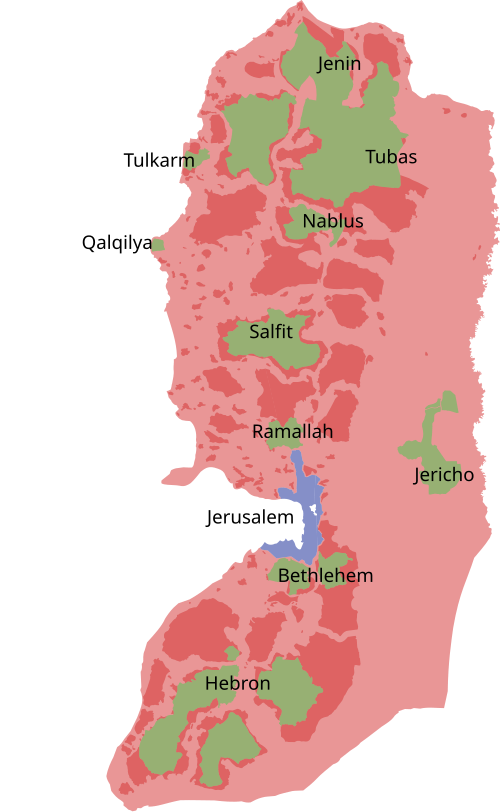
Areas A and B are where roughly 90% of the Palestinian Arabs live in Judea and Samaria.
The PA has built Illegal settlements for Arabs at 250 locations in Area C, covering more than 2,000 acres.5 European countries, which routinely criticize Israelis living in Judea and Samaria, hypocritically fund those illegal Palestinian Arab settlements.
Note: The PA, the UN, and other bodies hostile to Israel frequently mislabel parts of Jerusalem that are legally recognized by the U.S. as Israeli territory as being part of the “Israeli settlements.” More than 200,000 Israeli Jews reside in these areas, and they are often counted as “Israeli settlers.”
What we Propose: American Recognition of Israel’s Right to Sovereignty in Judea and Samaria
The United States should formally recognize Israel’s sovereign rights in Judea and Samaria. This paper does not ask Washington to draw Israel’s map or to dictate how Israel governs the territory. The scope, sequencing, and legal form of any exercise of sovereignty belong to Israel’s democratically elected government, which bears responsibility for the security of its citizens and answers to its voters. American policy should affirm those rights, retire the presumption that Israel must eventually withdraw, and stop pressing Israel to trade away the territory on which its security depends.
This approach mirrors the posture the United States has taken on other questions of Israeli sovereignty. Washington recognized Jerusalem as Israel’s capital in 2017 and Israel’s sovereignty over the Golan Heights in 2019, in each case affirming Israel’s rights without dictating how Israel administers the territory.
The following are major reasons for the U.S. to support Israel’s right to sovereignty in Judea and Samaria:
Israel is a Narrow and Small Nation
Judea and Samaria remain vital to Israel’s security. Without them, Israel would be only nine miles wide at its narrowest point.
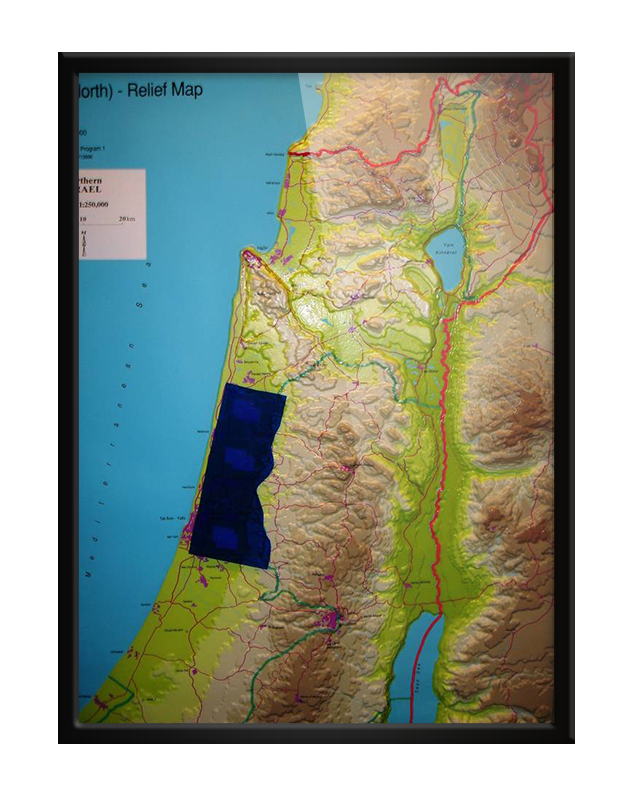
The Jordan Valley provides a critical buffer against threats from the Jordanian desert plains, while the western ridges of Judea and Samaria overlook Israel’s main international airport and its most populous urban centers, which are home to 70 to 80 percent of the total Israeli population. Israeli sovereignty ensures these strategic high grounds do not fall under the control of Islamist groups who would use them to rain rockets, missiles, drones, and gunfire on communities below.
Map B: The Topography of Judea and Samaria
Courtesy of Mark Langfan, https://marklangfan.com/
The Blue Area Contains 70-80% of Israel’s Population
The region’s aquifers and rivers are critical to the water supply of Israelis and Arabs alike. The region depends on prudent management of the rivers, pumping stations, pipelines, and aquifers in Judea and Samaria.
A Palestinian Arab State is Destabilizing and a Danger to Israel
Israeli sovereignty prevents the creation of yet another failed state in the Middle East. A Palestinian Arab state in Judea and Samaria would almost certainly collapse into violence and chaos, as Gaza did when Israel withdrew in 2005. Within two years of Israel’s withdrawal, Hamas seized control from the PA, transforming Gaza into a terror state that has launched tens of thousands of rockets at Israeli civilians and repeatedly attacked America's closest Middle Eastern ally.
This is unsurprising since Palestinian Arab children are steeped in hatred of Jews and Israel. After Oslo, the PA established a school curriculum for Judea, Samaria, and Gaza, which was most recently updated in 2025. According to one analysis, this curriculum:6
Incites antisemitism and violence, promotes Jihad [holy war] and martyrdom, glorifies terrorism, rejects peacemaking… and erases Israel from maps…. It depicts Jews as deceitful, manipulative, or inherently corrupt enemies of Islam [and Allah]…. Israelis are depicted not as human beings, but as demonic monsters, laughing while committing atrocities, slaughtering children, and extinguishing life. Texts and poems liken Israelis to serpents, vipers, and Satan’s aides, while legitimizing violence, and teaching that the existence of Israel is incompatible with justice or humanity….
Jihad is interpreted in its militant sense and directly connected to the contemporary conflict with Israel. It is presented as a personal obligation, the pinnacle of faith, and the path to glory and divine reward. Martyrdom and death for religious, national, or political goals are celebrated as the highest moral ideals…. Violence and terrorism are openly glorified and morally justified…. Terrorists are exalted as national heroes and are presented as martyrs and role models for youth….
Given this constant indoctrination, future generations of Palestinian Arabs are unlikely to become open to peaceful coexistence with Israeli Jews anytime soon.
Creating a Palestinian Arab state in Judea and Samaria would be catastrophic for U.S. interests. Unlike Gaza, which is a small coastal strip, Judea and Samaria sit in Israel’s strategic heartland. Ben Gurion International Airport, Tel Aviv, and Haifa are all easily targeted from nearby hilltops. A Hamas or other Islamist takeover would place these population centers within rocket range of these terror groups and provide Iran with a forward operating base on Israel's eastern border.
Such a menace directly threatens the United States. The U.S. has waged wars against both Iran and the Sunni Islamist organizations of al-Qaeda and ISIS. Iranian-backed forces have killed over 1,000 Americans, taken over 100 Americans hostage, and threatened U.S. presidents with assassination. Al-Qaeda killed almost 3000 Americans on September 11, 2001. ISIS has murdered Americans, some in beheadings, and inspired terror attacks on U.S. soil.
Hamas moreover is funded by Iran, the leading state sponsor of terrorism, and Hamas itself has killed and wounded many Americans.7
Giving any of these groups a strategic foothold in the heart of the Middle East and right next to America’s strongest ally in the region would endanger American lives and interests.
Professional Israeli security administration has prevented Judea and Samaria from becoming another Gaza, and sovereignty would secure it. Israel's intelligence services provide critical information that protects American lives. This intelligence stream would be jeopardized by creating an unstable Palestinian Arab state in the region.
A Palestinian Arab State Is a Danger to the Rest of the Middle East
Palestinian Arab political and militant organizations have destabilized several Arab states in which they have operated. In the 1950s, they brought terrorism to Egypt, staging attacks on Israel while also fomenting violence in Egypt. In the 1960s, they did the same in Syria. In the 1970s, they tried to oust the King of Jordan. In the 1970s and 1980s, they helped fuel a civil war in Lebanon. In the 1990s, they assisted Saddam Hussein in his attempt to conquer Kuwait. As a result of this consistent pattern of terrorism, other Sunni Arab states despise and have often expelled Palestinian Arabs.
Hamas itself is part of the Muslim Brotherhood, which has been a consistent opponent of the regimes in Egypt, Jordan, Bahrain, the UAE, and Saudi Arabia.
In particular, a Palestinian Arab state created in Judea and Samaria would place Jordan in mortal danger. Jordan’s U.S.-aligned monarchy is Hashemite, while a majority of the country’s population is of Palestinian Arab origin.8 A Palestinian Arab state in Judea and Samaria would almost inevitably lead to the overthrow of the Hashemite monarchy and the creation of a united Palestinian Arab state composed of Judea, Samaria, and Jordan. As noted above, Palestinian Arab forces already tried to seize Jordan in 1970.
Any united Palestinian Arab state would probably become a threat to the oil-rich U.S.-allied nations of Saudi Arabia, Kuwait, Bahrain, and the UAE.
When it comes to the demographic realities of the Palestinian Arab population in Judea and Samaria, the supposed danger to Israel is largely a mirage. The Arab population in Judea and Samaria is significantly smaller than international statistics suggest, while the population growth of Jewish Israelis equals or even exceeds that of the Arab population.9 In fact, the population growth of Arabs in the Middle East has been rapidly declining.10 The real number of Palestinian Arabs in Judea and Samaria may be as low as 1.5 million, less than half the number claimed by the deliberately inaccurate PA estimates.11 The PA double-counts Palestinian Arabs living in Jerusalem, includes Palestinian Arabs who marry Israeli Arabs (who are already counted in Israel), includes Palestinian Arabs who have left the area for over a year and are unlikely to return, and fabricates a higher birthrate.
The PA overstates the population primarily for two reasons: 1) the international aid going to the Palestinian Arabs is partly dependent on population estimates; and 2) a larger population and growth rate bolster the PA’s case for the creation of an independent Palestinian Arab state.
The history of Israel and Judea and Samaria shows that the Jews were indigenous to the area, that they were dispossessed of control over the territory, and that the Palestinian Arabs arrived much later, as colonizers and economic migrants who were attracted by the booming economy created by the Jews. It also shows that the Palestinian Arabs are the party that is consistently unwilling to compromise or moderate.
Early Biblical History
As the Bible states, the land where Abraham’s cattle grazed after he left his family in the city of Ur to forge a new life is the same land that his descendants cultivated following their escape from slavery in Egypt. It is also the land that Jews across the globe reference weekly in their prayers, as they have for thousands of years.
Judea and Samaria comprise the historic heartland of this Jewish homeland. Situated on the land west of the Jordan River (hence the term “West Bank”), this region is smaller than half the size of metro Indianapolis. The word “Jew” refers to a person who comes from “Judea.” Despite its small size, Judea and Samaria hold profound historic, strategic, and demographic importance.
Zion, from which Zionism takes its name, is a mountain adjacent to Jerusalem. Three thousand years ago, King David himself secured the fortress that stood on this hill.
In Hebron. on land Abraham purchased 4,000 years ago, lie the burial places of the Biblical Patriarchs Abraham, Isaac, and Jacob and the Matriarchs Sarah, Leah, and Rebecca.
Hebron, King David’s first capital, and Jerusalem, the eternal capital where the Temple built by Solomon stood, are in this region. Today, that same Jerusalem is the capital of modern Israel and home to the Church of the Holy Sepulcher, the Dome of the Rock, and the Western Wall that surrounded the Temple in Jerusalem. In Shiloh, Joshua apportioned the Promised Land among the twelve tribes after 40 years of wandering in the desert following their deliverance from slavery.
For over 300 years, Shiloh housed the Tabernacle, containing the Ark of the Covenant. Twenty miles to the southeast is Jericho, the famed walled city the Israelites to marched around for a week, blowing shofars, before God brought its walls down.
As the Bible demonstrates, Judea and Samaria are the heart of the Jewish homeland. Orchards, groves, farms, and vineyards in Judea and Samaria thrive on plots of land cultivated by Jewish farmers 2,000 years ago.
Foreign Domination Through History
Beginning in the 8th century BCE, the land came under foreign powers: Assyrians, Babylonians, Persians, Greeks, Romans, Greeks, Byzantines, Arabs, Crusaders, Mamluks, and Ottomans (16th century onward).12 The Ottoman Empire controlled the land until its defeat by Britain in World War I.
Under British rule, the region became known as Palestine, reflecting "Palestina," the name the Roman Empire gave Judea in the second century CE to suppress Jewish hopes for political independence. The Romans named the area after the Philistines, an ancient people of Aegean origin who were enemies of the Jews.
Jews were dispersed into exile across modern-day Iran, Iraq, Arabia, Europe, Africa, and beyond. By the 16th century, only an estimated 5,000 Jews remained in their homeland.
Yet through centuries of exile marked by forced conversions, pogroms, and repeated expulsions, the Jewish people never wavered in their longing for Zion and hope of national restoration.
Passover seders conclude with the exclamation, “Next Year in Jerusalem!” When praying, whether at home, in public, or in a synagogue, Jews turn toward Jerusalem and the Temple Mount, where the Temple stood. An unbreakable bond exists between the soul of the Jewish people and their homeland.
In the late 19th century, Theodor Herzl’s vision of an imminent reestablishment of a Jewish state rekindled hope. After the Allied victory in World War I dissolved the Ottoman Empire, the next generation of Zionists built on his accomplishments.
The British Mandate Period
In 1917, British Foreign Secretary Balfour affirmed support for a “Jewish national home” that included Judea and Samaria and parts of modern-day Jordan to the east of the Jordan River. The 1922 League of Nations Mandate refined this to only the land west of the Jordan River, still including Judea and Samaria. This limited the Jewish national home to the roughly one-quarter of the Palestine Mandate west of the Jordan River. This territory now comprises Judea, Samaria, the remainder of Israel other than the Golan Heights, and Gaza. The remaining land became Transjordan (now the Hashemite Kingdom of Jordan).13
But not until the end of World War II, in the aftermath of the Holocaust, did the dream of a reestablished Jewish state become a reality, as a substantial number of Jews immigrated back to their homeland. Throughout the period, as Jewish ingenuity fueled an economic boom, Arabs from Egypt, Jordan, Saudi Arabia, Yemen, and elsewhere also migrated to the area, eventually becoming the Palestinian Arabs.
Even today, the names of Palestinian Arabs can be used to determine their origin. For example, the surname al-Masri literally means “The Egyptian.”
In 1946, Transjordan gained independence.
In 1947, the U.N. partition plan proposed splitting the remaining land between the Mediterranean Sea and Jordan River into Jewish and Arab states. Although the plan denied sovereignty over Jerusalem to the future Jewish state, the Jewish leadership accepted it.
Israeli Independence and Arab Aggression
Despite disappointment with the partition plan’s boundaries, Israel declared independence on May 14, 1948. Rather than accept a Jewish nation, Israel’s Arab neighbors attempted to extinguish her. But Israel survived and gained lawful sovereignty over much of the territory. However, the armistice left Egypt illegally occupying Gaza and Jordan illegally occupying Judea and Samaria.
For the next 19 years, Israel lived in a tense cold war with her Arab neighbors. In 1967, the Arabs mounted another attempt at annihilation. Israel’s victory in the Six-Day War proved decisive, leaving Gaza, Jerusalem, and the entirety of Judea and Samaria in its possession.
Israel initially chose to apply sovereignty only to its historic capital, Jerusalem, while maintaining a military presence for security purposes in Judea and Samaria and allowing limited Israeli development.
Rejected Peace Proposals
For decades, Israel has sought peace with the Arab world, offering numerous proposals that included the creation of another Arab state within the Jewish homeland.
The Palestine Liberation Organization (PLO) and the Palestinian Authority (PA) have rebuffed these overtures each time, including the autonomy provisions of the 1978 Camp David Accords, and U.S. President Donald Trump’s 2020 “Peace to Prosperity” plan. After signing the 1993 and 1995 Oslo Accords, the PLO failed to honor them. They also rejected generous proposals from Israeli prime ministers in 2000, 2001, and 2008. And they did not take peaceful advantage of the Israeli withdrawal from Gaza in 2005.
The PA has resumed violence after every Israeli concession and conditioned peace on terms no Israeli government could accept.
International Law Supports Israel's Legal Claim
International law strongly supports Israel’s claim to Judea and Samaria.
The standard legal objection to Israeli sovereignty rests on the false notion that Israel "occupies" Palestinian Arab territory in violation of international law. Occupation, in international law, refers to the seizure of another state's sovereign territory. Judea and Samaria was never part of a sovereign Palestinian Arab state. Jordan's 1949-1967 control was an illegal annexation recognized by almost no one.
Professor Eugene Kontorovich, a recognized expert in this area of law and senior legal fellow at Advancing American Freedom, succinctly explains:
Under international law, occupation occurs when a country takes over the sovereign territory of another country. But the West Bank was never part of Jordan, which seized it in 1949 and ethnically cleansed its entire Jewish population. Nor was it ever the site of an Arab Palestinian state. Moreover, a country cannot occupy territory to which it has sovereign title, and Israel has the strongest claim to the land. 14
Israel has the strongest claim to the land because:
There is a simple, clear rule to determine the borders of new countries, whether they arise from imperial collapse, decolonization, federal breakup, cession, or any other cause. Under the doctrine of uti possidetis juris, a new country automatically inherits the borders of the last top-level administrative unit in that area. In other words, the pre-independence internal boundaries carry over to the new state. The continuity of prior borders is the sole factor, trumping fuzzy and hard-to-administer considerations like ethnic self-determination or historical title.15
Kontorovich distinguishes this from the Russian seizure of Crimea, to which it is often compared:
Putting this move in the same category as Russia's seizure of Crimea is entirely misleading. There is no one-word name for what Israel plans to do because it is so technical and pedestrian. Israel already governs the territory in question, as it has since 1967, when it liberated the land from a two-decade Jordanian occupation. But at that time Israel didn't fully apply its domestic laws there, leaving it under military administration. Israel expected the Arab states to sue for peace after the Six-Day War, and it was prepared to transfer some of the land to them. There was no point in hurriedly applying Israeli law to territory that might not remain Israeli after a peace settlement. 16
The United States Has Already Rejected the “Illegal Settlements” Claim
The United States government has rejected the claim that Israeli communities in Judea and Samaria are illegal. On November 18, 2019, it announced that it had concluded that the establishment of Israeli civilian settlements in Judea and Samaria is not, per se, inconsistent with international law. The decision set aside the 1978 legal opinion to the contrary and returned to the view expressed in 1981. As U.S. Secretary of State Mike Pompeo explained, calling these communities illegal had not advanced the cause of peace.17 Although the Biden administration unsuccessfully sought to revive the flawed 1978 position, the 2019 determination rests on the stronger legal footing. Should Israel choose to extend its sovereignty in Judea and Samaria, the move would resemble what occurred in Morocco, when it established sovereignty over Western Sahara, and in Indonesia, when it asserted control over the Dutch New Guinea colony.18 The United States recognizes both of these actions. In neither of these cases did the international community impose meaningful consequences.
The Oslo Accords of 1993 and 1995 Are No Longer Relevant
The Oslo Accords of 1993 and 1995 are also no longer an impediment to Israeli sovereignty, because the PA has violated them repeatedly.19 Some prominent examples:
For that matter, the PA itself has declared that it no longer is bound by the Oslo Accords.27
Judea and Samaria play an increasingly important role in Israel’s economy. Israelis in Judea and Samaria build hospitals, schools and businesses, transforming once-barren land into thriving communities.
The Israel Defense Forces’ Coordinator of Government Activities in the Territories (COGAT) administers aspects of military and civilian governance in Area C. For Israelis, infrastructure and land-use decisions in Area C are governed by a byzantine legal and regulatory system, including laws dating to the Ottoman period.
Sovereignty would enable development with far less bureaucracy and lower costs. Rather than dealing with COGAT, developers could work through the Ministry of Construction and Housing. This would be a significant step forward for economic prosperity.
Civilian Israeli law would replace the patchwork of military orders and Ottoman-era laws. This would streamline development and expand economic opportunities for Israelis and Palestinian Arabs. Sovereignty would also assure businesses and families that they can invest without fear of eviction by their own government, as happened to Jewish families in Gaza twenty years ago.
Israel develops cyber systems, robotics, missile defenses, battlefield ISR, advanced munitions, IT innovations, water management technology, medical R&D, and clean energy solutions. It shares these technologies with the United States. Many of these innovations emerge from Israeli institutions and businesses located in Judea and Samaria. The region hosts universities, research facilities, and technology firms that contribute to Israel's world-leading innovation sector. Ariel University in Samaria, for example, conducts cutting-edge research in engineering, health sciences, and natural sciences. This research benefits not just Israel but also its American partners.
Both Israeli Jews and Palestinian Arabs would benefit from the economic growth unleashed by this change. As President John F. Kennedy once said, “A rising tide lifts all boats.”
Recognizing Israel’s right to sovereignty in Judea and Samaria is the only alternative to the international demands of retreat in exchange for empty promises of peace. Each major Israeli withdrawal or peace overture over the past thirty years has produced more war, not stability:28
A hostile entity on the ridges of Judea and Samaria would sit within a few miles of Ben Gurion Airport, Tel Aviv, and the coastal corridor where most Israelis live and work. Israel would have no strategic depth to absorb a first blow, no time to mobilize, and no margin for error.
Palestinian Arabs in Judea and Samaria under the PA are not free. Under PA governance, elections are rare and suspect, women face discrimination, Christians are persecuted, homosexuals are murdered, people are imprisoned without trial and tortured, the press is not free, and terrorists who murder Americans are paid and celebrated.33 Civilians live in squalor as leadership siphons off international aid for its own uses, including terrorist endeavors.
The Arabs generally, and the Palestinian Arabs specifically, already have their own states. The Arabs currently dominate 21 separate states in the Middle East and North Africa. That includes the neighboring Kingdom of Jordan, where, as noted above, it has long been acknowledged that a majority of the population is made up of Palestinian Arabs.34 The fact that the ruling Hashemite dynasty is from Saudi Arabia is immaterial, as none of the Arab states has a functioning democracy, and neither would any new Palestinian Arab entity. Moreover, the current King of Jordan is married to a Palestinian Arab, and their son, the crown prince, is heir to the throne.
Meanwhile, other ethnic or religious groups, including the substantial Muslim Kurdish population divided among Iran, Iraq, Syria, and Turkey, have no independent states.
Israel's democratic population consistently and overwhelmingly favors peace with its neighbors in poll after poll. Every war Israel has fought has been defensive. The rights of racial and religious minorities are respected. Dissent is abundant and protected.
Contrast this with Israel’s neighbors across the Middle East. The Middle East and North Africa generally register the worst human freedom scores of any region35, Israel excepted. Dictators rule through force, often resorting to violence. Religious toleration is minimal or nonexistent. Nearly the entire Jewish population across the region was forced to flee following the establishment of the modern Jewish state. Christian populations, too, face extinction through persecution, including mass killing. 36Once-robust Christian communities in Syria and Iraq have disappeared. Women face significant legal and social restrictions across much of the region.
Another Arab state created by carving up the Jewish homeland would risk becoming another unstable, undemocratic state. This new state would be dangerous both to its citizens and its neighbors.
Israel is a democracy in which its Jewish, Druze, Muslim, and Christian citizens are fully equal under the law, including the right to vote. Israel does distinguish between its citizens (many of whom are Arabs) and Palestinian Arabs who are not citizens, but those distinctions reflect legitimate security needs. Over 10% of the Israeli parliament is made up of Israeli Arabs. Arabs attend Israeli universities in significant numbers, serve as leading judges, and make up a substantial share of doctors, nurses and pharmacists in Israeli hospitals. Access to public health care, public education, freedom of speech, and protection of legal rights are enjoyed by all Israeli citizens, regardless of race and religion. The few restrictions on some Arab Israelis exist only because of documented and ongoing terrorist threats, not racial classification.
Apartheid, as it actually existed in South Africa, bore no resemblance to this. Such a comparison is not just inaccurate; it’s defamatory.37
Critics of Israeli sovereignty predict diplomatic catastrophe if Israel extends sovereignty to Judea and Samaria. These fears are overblown. During the Trump administration, critics made the same arguments about moving the U.S. embassy to Jerusalem and recognizing the city as Israel's capital. Similar concerns surrounded U.S recognition of Israeli sovereignty over the Golan Heights. Neither action produced significant repercussions. Israel’s security was enhanced with minimal diplomatic cost.
The Palestinian Authority Response
The PA will, no doubt, virulently oppose sovereignty, as it objects to every expression of Israeli permanence. It has periodically threatened and launched violent intifadas for various reasons, often following its rejection of peace plans. But the underlying driver of this terrorism is not any specific Israeli policy; rather, it’s the existence of a Jewish state in the historic Jewish homeland. No Israeli concession short of national suicide will satisfy its demands.
The PA has also demonstrated its unwillingness to cooperate with the U.S. and work toward peace through its immediate rejection of the Trump peace plan and the Abraham Accords. Its leadership also continues "pay to slay" policies, rewarding terrorists who have killed Americans. And it continues to educate its children to hate those who are not Sunni Muslims.
The Palestinian Arab people would be far better off without the PA. In fact, they would benefit immensely from the influx of business development following Israeli sovereignty in the region.
Jordan's Response
Jordan can also be expected to strongly oppose sovereignty.
However, Jordan’s Palestinian Arab majority places it in a unique position. It must therefore cater to Palestinian Arab demands, at least publicly. But Jordan has long played a double game on the issue. It is well known that the Hashemite monarchy deeply fears the creation of a Palestinian Arab state in any part of Judea and Samaria, as it could easily lead the Palestinian Arab majority in Jordan to rebel against the King.
Moreover, Jordan depends on U.S. foreign aid, which limits how strongly the Jordanian government can oppose Israeli sovereignty over any area of Judea and Samaria.
Qatar's Response
In 2020, Qatar's foreign minister called annexation "the last bullet" in the peace process. However, Qatar is not representative of the Arab world and is not a power to emulate, given that it underwrites Hamas operations. In the midst of Israel’s 2014 fight against Hamas (Operation Protective Edge), Qatar’s current Deputy Prime Minister and Minister of State for Defense Affairs Saoud bin Abdulrahman Al Thanideclared, “We are all Hamas.”38
The Broader Arab World’s Response
Many warned of intifadas or worse when the United States moved its embassy to Jerusalem, yet reactions across the Middle East (including from Arab states and the PA) were muted. Israel's staunchest allies correctly predicted this outcome. Similarly, the U.S. recognition of Israeli sovereignty over the Golan Heights brought minimal negative repercussions and lasting security benefits.
As the Abraham Accords demonstrated, Arab governments increasingly calculate their interests independently of the Palestinian Arab question. While Arab elites may publicly oppose extension of sovereignty, they increasingly recognize that it reflects a long-term reality on the ground. Behind the scenes, and increasingly in public, many Arab neighbors cooperate with Israel to enhance security against terrorism. In fact, Palestinian Arabs have been publicly voicing concerns that their Arab neighbors seem indifferent towards Israel's plans for sovereignty.39 This reflects reality: Arab governments are more accepting of a Jewish state in their midst than are their citizens.
Turkey’s Position
Turkey, a non-Arab Sunni Muslim state, is hostile to Israel. It will certainly object strenuously and probably threaten a violent response to the establishment of Israeli sovereignty over Area C. The Islamist dictator of Turkey, President Erdogan, and his regime already frequently threaten the Jewish state. 40 Turkey has a strong military, so it would be a particularly dangerous opponent.
However, Erdogan is known for reckless rhetoric and does not always follow through with his threats. His hostility is also religious and ideological rather than a response to a particular Israeli action. As an Islamist, he rejects the very concept of a Jewish state.
If Turkey does turn aggressive, its NATO membership and alliance with the United States give Washington considerable leverage to prevent a full-scale conflict.41
The International Response
Legitimate concerns exist over potential global turmoil following a sovereignty declaration. Antisemitism is rife throughout the globe, especially in Europe. Also, many European nations have large, restive Muslim populations, segments of which are violently hostile to Jews and Israel, and governing parties frequently cater to them.
However, most fears of such international turmoil are overblown. Few foreign states will initially recognize Israeli sovereignty. The United Nations and EU will certainly object, but international bodies have long been hostile to the world's only Jewish state, and their bias has few consequences. Several EU countries already effectively boycott Israeli businesses in Judea and Samaria. U.S. veto power on the UN Security Council should blunt the impact from even the most vocal objecting nations.
Some will argue that the status quo created by the Oslo Accords should simply continue. We strongly disagree. The status quo cannot and should not be maintained, for several reasons.
In 2005, Israel relinquished control over Gaza, leaving it to the Palestinian Arabs to, essentially, create their own state. Instead, Gaza’s Palestinian Arabs prepared for war, arming themselves to the teeth and electing Hamas, the even more violent Islamist terror party. After numerous smaller wars against Israel, and constant terrorism conducted against it, on October 7, 2023, Hamas-led terrorists from Gaza invaded Israel and slaughtered some 1,200 innocent people, most of them Israeli civilians, leading to a major Middle East conflict.
This cannot be allowed to happen again. The PA has built an illegal army in Judea and Samaria of heavily armed terrorists.42 Left unchecked, the PA, or Hamas, which at times polls as more popular in the area,43 will attempt a similar attack. The best way to head this off is for Israel to extend sovereignty over Area C (at least), which has relatively few Arab residents and includes the strategic high ground.
Moreover, a party that initiates a war or violates agreements, as the PA has violated the Oslo Accords, should bear its consequences. Without consequences, bad behavior continues. Extending sovereignty is a fitting response to the constant aggression and violence coming from the Palestinian Arabs.
Finally, as noted above, a Palestinian Arab entity in Judea and Samaria would endanger Jordan, a U.S. ally. Supporting Israeli sovereignty would prevent such an entity from being created.
The extension of Israeli civilian law to Judea and Samaria aligns with international law, historical precedent, demographic reality, and the strategic interests of the United States. It will not produce the diplomatic catastrophe predicted by critics: Jerusalem and the Golan Heights are evidence of that.
If the United States presses Israel to forgo sovereignty over its historic homeland of Judea and Samaria, adversaries will draw a dangerous lesson: American commitments to its allies can be worn down. Allies from Taiwan to Poland to South Korea will have reason to question whether Washington will stand firm when their own security is threatened. Lasting stability in the Middle East requires American strength and the resolve to demonstrate it consistently.