Policy Memo
Topline
July payroll employment fell by -23,000 jobs, while the unemployment rate edged down to 4.1 percent, from 4.2 percent in June (U.S. Bureau of Labor Statistics n.d.-a, U.S. Bureau of Labor Statistics n.d.-b).
Institute for Statistical Policy Analysis · Plymouth Institute for Free Enterprise
July payroll employment fell by -23,000 jobs, while the unemployment rate edged down to 4.1 percent, from 4.2 percent in June (U.S. Bureau of Labor Statistics n.d.-a, U.S. Bureau of Labor Statistics n.d.-b).
The economy experienced its first month of job losses in July, after four consecutive months of job gains. May and June job gains were revised downward by a combined -103,000 jobs, after the previous month’s -97,000 downward revision. Estimated payroll growth is still positive from March to June, but at much reduced levels.
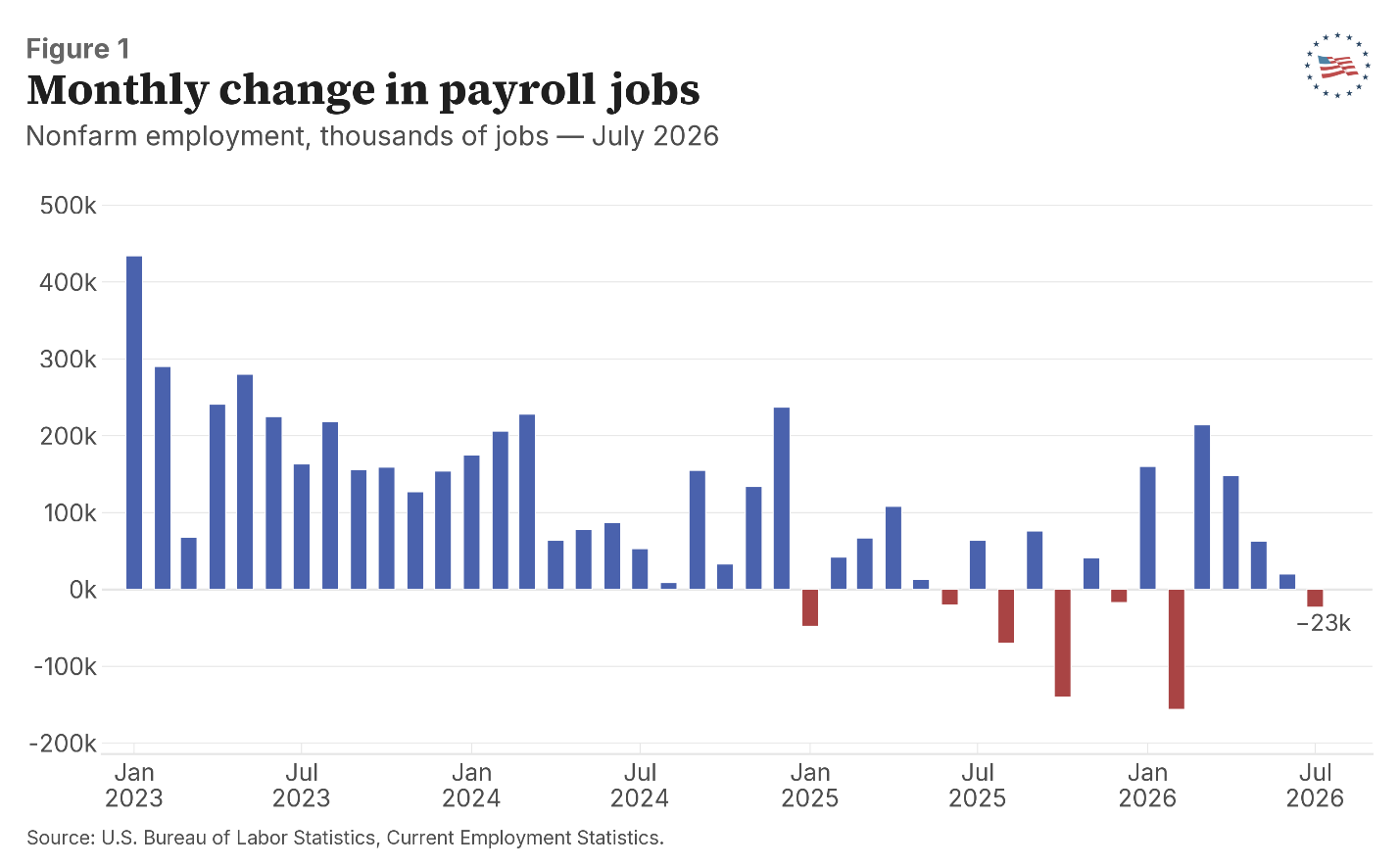
Government employment fell by a statistically significant -53,000 jobs, with -50,000 of those job losses coming from local government education, while total private employment grew by +30,000. Employment in the retail trade sector fell by -19,400, and the remaining sectors in the private economy (such as financial services, information, transportation and warehousing, etc.) did not experience statistically significant employment gains or losses.
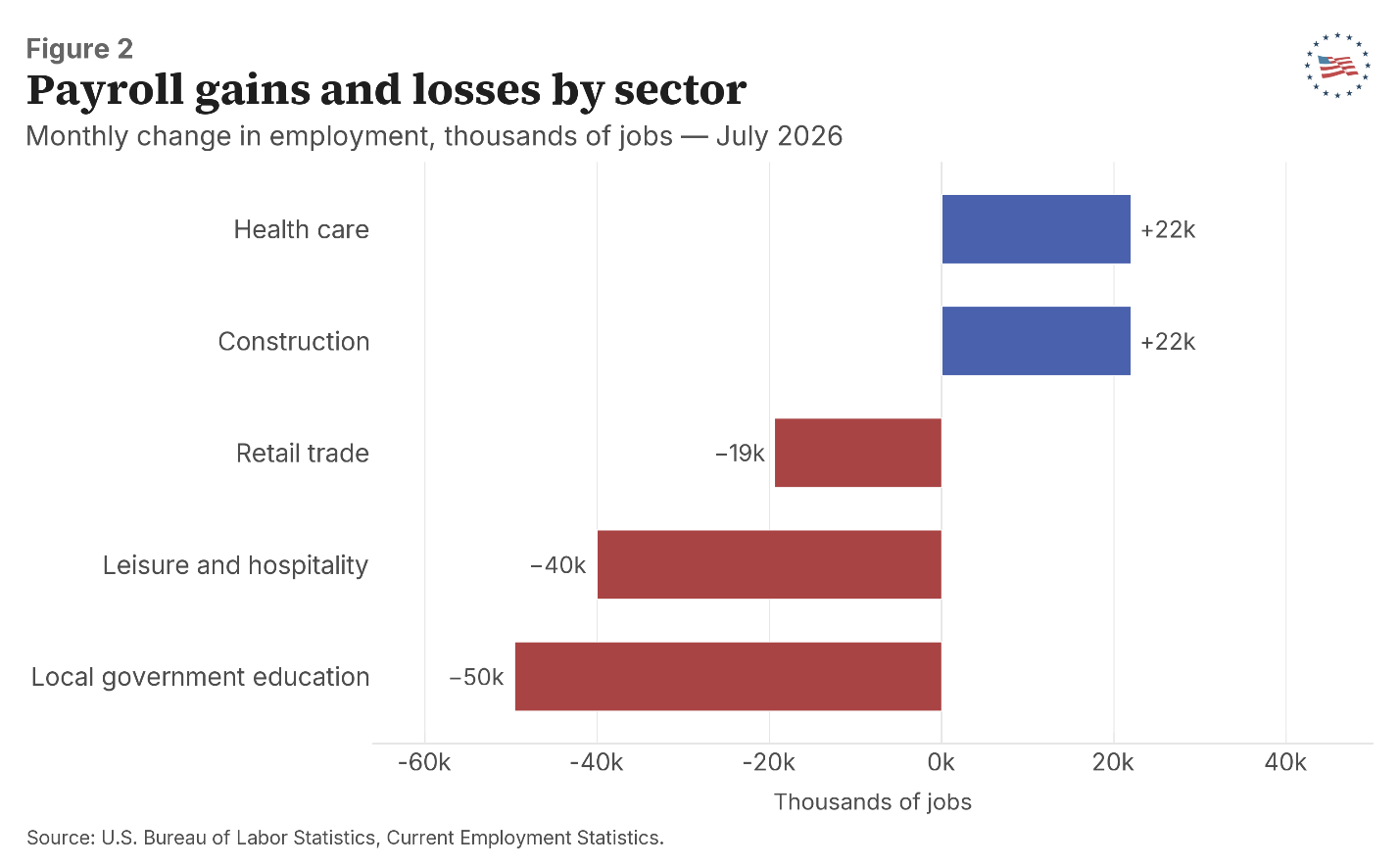
The highly subsidized healthcare sector continued to grow in June with a +22,000 seasonally adjusted increase in employment. The social assistance sector, which is almost entirely funded by the government, saw gains of only +600 jobs. Neither of these gains were statistically significant.
Excluding the highly subsidized healthcare and social assistance sectors, the private sector only gained 7,000 jobs in July.
This continues to be a worrying trend, as the “true” private sector has seen shaky growth since early 2024, following a period of economic recovery from the COVID-19 pandemic in 2023. This measure of “true” private employment serves as an even more valuable indicator of the health of the economy than total nonfarm employment, as it reduces the impact of distortionary effects of government spending on the economy.
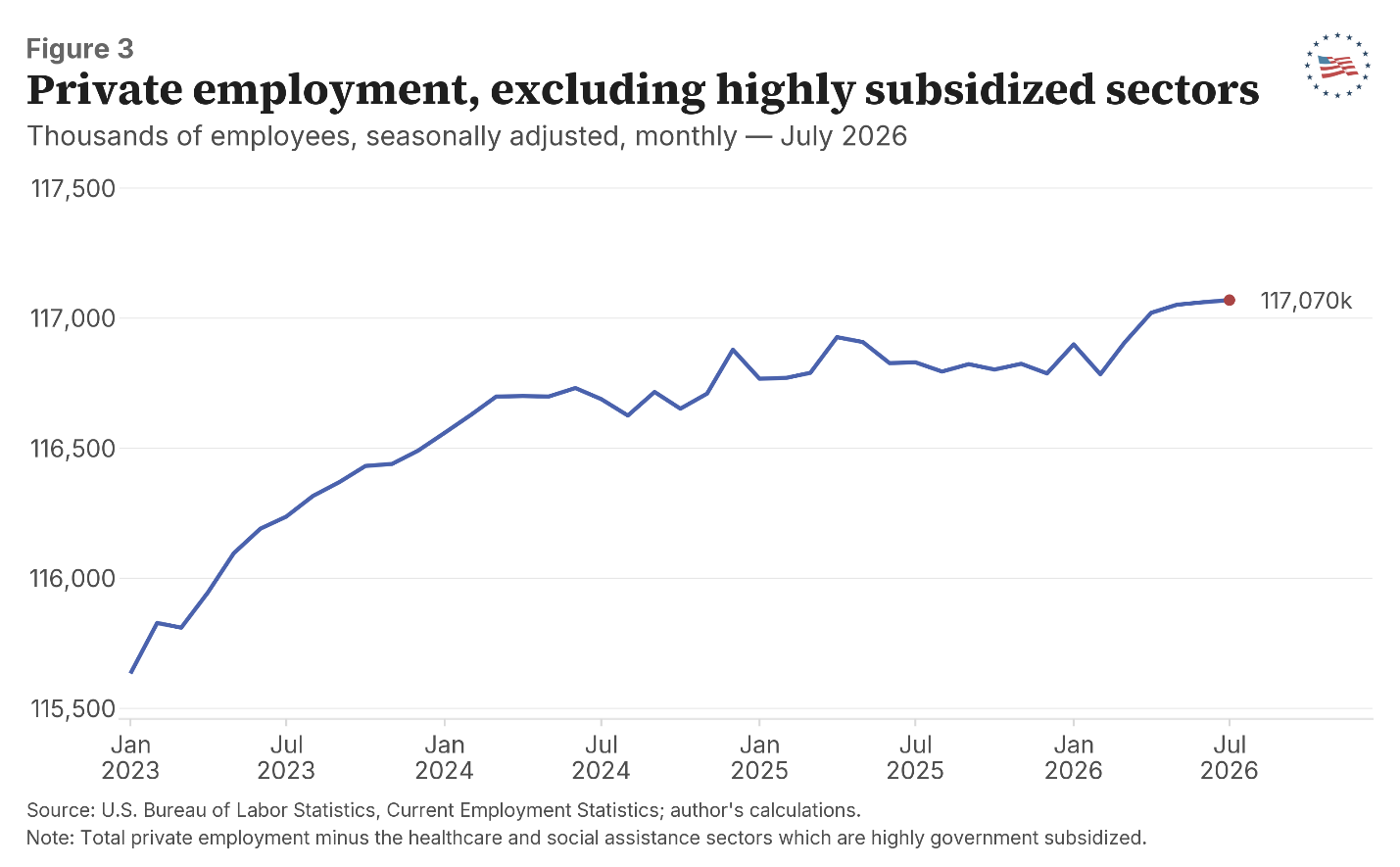
“True” private employment declined from April 2025 to February 2026, during the period in which the Liberation Day Tariffs were in full effect.
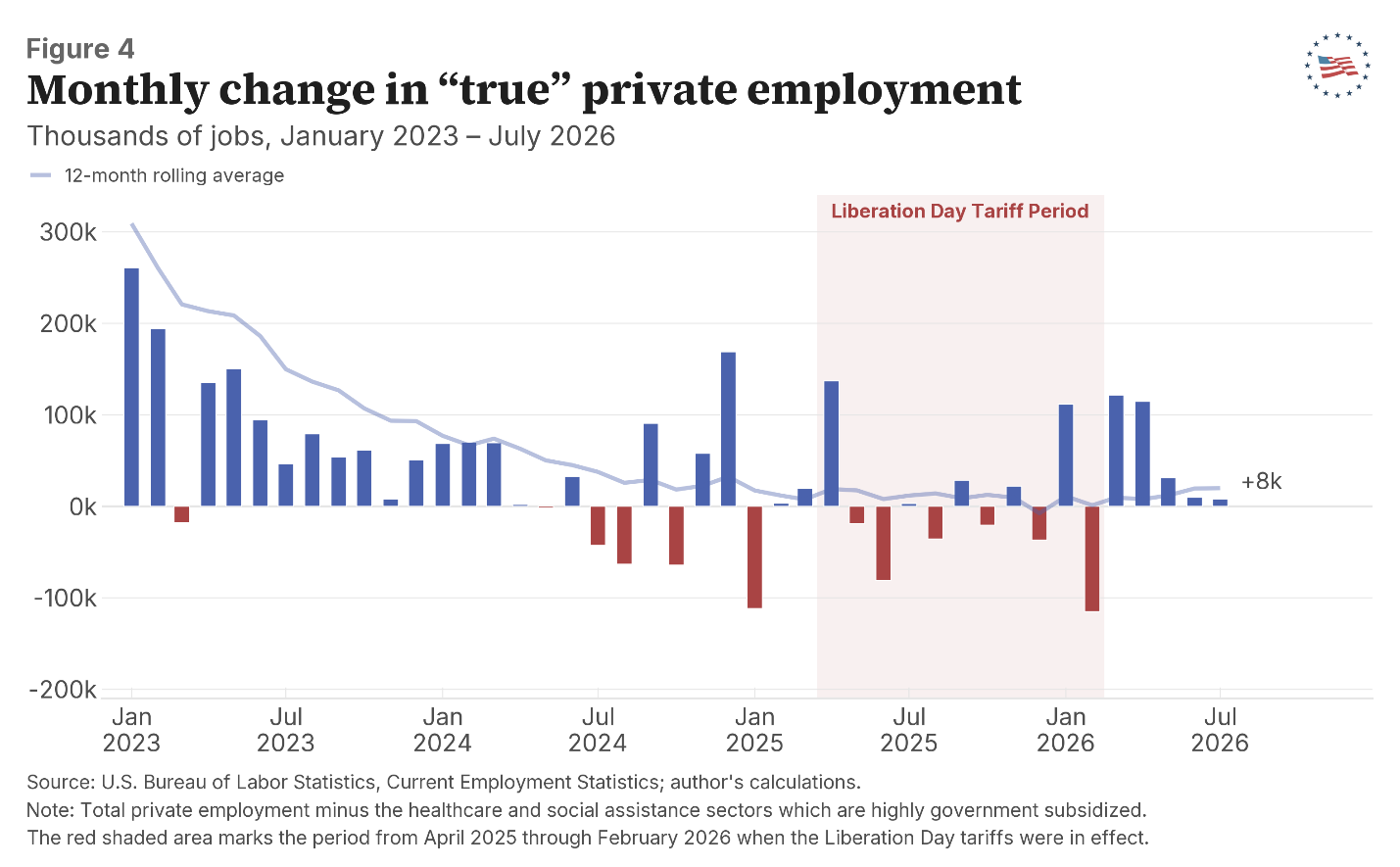
There was an uptick in employment growth in the months of March and April 2026, after the Supreme Court struck down President Trump’s authority to unilaterally enforce broad tariffs using the International Emergency Economic Powers Act (IEEPA) in February 2026. President Trump and his administration have since continued to pursue somewhat more limited tariff policies through other means.
The conflict with Iran this year and associated surge in energy prices certainly isn’t an economic accelerant, but this year’s lackluster jobs performance is a continuation of the downward trend that began in 2024 under the Biden administration and continued to worsen in 2025 with the Trump administration’s tariff policies. Even with a more limited tariff regime, job growth remains depressed, with the 12-month average for the monthly increase in “true” private employment being just +8,000 jobs.
Since the turn of the twenty-first century, only a few periods fared worse than 2025 and 2026 for “true” private sector jobs growth: The beginning of the COVID pandemic (2020), the Dotcom bubble popping (2001-2002), and the Great Recession (2008-2009). Both 2025 and 2026 rank in the bottom fifth in the last 25 years for “true” private sector job growth (U.S. Bureau of Labor Statistics n.d-c). This is alarming, because those other periods were considered recessionary.
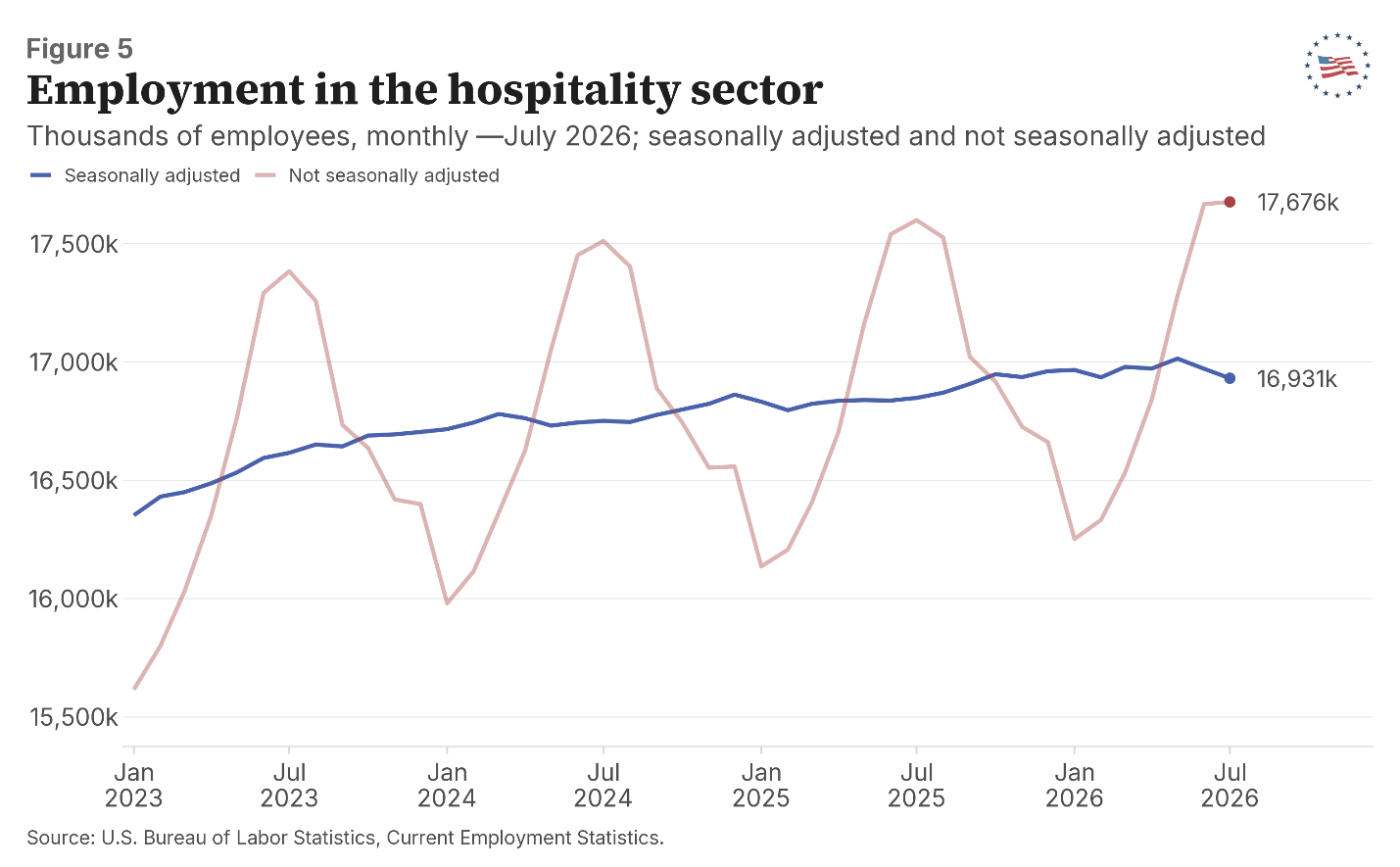
The leisure and hospitality sector is an interesting case study in the July Jobs Report. Considering that the survey period covers when the FIFA World Cup was still going on, one would expect leisure and hospitality employment to grow. The BLS’ seasonally adjusted figures actually showed declining employment with -40,000 jobs lost in July, following another -43,000 decline in jobs in June. However, the not seasonally adjusted value for hospitality employment is at the highest level it has ever been, at almost 17.7 million jobs. This does not mean the seasonal adjustment is inaccurate, as employment growth has generally been higher in the July months of previous years, but it is worth noting considering conventional wisdom would presume hosting FIFA would provide a discernible (albeit temporary) boost to bars and other entertainment venues.
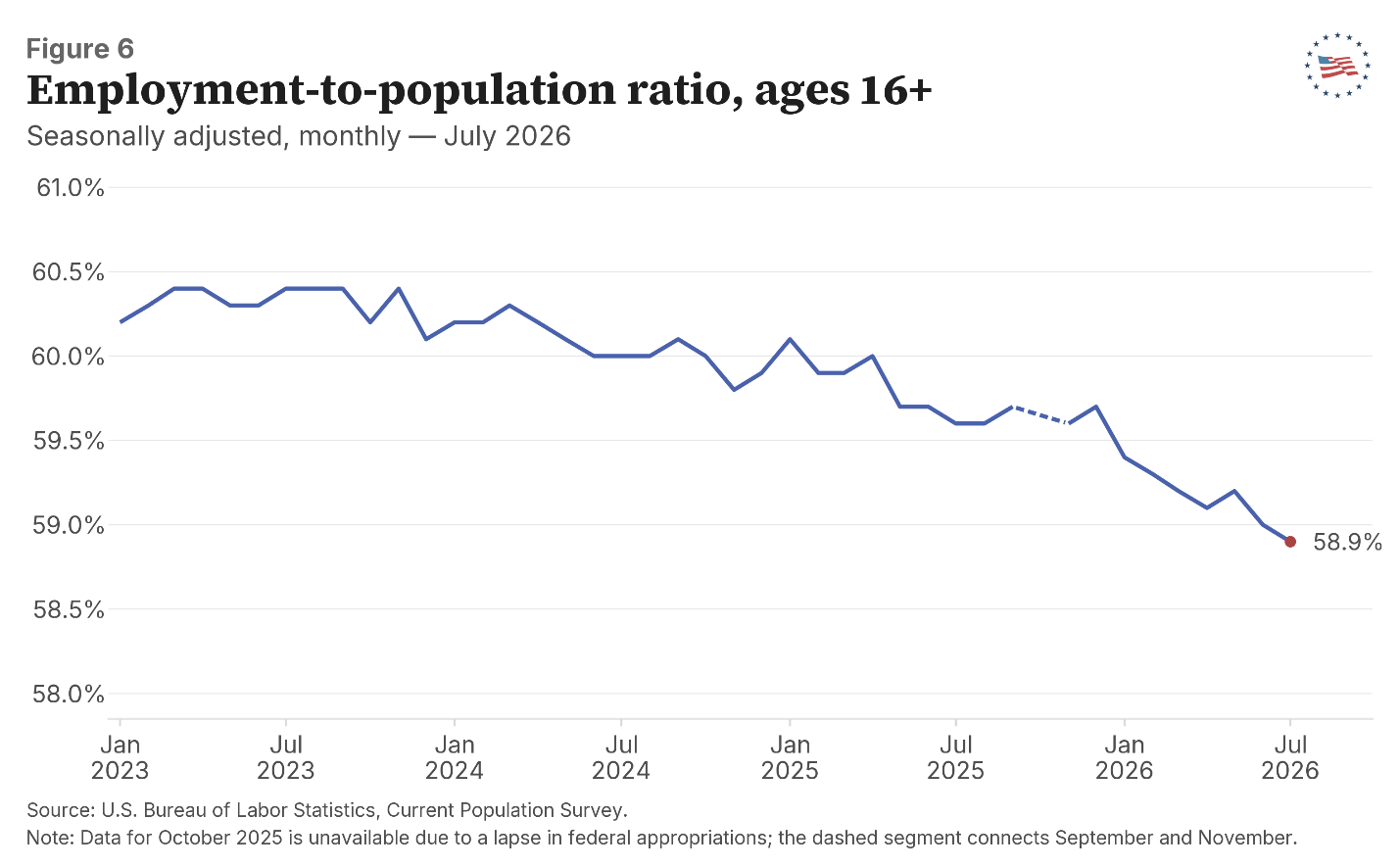
The continuing downward trend in the overall employment-to-population ratio remains worrying.
The July Jobs Report paints a worrying picture of the state of the economy, with payroll losses for the first time in four months.
Additionally, historically low private job growth for an economy not declared to be in a recession should be unsettling to many.
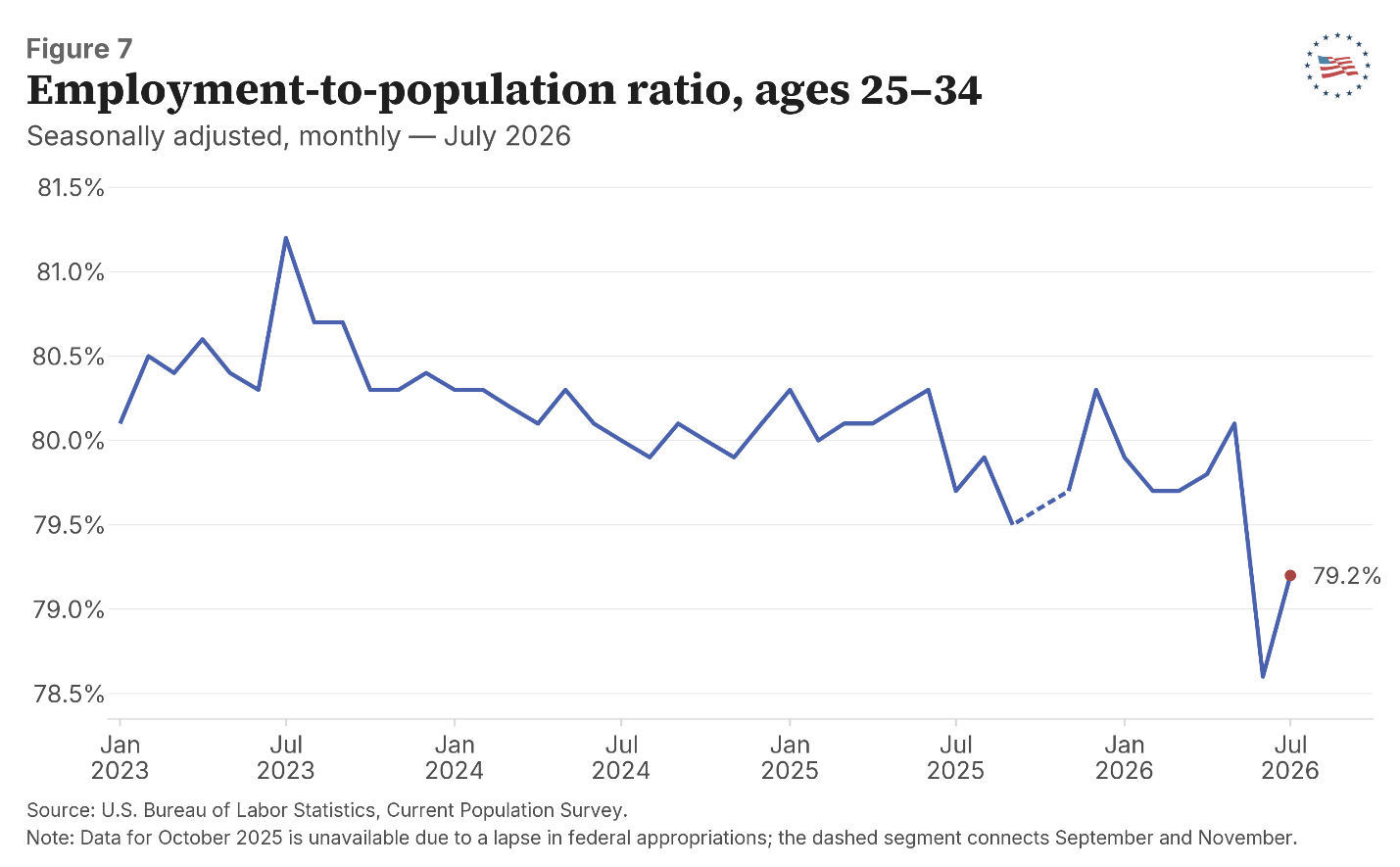
Continued downward trends in the labor force participation rate and employment-to-population ratio also remain concerning because strong economic growth requires high employment.
U.S. Bureau of Labor Statistics. (n.d.-a). All employees, total nonfarm [FRED series PAYEMS]. Federal Reserve Bank of St. Louis. Retrieved August 7, 2026, from https://fred.stlouisfed.org/series/PAYEMS
U.S. Bureau of Labor Statistics. (n.d.-b). Labor force statistics from the Current Population Survey [Data set]. U.S. Department of Labor. Retrieved August 7, 2026, from https://www.bls.gov/cps/data.htm
U.S. Bureau of Labor Statistics. (n.d.-c). All employees, total private [FRED series USPRIV]. Federal Reserve Bank of St. Louis. Retrieved August 7, 2026, from https://fred.stlouisfed.org/series/USPRIV