
Policy Memo
Topline
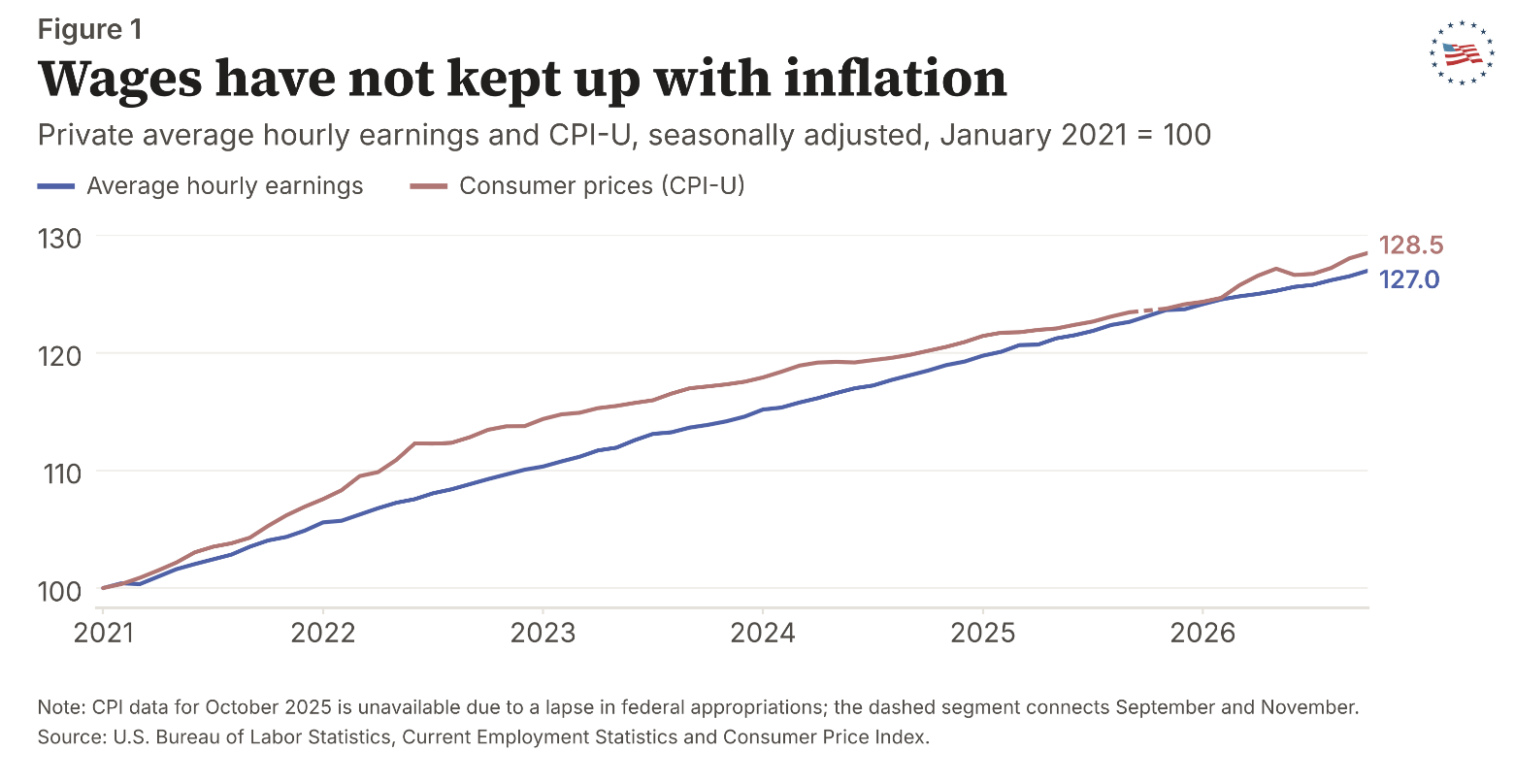
American families continue to lose ground as inflation extends its hot run. Since April, year-over-year prices have risen faster than paychecks, and the war-driven energy squeeze only adds to the inflation problem.
Plymouth Institute for Free Enterprise · Institute for Statistical Policy Analysis
TOPLINE: American families continue to lose ground as inflation extends its hot run. Since April, year-over-year prices have risen faster than paychecks, and the war-driven energy squeeze only adds to the inflation problem.
BACKGROUND: The Consumer Price Index (CPI) rose 0.4% in October, an annualized rate of 4.9%, after rising 0.6% in September.
The 11-month change of 3.8% suggests a 4.2% year-over-year change, more than double the Federal Reserve’s “target”. Core inflation (excluding food and energy) rose 0.3% in October. (A 12-month-change is not available due to a lack of October 2025 data.)
Energy led October’s increase again, but inflation is across the board:
Here’s what you need to know about October price increases:
| Energy Heating and travel costs | Gasoline ▲ 1.0% Fuel oil ▲ 2.0% Airfare ▲ 0.4% Energy overall ▲ 0.7% |
| Groceries Food at home is up just 1.8%, but staples rise faster | Groceries ▲ 0.4% Meats ▲ 0.6% Baby Food ▲ 5.1% Fruits/vegetables ▲ 0.8% |
| Import-heavy goods Tariff pressure in household goods | Appliances ▲ 1.3% Toys ▲ 1.8% Televisions ▲ 3.3% Footwear ▲ 1.0% |
| Services Prices climbing here too | Rent ▲ 0.3% Auto repair ▲ 0.9% Water/sewer ▲ 0.6% Medical care ▲ 0.3% |
Borrowing costs are missing from the headline. The CPI does not capture the impact of interest rates on the economy.
Real (adjusted for inflation) wages are shrinking. Real average hourly earnings increased by a minuscule 0.02% in October.
AFFORDABILITY 101: A plan to bring prices down.
CONCLUSION: The conflict with Iran was not the beginning of inflation. From January 2025 through February, before Operation Epic Fury began, headline inflation averaged 2.8% annualized, while core inflation ran even hotter at 2.9%. Tariffs have further pushed up the prices of goods. Yet the principal force driving inflation over the longer term remains monetary policy. A long-term solution requires allowing a free market to expand the supply of goods and services while reining in government spending.