
Policy Memo
Topline
By emphasizing the changes in the content and accessibility of pornography since the 1970 Commission on Obscenity and Pornography, the 1986 Commission provided a solid foundation for the ongoing effort to limit the harm from pornography.
The Edwin Meese III Institute for the Rule of Law
When he signed the Child Protection Act into law on May 21, 1984, President Ronald Reagan announced that “the Attorney General is setting up a new national commission to study the effects of pornography on our society. The commission will study the dimensions of the problem and what we can do about it.”2 Attorney General William French Smith established the Attorney General’s Commission on Pornography on February 22, 1985, under the terms of the Federal Advisory Committee Act.3 Edwin Meese III became Attorney General three days later and it soon became known as the Meese Commission.4 He notified Congress of its creation, publicly announcing the commission and its members on May 20, 1985.5
Reagan emphasized that the new commission would be different than the controversial Commission on Obscenity and Pornography, created by Congress in 1967, that issued its report in 1970.6 “Back in 1970,” Reagan said, “a Presidential commission…[concluded that] pornography has no significant effect on behavior.”7 Without explicitly rejecting or criticizing the 1970 Commission’s work, Reagan said the new commission would focus on the pornography problem as it existed in 1986. “I think the evidence that has come out since that time,” he explained, “plus the tendency of pornography to become increasingly more extreme, shows that it is time to take a new look at this conclusion.”8 French’s official notice of the 1986 Commission’s creation stated that it would study the changing content of pornography, “its volume, the impact of new technology, and pornography that relates to children.”9 The Commission would also review evidence “on the relationship between exposure to pornographic materials and antisocial behavior” and recommend “possible roles and initiatives that…local, State, and Federal government could pursue in controlling, consistent with constitutional guarantees, the production and distribution of pornography.”10 This Legal Report will assess the 1986 Commission’s contribution to limiting the negative impact of pornography by examining its work in its legal and policy context and how it provides a foundation for further efforts.
“By the 18th century, English Common law recognized publishing obscenity as an indictable offense.”22 Regina v. Hicklin established the “test of obscenity” as “whether the tendency of the matter charged as obscenity is to deprave and corrupt those whose minds are open to such immoral influences, and into whose hands a publication of this sort may fall.”23 In the United States, some state24 and federal25 courts used the Hicklin standard,26 while others found it deficient. In 1934, for example, the U.S. Court of Appeals for the Second Circuit questioned whether the Hicklin test might “involve an impracticability that cannot be imputed to Congress”27 and attempted to fashion a more objective test.28 Those questions continued, with the D.C. Circuit holding in 1940 that the Hicklin test “has been repudiated, and for it has been substituted the test a book must be considered as a whole, in its effect, not upon any particular class, but upon all those whom it is likely to reach.”29
Roth v. United States30 consolidated a federal and a state case in which individuals were convicted for violating, respectively, the Comstock Act and a California statute prohibiting mailing material that is “obscene or indecent.” The Supreme Court first drew a constitutional line between pornography and “obscenity,” holding that obscenity lacks “redeeming social importance” and, therefore, “is not within the area of constitutionally protected speech or press.”31 Second, the Court established a test for obscenity that was based on content rather than, as in Hicklin, on effect: “whether to the average person, applying contemporary community standards, the dominant theme of the material taken as a whole appeals to prurient interest.”32
The Supreme Court, however, did not identify the relevant “community” from which standards for identifying obscenity would be drawn; define the “prurient” interest or explain how to determine what appeals to it; or explain how to measure “redeeming social importance.” These uncertainties soon produced deep divisions within the Court33 and inconsistent guidance for lower courts.
Two Supreme Court decisions that did command a majority during this period added elements to the legal landscape. In Ginsberg v. New York, the Supreme Court upheld a law restricting the sale to minors of sexual materials that were not obscene for adults, permitting the definition of obscenity to be adjusted to the intended audience.34 One year later, in Stanley v. Georgia, the Court held that a state could not criminalize the mere private possession of obscene material in the home.35 These decisions, however, did not answer Roth’s central question, namely, how courts were to determine whether material distributed to adults was obscene.
The next significant development came in Miller v. California36 when the Supreme Court reconsidered the Roth framework.37 The Court retained Roth’s prurient-interest inquiry, limited patent offensiveness to sexual conduct specifically defined by the applicable law, and added an inquiry into whether the work lacked serious literary, artistic, political, or scientific value. The resulting Miller test asks whether:
Finally, the Court answered an important question left open in Roth by holding that “community standards” meant just that, the standards of a particular community rather than society at large.39 It was not “a national standard.”40 The First Amendment, the Court said in Miller, does not require “the people of Maine or Mississippi [to] accept…conduct found tolerable in Las Vegas.”41
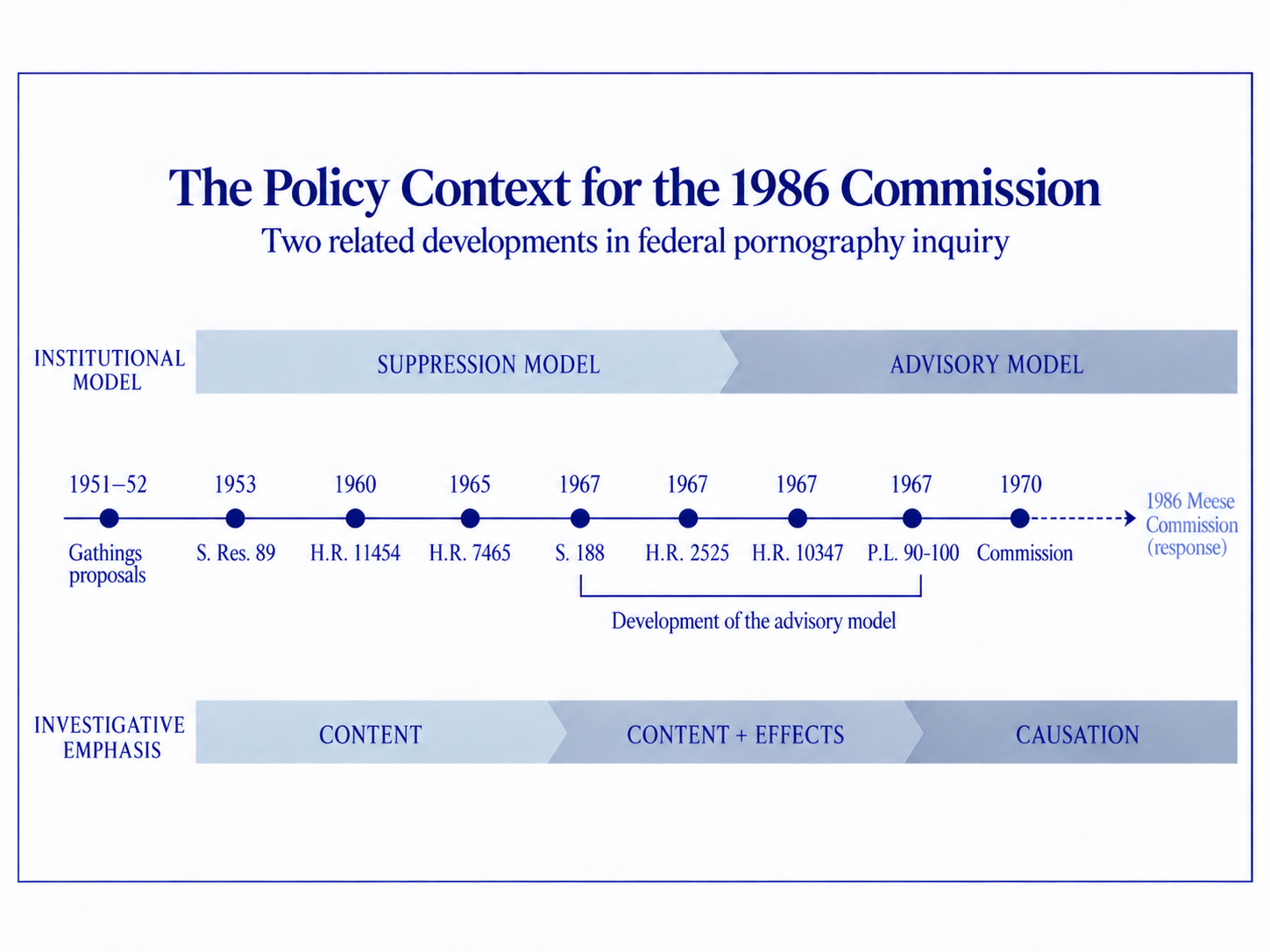
Critics tried to dismiss the 1986 Commission as little more than “a small sop to Reagan’s New Right constituency,”42 a less-than-serious exercise meant only “to appease conservative and fundamentalist supporters.”43 That accusation may have had political utility, but it seriously mischaracterized both what the 1986 Commission did and how it fit into, and improved upon, existing efforts to address the pornography problem. Pre-1986 efforts generally followed two different models. The suppression model presumed that pornography is a problem and assessed that problem to inform recommendations for restricting it. The advisory model sought to determine whether pornography is a problem at all and, therefore, whether to recommend any restrictions.
The Suppression Model. Most pre-1986 proposals followed the suppression model. Legislation or resolutions often included negative language that lacked definition but identified pornography as a problem. Some proposals acknowledged the need to learn more about the pornography industry, as well as some aspects of pornography’s impact on individuals and society, for the purpose of justifying and formulating suppression strategies.
Rep. Ezekiel Gathings (D-AR) was the driving force behind efforts during the 1950s to examine the content of radio and television shows as well as printed material. His proposals called for suppression based exclusively on content. He introduced resolutions directing existing House committees, or creating new ones, to determine “the extent to which the radio and television programs currently available to the people of the United States contain immoral or otherwise offensive matter, or place improper emphasis upon crime, violence, and corruption” and to make recommendations “to eliminate offensive and undesirable radio and television programs.”44 Another Gathings resolution created a Select Committee on Current Pornographic Materials to conduct a “full and complete investigation and study” to determine “the extent to which current literature – books, magazine, and comic books – containing immoral, obscene, or otherwise offensive matter…are being made available to the people of the United States.”45
These resolutions, which preceded the Supreme Court’s decision in Roth, used terms such as immoral, offensive, undesirable, and obscene without defining them. The select committee’s report acknowledged the “difficulty of establishing a precise interpretation of the word ‘obscene’ and its synonyms and near-synonyms” as one of the “greatest impediments to the prompt and effective enforcement of existing laws intended to control pornographic material.”46
In June 1953, the Senate passed S.Res. 89 authorizing the Judiciary Committee to conduct “a full and complete study of juvenile delinquency in the United States.”47 A Special Subcommittee on Juvenile Delinquency, chaired by Senator Estes Kefauver (R-TN), held hearings that focused specifically on obscene and pornographic materials48 and made two important contributions. First, while Gathings’ resolutions focused solely on undesirable content, it added the effects of obscene and pornographic literature on juveniles as an additional basis for suppression.49 Second, it described the need to better inform the public about the pornography problem. The subcommittee found that “pornography was most often thought of as having only adult appeal and that it was considered mostly a nuisance.”50 The subcommittee’s recommendations reflected both its general view that pornography could negatively affect young people and its emphasis on educating the public about the problem. The report called on religious, civic, and service groups to provide “aggressive leadership” to shape public opinion and inspire the public to fight pornography.51
On March 29, 1960, Rep. James Oliver (D-ME) introduced H.R.11454 to create a Commission on Noxious Printed and Pictured Material.52 It included elements of both the Gathings resolutions and the Kefauver special subcommittee approach. It referred to “noxious printed and pictured material dealing with acts or suggestive acts of sexuality and sexual deviations and perversions.”53 At the same time, it went a step beyond the 1956 select subcommittee report regarding consideration of effects. This refinement had three elements: a “scientific” evaluation of the “causal” relationship between the “traffic” in pornography and certain behavior.54
In June 1960, Senator Karl Mundt (R-SD) introduced S.373655 to create a Commission on Noxious and Obscene Matters and Materials, which the Senate unanimously passed four days later.56 Changing the name from “Noxious Printed and Pictured Material” to “Noxious and Obscene Matters and Materials” signaled, at the same time, a narrower focus on the more specific category of obscenity and a broader focus on different kinds of media, potentially including film, radio, or television.
Rep. Dominick Daniels (D-NJ) introduced H.R.7465 to create a Commission on Noxious and Obscene Matter and Materials, which he described as a “Presidential commission to find ways to combat smut.”57 The bill was referred to the House Committee on Education and Labor, and a subcommittee, which Daniels chaired, held an extensive hearing in September 1965. In addition to the familiar references to “smut,”58 “rotten wares,”59 and “filth,”60 bill supporters emphasized the need to collect data, study distribution networks, evaluate effects on minors, and identify policy options that are consistent with the First Amendment.61
The Advisory Model: The 1970 Commission. The suppression model presumes that pornography is a problem and should be restricted. Judgments about content, concepts of harm and evidence, and discussion of pornography’s impact generally serve that purpose. The advisory model turns this on its head, with investigation and assessment designed not to inform efforts to suppress pornography, but to determine whether pornography is a problem at all and, therefore, whether it should be restricted. Leaving that foundational question open makes the advisory model an attractive vehicle for interest groups opposed to any effort to restrict pornography to engineer a negative answer. The legislation that created the 1970 Commission on Obscenity and Pornography, as well as the commission’s operation, show how this works.
Senator Mundt introduced a bill, S.188, in January 1967 to create a suppression commission with a familiar name and mandate. Declaring that “traffic in obscene matters and materials is a matter of grave national concern,”62 the legislation would create a Commission on Noxious and Obscene Matters and Materials to protect the public from “the morally corrosive effects of such matters and materials.”63 Its purpose was “to bring about a coordinated effort at the various governmental levels, and by public and private groups, to combat by all constitutional means this pernicious traffic.”64
On May 10, 1967, the Senate Government Operations Committee favorably reported S.188 substantially as Mundt introduced it, and the Senate passed it by a voice vote the next day.65 Mundt’s proposal was consistent with public opinion during this period. A June 1969 TIME-Louis Harris poll, for example, found that 76 percent “want pornography outlawed.”66 A 1969 Gallup poll showed that 85 percent favored stricter obscenity laws.67
Two groups, the American Civil Liberties Union (ACLU) and American Library Association (ALA), opposed H.R.7465, Daniels’ original suppression commission bill, because it assumed a “causal relationship” between pornography and criminal or antisocial behavior without “clearly demonstrable proof.”68 Instead, they favored language in H.R.11454, Rep. Oliver’s 1960 proposal, because it would require a “scientific evaluation of the existence and extent of the causal relationship between the traffic in such material and criminal, delinquent, or other undesirable or antisocial behavior.”69
Bowing to their pressure, Daniels changed course, introducing H.R.2525 to create an advisory commission. Lawrence Speiser, director of the ACLU’s Washington office, testified in the April 1967 hearing on this bill, noting that it reflected specific changes the ACLU had advocated:
The ACLU, however, wanted more. First, Speiser said, a commission should be limited only to conducting “a scientific investigation of the causation question”73 and have no authority to recommend measures for more effectively limiting the traffic in pornography. Second, the scientific study should be “carried out by contracting with a foundation or with a major university having a particular expertise in this field, to conduct the actual investigation and evaluation.”74 Finally, Speiser pushed for restricting the proposed commission’s membership to those with “the detachment and specialized skill of the social scientist.”75 The ALA even demanded that any evidence of causation must be “acceptable by legal or medical standards.”76 The ALA also opposed H.R.2525 because it allowed suggestions from and consultations “with governmental organizations and private groups.”77
Daniels had already made the foundational concession of changing the very nature and direction of the commission he proposed. After the April 1967 hearing, he went further by introducing a new advisory commission bill, H.R.10347, that incorporated even more ACLU/ALA recommendations. The House took up S.188 as passed by the Senate, amended it with H.R.10347’s language, and passed it; the Senate passed it without a recorded vote; and President Lyndon Johnson signed the newly configured S.188 into law on October 3, 1967, as Public Law 90-100.78
The ACLU and ALA helped turn S.188 into something intended to stop all suppression commission efforts for good. The 1970 Commission then did exactly what it was designed to do, making conceptual choices that virtually guaranteed conclusions the ACLU and ALA favored.
Conclusions. These conceptual choices were made to facilitate the conclusion that pornography does not affect behavior. True to its design, the 1970 Commission found “no evidence to date that exposure to explicit sexual materials plays a significant role in the causation of delinquent or criminal behavior among youth or adults.”85 This conclusion incorporated the Commission’s concepts of content (all “explicit sexual materials”), harm (“delinquent or criminal behavior”), and evidence (“significant role in the causation”). Not surprisingly, the ACLU and ALA echoed the conclusions they helped engineer: “scientific studies provide no evidence that obscene books or motions pictures incite adults to criminal conduct, sexual deviancy or emotional disturbances.”86
Recommendations. Consistent with these conclusions, the 1970 Commission recommended that “federal, state and local legislation prohibiting the sale, exhibition or distribution of sexual materials to consenting adults should be repealed.”87 It did not, however, recommend repealing restrictions on access to pornography by minors.88
Reaction. The 1970 Commission’s conclusions and recommendations received wide criticism.
Conceptual Choices. The 1970 Commission’s conceptual choices regarding content, harm, and evidence closely paralleled the ACLU/ALA recommendations, designed to effectively make possible only one conclusion: that pornography is not harmful and, therefore, that laws restricting it from adults should be repealed. The 1986 Commission’s conceptual choices were more holistic, informed by the reality of pornography at the time as well as by scientific evidence and experience.
Conclusions. The 1970 Commission’s narrow concepts of content, harm, and evidence were divorced from how the real world works. Setting a standard that there must be scientific evidence that generalized pornography, by itself, causes criminal or antisocial behavior produced the outcome that commission desired. The 1986 Commission’s concepts of content, harm, and evidence, and its acknowledgement of multiple rather than singular causation, were much more consonant with the realities of existing pornography, its content, and how it actually affects individuals and society. The Commission’s report discussed conclusions related to each of the four content categories it utilized, noting both the strength or weakness of the evidence and, where appropriate, differing views of commission members. This holistic approach not only took into account the actual content of pornography as it existed at the time, but it allowed for a more nuanced discussion of the evidence and a more refined presentation of its conclusions.
Child Pornography. Federal law defines child pornography as “any visual depiction” of “a minor engaging in sexually explicit conduct”120 and provides robust prison sentences for those convicted of producing,121 distributing,122 or possessing123 it. While the 1970 Commission said nothing about child pornography, the 1986 Commission devoted an entire chapter to this “special horror,”124 explaining how “the ‘industry’ of child pornography is largely distinct from any aspect of the industry of producing and making available sexually explicit materials involving only adults.”125 As a result, “tools designed to deal with the latter are largely ineffective in dealing with the former.”126
Recommendations. The 1986 Commission report offered recommendations for changes to both federal127 and state law,128 the U.S. Department of Justice129 and federal law enforcement agencies,130 state and local prosecutors131 and law enforcement agencies,132 and the judiciary.133 It also provided separate recommendations related to child pornography.
The 1970 Commission’s conceptual choices, and its intended design, suggested that government can act only with respect to material that lacks any First Amendment protection, and then only by outright prohibition. This may have fit the ACLU/ALA agenda, but it is far too narrow to address the pornography problem. Another benefit of the 1986 Commission’s more holistic perspective regarding content, harm, and evidence is that it makes possible recommendations responsive to various aspects of the pornography problem. To that end, in addition to recommendations for the justice system and law enforcement agencies and legislatures, the 1986 Commission’s report included a section on “the role of private action.”134
At the urging of the ACLU and ALA, Congress removed from the legislation that created the 1970 Commission any mention of public education or engagement. The 1986 Commission rejected that narrow approach. “We are a government commission, and thus most of what we have to say is addressed to government. Yet it is simply mistaken to assume that citizen concerns need be exclusively or even largely channeled into government action.”135 This section of the report discussed the right of citizens to protest or condemn pornography. The First Amendment, after all, protects their right to speak out against pornography as it does much of that pornography itself.
“To the extent that citizens have concerns about the kinds of sexually explicit material that are available in contemporary America,” the report explained, “they should not only recognize that the First Amendment protects and encourages their right to express these concerns loudly and often, but should as well appreciate the fact that in many aspects of our lives to keep quiet is to approve.”136 The report also emphasized that citizens have the freedom not only to direct their voices against “materials that [they] find harmful, immoral, or objectionable” but also “if citizens are dissatisfied with the work of their law enforcement officials, their prosecutors, their administrators and executives, their legislators and their judges.”137 The report discussed different methods of public protest including participation in organizations that advance their point of view, pickets or marches, and boycotts.138
Finally, in this citizen-focused category, the Commission also noted that, “with respect to values and awareness as well as to facts, education is the real solution to the problem of pornography.”139 Recall that the Senate special subcommittee had suggested in 1953 that the American people needed to better understand the pornography problem and to change its view that pornography is “mostly a nuisance” that has only adult appeal.140 The subcommittee recommended that religious, civic, and service groups help to shape public opinion and engage the public to fight pornography.141 As introduced in 1967, S.188’s stated purpose was to “bring about a coordinated effort at the various governmental levels, and by public and private groups, to combat by all constitutional means this pernicious traffic.”142
Implementation. A number of the 1986 Commission’s recommendations were implemented after its final report was released. For example:
At his announcement of the 1986 Commission, President Reagan emphasized that much had changed in the 16 years since the 1970 Commission did its work.151 The transformation during that period from print to video, for example, changed how pornography is consumed. The digital revolution since then is much more profound, radically changing production, distribution, accessibility, monetization, and even the nature of pornography itself. Production is far cheaper, faster, and can be done anywhere without sacrificing visual quality. Not long ago, pornography production and distribution were controlled by a limited number of companies; today, they are completely decentralized.
Digital technology also enables entirely new forms of pornography such as live streaming, webcam performances, subscription-based direct distribution, interactive content, AI-generated images and video, and even the “sexting” phenomenon. Moving from print to video privatized pornography and brought it into the home; moving from video to digital democratized its production, universalized its distribution, and made the home a production studio. Wholesale changes like these would alone be enough to justify a “second look” and it does not take a social scientist to know that these same changes will not only magnify pornography’s harmful effects, but even introduce new ones. Anyone can easily, anonymously, and without cost access virtually any pornographic content he or she seeks and consume that content entirely in private.
Attorney General French’s regulatory description of the 1986 Commission said it would focus on “the impact of new technology, and pornography that relates to children.”152 These can be the two broad themes for organizing a new commission’s agenda. Following the 1986 Commission’s example, a new commission should be based on the suppression model, created and managed within the executive branch, and should build on the Commission’s important contributions. These include subdividing pornography into content-based categories, considering multiple rather than singular causation, and utilizing holistic concepts regarding content, harm, and evidence drawn from the real world of what the commission is studying. The 1986 Commission also offered suggestions about topics that deserved more attention from researchers.
“The research that has led to further subdivision of the large cate9ory of sexually explicit materials has perhaps been the most important development in recent years, and we strongly encourage research that will deal more precisely with different varieties of materials. We also believe that many other specific questions are in need of further research. There needs to be more research, for example, about the effect of porn09raphy on the marriage relationship, about the nature of appetites for pornographic material and how those appetites are developed, about the effect of depiction of particular sexual practices on the sexual preferences of those who view them, and about the effects of exposure to pornographic material on children. This list could be much longer.153
Child Pornography. The U.S. Sentencing Commission first outlined ways that technology can be used to promote the distribution of child pornography three decades ago.154 Today, more than two-thirds of the global population is connected to the Internet and sexually explicit websites number in the millions. The ease and anonymity of obtaining and distributing all forms of pornography have vastly expanded the trafficking in images of child sexual abuse, fueling the demand for production of those images and magnifying the unique harm caused by these non-contact crimes.155 Researchers found more than a decade ago that “[t]he child pornography market is one of the fastest growing businesses on the Internet.”156
A new commission can make significant contributions to more fully understanding and tackling the child pornography crisis. As noted above, the 1986 Commission began addressing child pornography at a time when it took the form of physical photographs of actual children engaged in sexual activity. “The distinguishing characteristic of child pornography,” the Commission explained, “is that actual children are photographed while engaged in some form of sexual activity.”157 This makes most obvious the fact that “child pornography is child abuse.”158 Since then, technology has made possible “virtual” child pornography created without involving real children but that appears nearly indistinguishable from the real thing. Technology thus facilitates child pornography production (whether real or virtual), distribution, and possession far beyond what was happening in 1986. A new commission can address the way the child pornography crisis has developed into what it is today.
In New York v. Ferber,159 the Supreme Court held that child pornography is not protected by the First Amendment because the state has a “compelling” interest in protecting the well-being of children.160 The “prevention of sexual exploitation and abuse of children constitutes a government objective of surpassing importance.”161 In Ashcroft v. Free Speech Coalition,162 the Supreme Court applied Ferber, holding that provisions of the Child Pornography Prevention Act of 1996 banning virtual child pornography violated the First Amendment because real children were not being directly abused. A new commission can help the public and the courts understand that this view is too narrow and that virtual child pornography makes its own contribution to child sexual exploitation.
A new commission can also help establish how child pornography distribution and possession, separate from production, are integral parts of the broader child sexual exploitation enterprise. The U.S. Sentencing Commission explains that “[n]on-production child pornography offenses normalize and validate the sexual exploitation of children, which contributes to the sexual abuse of new victims.”163 One sentencing judge put it this way: “[E]very time one of these web sites is opened and every time one of these images is viewed, additional harm is visited upon the victim” that is “separate from the harm of production.”164
Child pornography distribution and possession not only fuel the demand for the production of child pornography, but inflict on victims harm that the U.S. Sentencing Commission has described as “recurrent victimization through existence of images.”165 The knowledge that images of a victim’s abuse are forever circulating, and that most individuals who obtain and traffic in those images will never be identified or prosecuted, can devastate a victim’s entire life. Prosecution of a child pornography producer brings his specific actions to an end. Ongoing trafficking in the result of that production, however, will never bring such closure. As a result, child pornography distribution and possession help fuel the overall child sexual exploitation crisis and, at the same time, cause their own unique kind of harm.
Congress enacted the PROTECT Our Children Act166 in 2008, requiring the Attorney General to “create and implement a National Strategy for Child Exploitation Prevention and Interdiction”167 and specifying subjects that the report must address, including “[a]n analysis of future trends and challenges, including new technologies, that will impact the efforts to combat child exploitation.”168 The act required the Attorney General to submit the initial strategy to Congress no later than October 13, 2009, and an updated strategy every two years thereafter. Attorneys General of both parties have failed to do what Congress required. In a 2022 report, the Government Accountability Office documented the Justice Department’s poor performance, specifically noting that “the strategy is not up-to-date on key technology advances that are making it more difficult to catch perpetrators.”169 A new commission can address what the Justice Department has failed to do.
The Attorney General’s Commission on Pornography was part of a tradition of federal efforts to address pornography through investigative committees or commissions. It rejected the 1970 Commission’s strategy of choosing concepts, definitions, and approaches designed to produce a pre-determined outcome. Instead, the 1986 Commission improved upon earlier attempts to address pornography as a problem through a more balanced and holistic approach. Its report includes a nuanced application of concepts regarding content, harm, and evidence and a candid acknowledgement of differing levels of support for its conclusions. And it identified issues that would need further research and attention. The 1986 Commission, therefore, provides a good example for a new commission that should address pressing issues presented by pornography in the digital age.