TOPLINE: U.S. goods trade with Canada has fallen $50 billion since the March 2025 tariffs, and U.S. manufacturing saw no boost. Simultaneously, Mexico overtook Canada as the leading U.S. export market. This memo compares the year before tariffs (March 2024 to February 2025) with the latest year of data (July 2025 to June 2026).
BACKGROUND: During the spring of 2025, the Trump Administration imposed a series of tariffs on most Canadian goods under the International Emergency Economic Powers Act (IEEPA), starting at 25% and later raised to 35%. Goods that qualify as North American under the USMCA were exempt. The Supreme Court struck down the IEEPA tariffs, including the “Liberation Day” tariffs, on February 20, 2026.
U.S. Goods Trade with Canada Fell $50 Billion
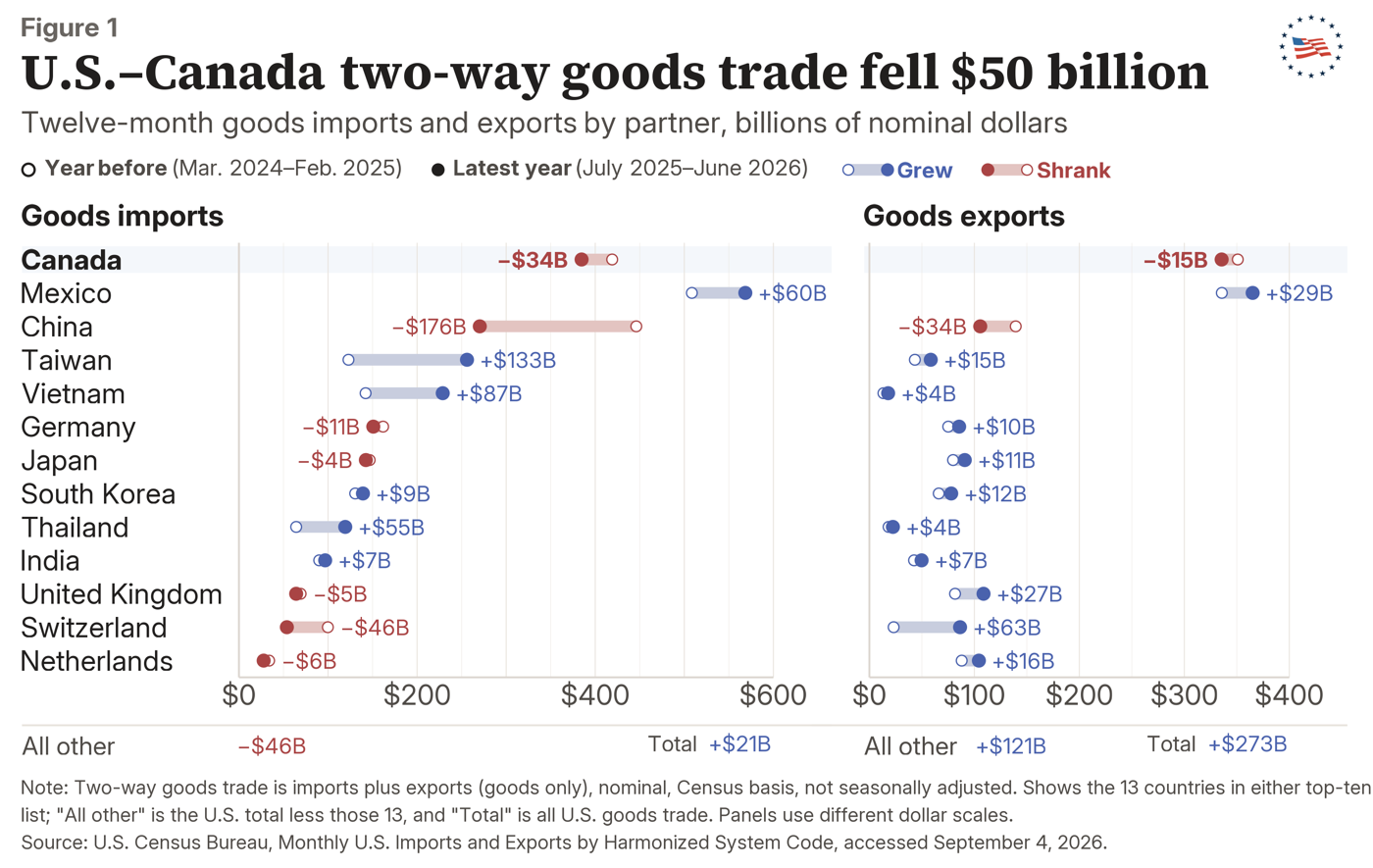
In 2025, two-way goods trade with Canada was $770 billion.
In 2026, it fell $50 billion (6.5%) to $720 billion (Figure 1).
Imports from Canada fell $34 billion and exports to Canada fell $15 billion, as U.S. goods trade with the rest of the world grew 7.4%.
Figure 1
Mexico Surpassed Canada as the Leading U.S. Export Market
In 2024, Canada was the top destination for U.S. exports.
However, in 2025, Mexico overtook Canada as the top export market.
Between the year before the tariffs and the latest 12 months, U.S. exports to Mexico rose from $336 billion to $365 billion.
U.S. exports to Canada fell from $351 billion to $336 billion (Figure 1).
U.S. Manufacturing Saw No Boost Under Liberation Day Tariffs
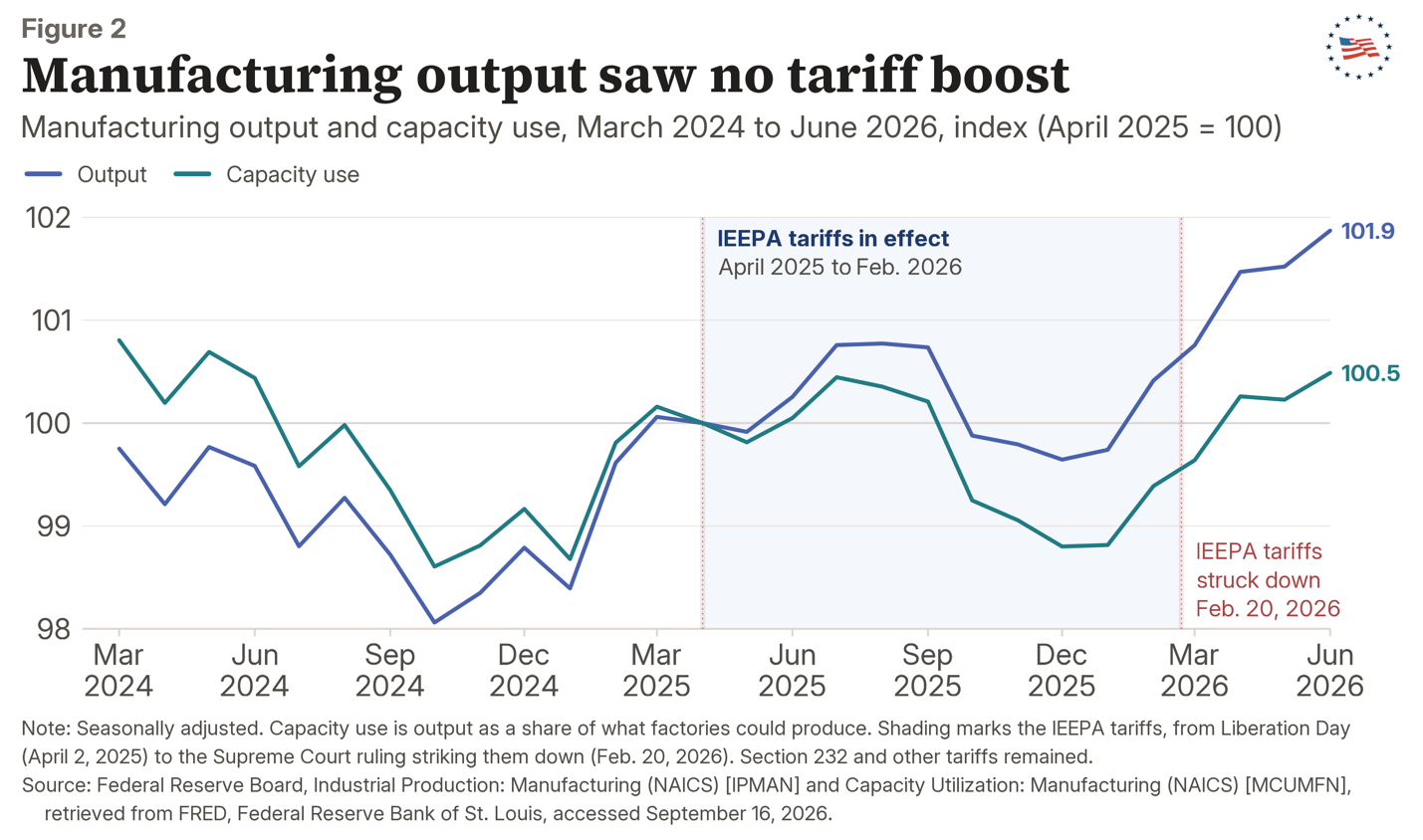
American manufacturing did not grow, even as trade with Canada decreased.
American factories were using about 75% of their capacity when the tariffs began in April 2025 and stayed roughly the same when the Court struck them down nearly a year later.
The rate even decreased at some points during this period.
Output was also fairly flat over the same period, rising only 0.4% (Figure 2).
Total U.S. imports did not decline despite lower imports from Canada and China. Imports shifted to other suppliers, led by Taiwan, Vietnam, and Mexico (Figure 1).
Figure 2
BOTTOMLINE: The tariffs on Canada failed to boost U.S. manufacturing. Although imports from Canada fell, the United States turned to imports from other trading partners rather than spurring domestic manufacturing.