The House surface transportation reauthorization (BUILD America 250 Act, H.R. 8870) effectively ends the Federal Railroad Administration’s (FRA) Automated Track Inspection waiver before FRA finishes evaluating a method that finds far more shape and alignment defects per mile, imposing an unfunded mandate on rail of up to $204 million over ten years.
TOPLINE: The House surface transportation reauthorization (BUILD America 250 Act, H.R. 8870) effectively ends the Federal Railroad Administration’s (FRA) Automated Track Inspection waiver before FRA finishes evaluating a method that finds far more shape and alignment defects per mile, imposing an unfunded mandate on rail of up to $204 million over ten years.
The Waiver Works
A Measured Waiver. FRA requires railroads to manually inspect their busiest rail lines twice a week, but through pilots since 2018 and a waiver since December 2025 it has allowed railroads to drop to a single weekly inspection on lines that run Automated Track Inspection (ATI) geometry cars at least once a month, advancing safety and innovation.
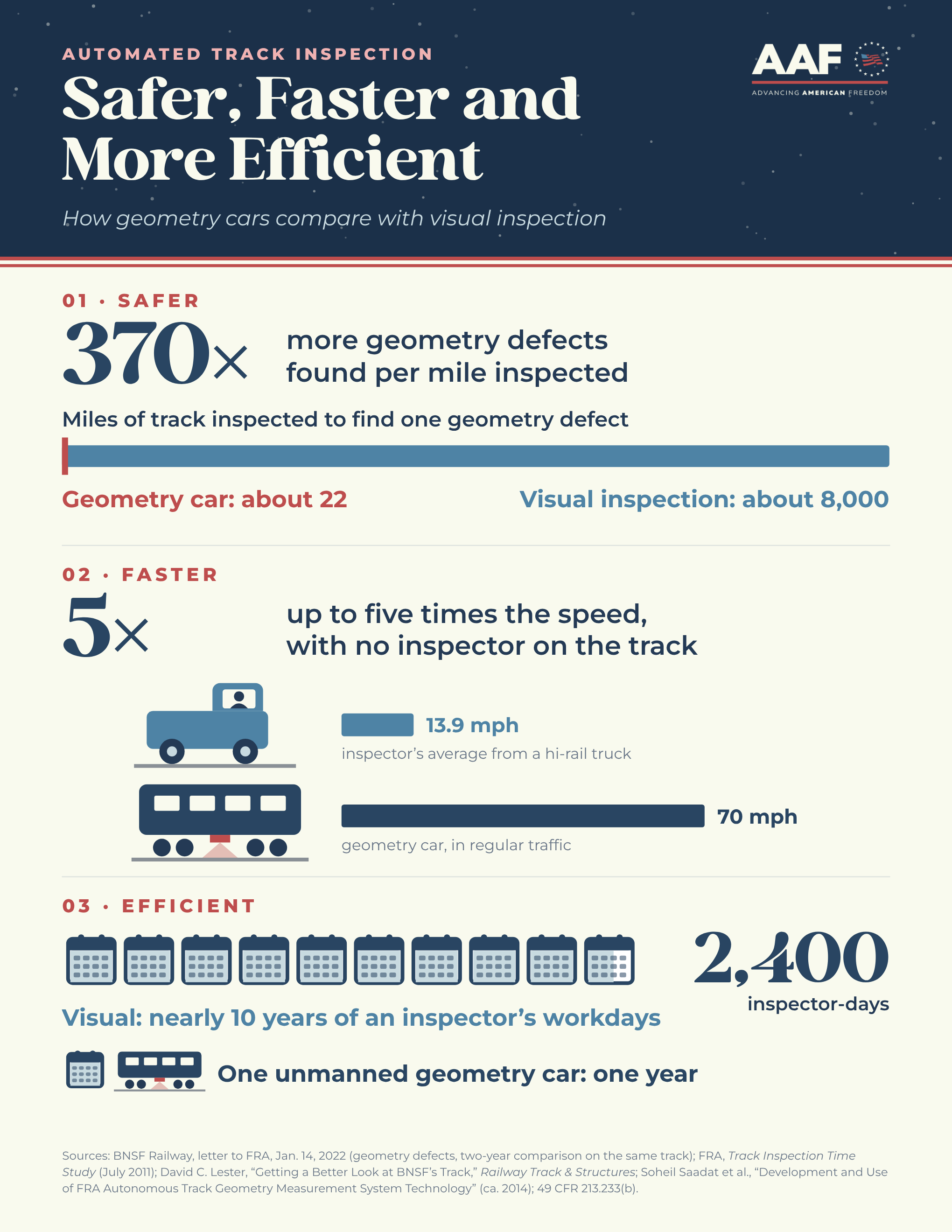
Better Technology. These rail cars, fitted with lasers and sensors that evaluate track under a moving train, are vastly superior in evaluating geometry defects: they can identify defects at 370 times the per-mile rate of a manual visual inspection; they cover the same stretch much faster (up to 70 mph compared to inspectors’ average 13.9 mph, slowing to 5 mph at crossings and switches); and their record is strong (Union Pacific reports zero track-caused derailments on waiver routes). The result is that more defects are found and fixed.
Built-In Safeguards. The waiver isn’t naive about the potential for a new technology to be less than an improvement, and it requires railroads over fixed defect limits to revert to the old standard.
Banning It Ignores Established Evidence
Effectively Bans Better Technology. No method, whether human or machine, will be perfect, so when Section 10432 ends the waiver and requires that any future alternative find “all defect conditions,” it blocks the next, better technology too.
Expands Outdated Methods. Section 10432 locks in twice-weekly visual inspection of all Class 3 and higher main line (above 25 mph for freight) and doubles it on lighter Class 3 freight main line (5 to 10 million gross tons a year) that current rules inspect weekly.
Mandates Geometry Inspections. Where the waiver incentivized industry to adopt new technologies, Section 10432 mandates them in a way that is likely to hold adoption at the statutory floor and minimum frequency rather than encouraging further expansion.
What It Costs
AAF estimates ending the waiver would cost $16 million over ten years at today’s use, $82 million if use grows to the current leader’s peak (Union Pacific’s 19.6 percent cut in visual inspections in June 2026), and $204 million at the waiver’s full cut.
CONCLUSION: Congress should strike Section 10432, along with the misguided Railway Safety Act provisions, from the surface transportation reauthorization package. Rail safety comes through free market innovation, not government mandates.