Policy Memo
Topline
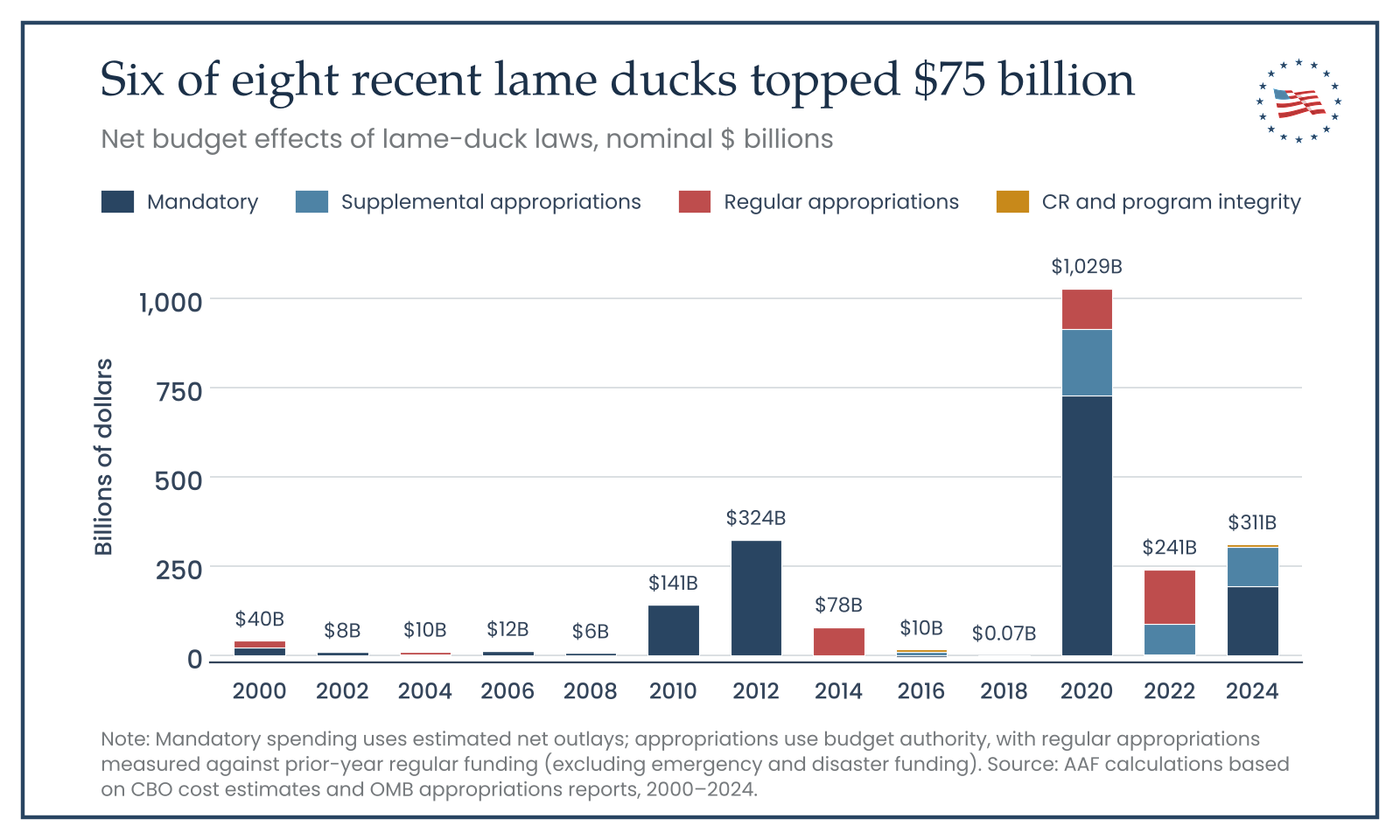
Congress has spent more than $75 billion in six of the past eight lame-duck sessions. In all, it has enacted more than $2.1 trillion of new spending in lame ducks dating back to 2010. As the 119th Congress now meets for the final session of 2026, lawmakers should buck the trend and avoid any net increase in nondefense spending.
Plymouth Institute for Free Enterprise
TOPLINE: Congress has spent more than $75 billion in six of the past eight lame-duck sessions. In all, it has enacted more than $2.1 trillion of new spending in lame ducks dating back to 2010. As the 119th Congress now meets for the final session of 2026, lawmakers should buck the trend and avoid any net increase in nondefense spending.
The continuing resolution (CR) now funding the government runs through December 11. None of the 12 regular FY2027 appropriations bills have yet passed both chambers of Congress, and the current Republican majority has until January 3 to fund the government before it relinquishes control of both the House and the Senate. During the lame duck, Congress is likely to pass another CR to keep the government funded at least a few months into the new year. Alternatively, it could pass a minibus that incorporates some of the regular appropriations bills, while using a CR to extend funding for the rest of the government. Passage of all 12 appropriations bills, whether as standalone bills or as an omnibus, is less likely.
The current lame duck may represent Republicans’ last chance to pass many of their legislative priorities for at least two years. The resulting sense of urgency could lead to an effective final sprint to enact conservative legislation. Or it could lead lawmakers to abandon fiscal restraint in the name of political expediency.
The majority could use budget reconciliation to get around the 60-vote Senate filibuster. Doing so could allow ambitious conservative legislation to pass with no Democratic support, though anything passed under reconciliation must conform to particular rules and would need near-unanimous support from Senate and (especially) House Republicans. Republican leadership may also work with Democrats to pass bipartisan legislation. The bipartisan permitting bill passed in the Senate on November 19 by a vote of 62-33, with 15 Democrats voting yes. The National Defense Authorization Act (NDAA) is another top lame-duck priority for many conservatives that could act as a vehicle for other legislative riders.
The U.S. has $40.7 trillion of debt and ran a $2 trillion deficit in FY2026. That fiscal imbalance has driven most of the high inflation over the past half decade as the Federal Reserve has expanded the money supply to accommodate Congress’s overspending (a textbook cause of high inflation). Elevated public borrowing also soaks up capital, driving up borrowing costs for both homebuyers and businesses.
While there is no good time for fiscal irresponsibility, large spending measures during lame-duck sessions are particularly problematic. Congress is the least accountable to voters during lame-duck sessions (those held after the November elections but before new members take office). After the 2026 lame duck, about 120 members of the 119th Congress will not return to either chamber, because of retirements and lost reelection bids. Voters generally will not have the opportunity to hold outgoing members accountable for any unpopular votes they take during the lame duck.
Reelected members also may steward taxpayer dollars less carefully during lame-duck sessions. Whereas votes for unpopular legislation in the lead-up to an election would be fresh in voters’ memories when they cast their ballots, nearly two whole years pass between lame-duck sessions and the next biennial election. Moreover, the coming allocation of committee assignments and the desire to return home for Christmas may weaken some members’ resolve to resist any fiscally irresponsible legislation that leadership supports.
The Constitution originally required that Congress assemble on the first Monday in December, unless Congress set a different date by law. December sessions were convenient for the many members who worked in agriculture, but as it turned out, that choice helped make lame-duck sessions the norm for roughly 140 years. After the Constitution was ratified in 1788, the Confederation Congress chose March 4, 1789, as the date the new government would begin to operate. March 4 became the start of each new congressional term. States originally determined the timing of their own elections, but typically they were held before the December session. In 1872, Congress established a uniform congressional election day, the Tuesday after the first Monday in November. That locked in the long lame-duck period. Voters elected a new Congress in November, the outgoing Congress assembled for its last session in December, and the new Congress’s term began in March.
Lame-duck sessions became controversial by the 1920s. Reformers argued that lame-duck sessions invited corruption and accused President Warren Harding of handing out appointments to lawmakers who supported his lame-duck legislative agenda. This opposition eventually led to the ratification of the 20th Amendment in 1933, which moved forward the start of congressional terms to January 3, significantly shortening the lame-duck period. Congress assembled for lame-duck sessions during World War II but only intermittently during much of the second half of the 20th century. Congress met for lame-duck sessions following only five of the 21 biennial elections between 1956 and 1996, and even then seldom passed major spending increases. In fact, Congress enacted a reduction in net outlays in the only lame-duck session (1994) in which both chambers met between 1984 and 1998. Since 2000, though, lame-duck sessions have become the norm again. Both chambers of Congress have assembled for lame-duck sessions after each of the 14 biennial elections since 2000 (including 2026).
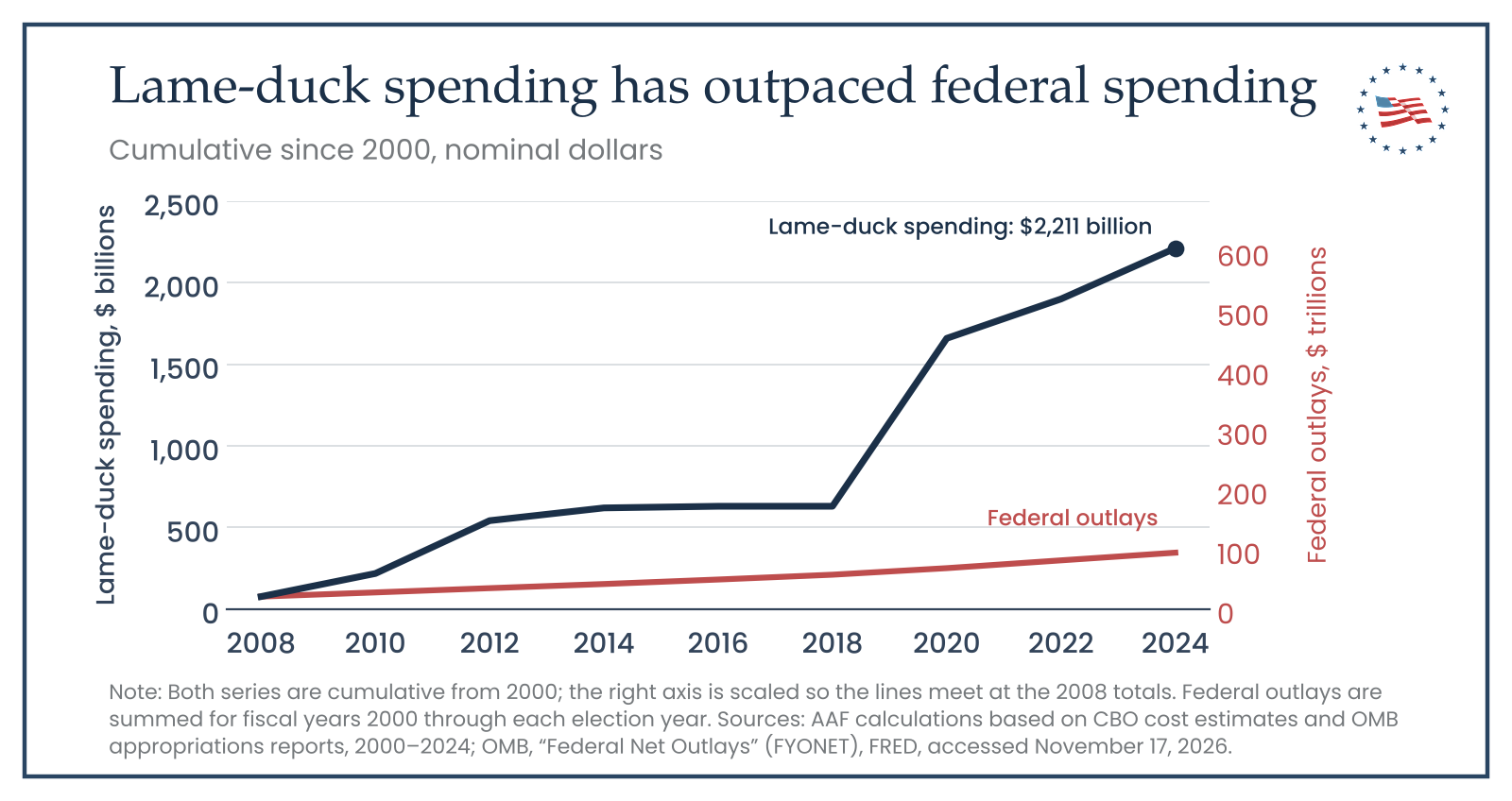
Cumulative lame-duck spending in the 2000s grew about 29-fold since 2008, compared with about 4.5-fold for cumulative federal outlays in the 2000s. If lame-duck spending had grown from its 2000–2008 average in line with total federal outlays, lame-duck spending from 2010 through 2024 would have totaled about $286 billion. Instead, Congress has enacted more than $2.1 trillion of lame-duck spending increases since 2010.
Lame-duck spending accelerated beginning in 2010. That year, Congress had waited until after the election to extend the expiring Bush tax cuts. The bipartisan deal lawmakers struck extended the tax cuts for two years but also kept federal funding for supplemental unemployment benefits in place for an extra 13 months. This allowed eligible individuals to continue collecting up to 99 weeks of benefits in some states, weakening incentives to find work in a period of high joblessness. The tax extension also included some provisions that qualify as spending, most notably expansions of child tax credits and earned income tax credits for individuals with no federal income tax liability (i.e., refundable tax credits). In total, lawmakers added more than $141 billion of net new outlays in the 2010 lame duck, nearly double the $77 billion in the previous five lame ducks combined.
In 2012, Congress again left the expiring Bush tax cuts unresolved until the lame-duck session. Just two days before the next Congress took office, lawmakers made most of the tax cuts permanent but let the top income tax rate rise. The deal included a total of $332 billion in estimated outlays over 10 years, mostly refundable tax credits.1
The largest fiscal expansion during a lame-duck session happened in December 2020 when Congress passed the second of three major COVID spending bills. That legislation included $1.02 trillion of new net spending, including $302 billion in Paycheck Protection Program (PPP) loans and other assistance to small businesses, $164 billion for stimulus checks, $119 billion for expanded unemployment benefits, and $82 billion for K-12 schools and colleges.
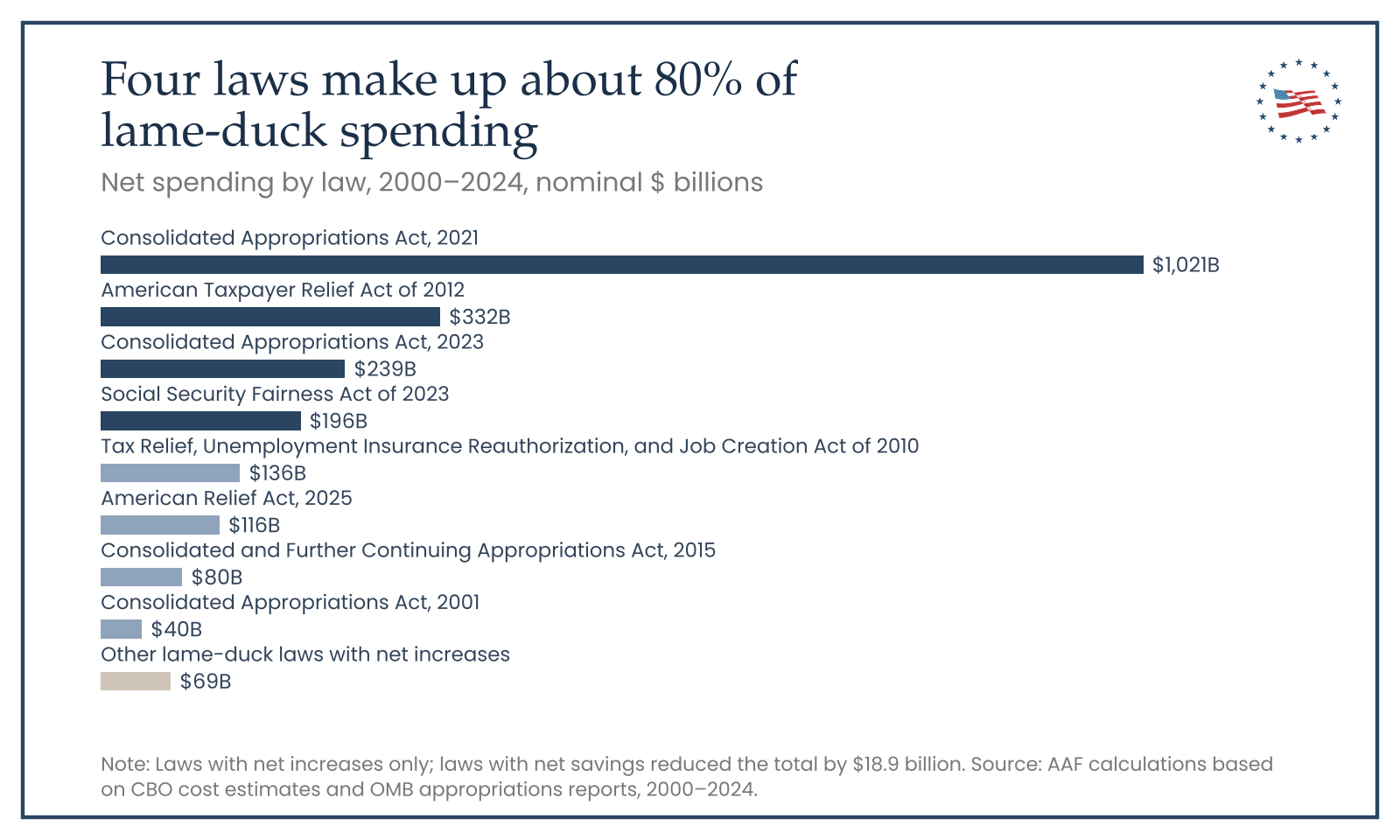
Congress entered the 2022 lame-duck session without having enacted any of the 12 regular appropriations bills, as in 2026. Congress finally passed an omnibus (the Consolidated Appropriations Act, 2023) that combined all 12 bills and added an estimated $152 billion above the prior-year regular appropriations, $85 billion in supplemental appropriations for Ukraine and disaster relief, and $2.3 billion related to program integrity. In total, Congress spent an estimated $241 billion in the 2022 lame duck above what it would have spent if it had continued prior-year appropriations.2
The largest 2024 lame-duck spending measure was the Social Security Fairness Act of 2023 (SSFA), which accounted for about $196 billion of the $311 billion of spending that session. The SSFA increased Social Security benefits mostly for certain state and local government workers who paid into Social Security for part of their careers and paid into a different public pension for another part of their careers.
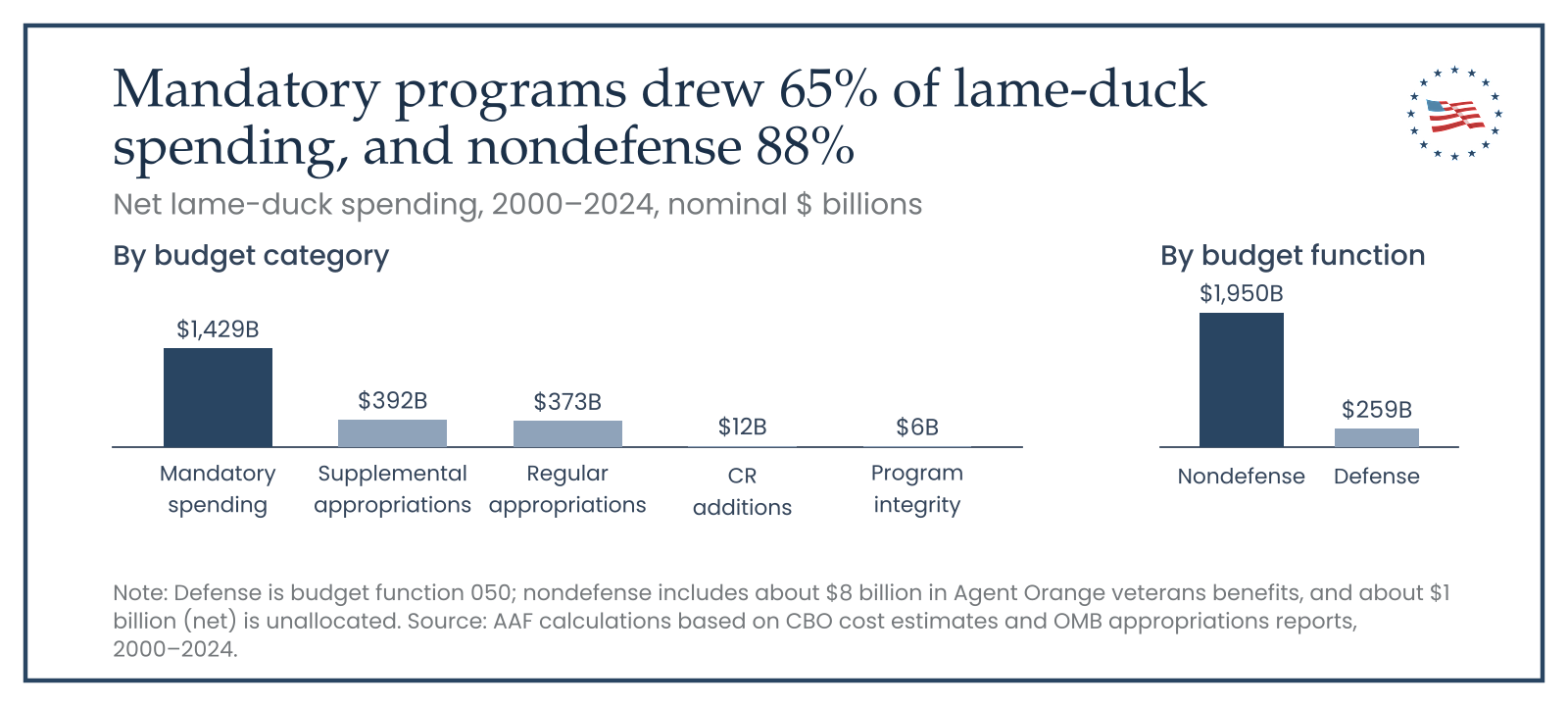
Mandatory spending accounted for about 65% of the recorded lame-duck spending between 2000 and 2024.3 About 88% of the spending was for nondefense purposes. Supplemental appropriations and increases in regular appropriations have accounted for about 18% and 17%, respectively, of new lame-duck spending.4 Net spending increases from CRs and program integrity account for less than 1% of the calculated lame-duck spending.
During the 2026 lame-duck session, Congress should:
CONCLUSION: Going forward, Congress shouldn’t wait until after the election of the next Congress to fund the government and advance other “must-pass” legislation. For the 2026 lame duck, Congress should pass a clean CR at current funding levels, advance a conservative permitting reform package, and reject any deal that would raise nondefense spending on net.