
Policy Memo
Topline
Danco, the brand name abortion pill Mifeprex manufacturer, does not print detailed production or manufacturing locations on its labels.
Mifepristone, known as the “abortion pill,” was first introduced to the United States by Abortion Rights Mobilization leader and Margaret Sanger biographer Lawrence Lader. Lader smuggled mifepristone into the United States with the explicit goal of bringing abortion “on demand” to mainstream American markets. The Population Council, a radical pro-abortion group, funded illegal abortion pill creation in an underground laboratory in New York City overseen by Lader.1
Funded by George Soros and David Packard, the Population Council was an integral partner for Danco Laboratories during the drug’s initial production. Danco Laboratories the pill on 100’s of women before controversially gaining FDA approval in 2000 during the waning days of the Clinton Administration.2 3 Danco’s mifepristone pill, called Mifeprex, remained the only commercially available abortion pill until 2019. tested the pill on 100’s of women before controversially gaining FDA approval in 2000 during the waning days of the Clinton Administration.4 5 Danco’s mifepristone pill, called Mifeprex, remained the only commercially available abortion pill until 2019.
The FDA does not require extensive labeling regarding manufacturing and production details on pharmaceutical products. It simply calls for, “the name and place of business of the manufacturer, packer, or distributor.”6 This means that, even if a product was produced in China, the company could solely use its American address as the “place of business” to cover up the manufacturing trail.
Each Mifeprex package simply states, “manufactured in Spain,” and displays Danco’s Manhattan P.O. box address.7 This lack of transparency was deemed necessary by Danco, which stated, “the potential for violence is still there.”8
Danco has done their best to hide all relevant information regarding where they produce and manufacture mifepristone. The Senate HELP Committee’s recent report revealed that Danco confirmed in a letter to Sen. Cassidy and other Republican Senators that its API manufacturer was an FDA-registered facility in Spain. After this process, APIs are sent to the United States, shipped back to Europe for packaging, and then distributed for sale back in the United States.9
Despite Danco’s continued secrecy, there are facts worth considering.
FDA-approved active pharmaceutical ingredients (API) producers have the option to choose whether their information can be viewed publicly in the FDA Drug Master Files (DMF).
According to active and inactive records, there is only one active mifepristone API manufacturer in Spain. Curia Spain, located in Valladolid, Spain, is part of a broader drug manufacturing group (Curia Global) based out of the United Kingdom. Its other locations include Italy, France, and the United States. According to its website, Curia produces mifepristone as an API that would fall under the synthetic steroid or small molecule category.10 This ingredient is listed as approved in DMFs from the European Union, Japan, and United States.
Afaquim, the Spanish Association of Fine Chemical Manufacturers, represents 30+ Spanish drug manufacturers – including Curia. On Curia’s associate page, they describe themselves as, “the only Spanish company dedicated to the research, manufacturing and marketing of steroidal Active Pharmaceutical Ingredients.”11
Mifepristone falls into the synthetic steroid category of APIs. Synthetic steroidal APIs fall under the greater umbrella of “steroidal” ingredients.
Since Curia is seemingly the only manufacturer of these APIs in Spain and Mifeprex’s label says, “manufactured in Spain,” this indicates that they could be producing Danco’s mifepristone APIs.
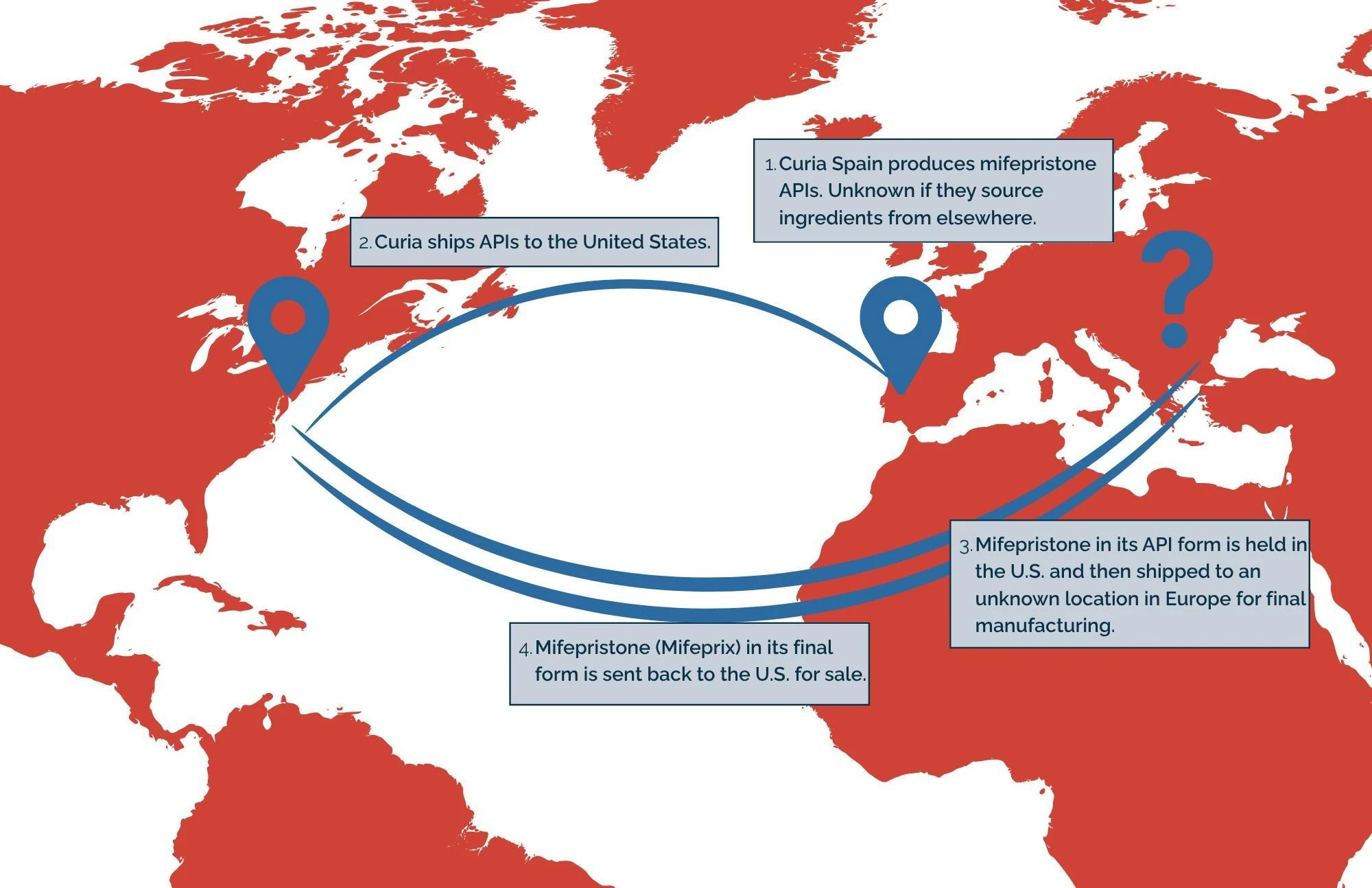
Evidence from the FDA’s Drug Master Files, Mifeprex’s labelling, and Spanish pharmaceutical companies suggests that Danco Laboratories is using Curia Spain to manufacture ingredients for its abortion pills that are eventually distributed for sale in the United States.
However, because the FDA allows for near-complete secrecy for pharmaceutical giants, we are unlikely to discover the complete truth anytime soon.