Under current law, Medicare’s Hospital Insurance Trust Fund is expected to become insolvent by 2033, which would jeopardize beneficiaries’ access to care. Reforms to prevent insolvency must address basic program imbalances and rising costs.
Authors: Gadai Bulgac, Policy Analyst; Elizabeth Lamb, Intern
Institute for Statistical Policy Analysis
TOPLINE: Under current law, Medicare’s Hospital Insurance Trust Fund is expected to become insolvent by 2033, which would jeopardize beneficiaries’ access to care. Reforms to prevent insolvency must address basic program imbalances and rising costs.
Medicare Part A
Medicare is a federal health insurance program that serves both Americans 65 and older and younger Americans with certain disabilities and illnesses.
Part A of the Medicare program, also called “Hospital Insurance” (HI), covers inpatient hospital care, skilled nursing facility, hospice, and certain home health care services. Part A equals about 37% of Medicare’s total costs.
Part A is financed mainly by Medicare payroll taxes. which equals 2.9% of covered earnings (with employers and employees each paying 1.45%). Workers with earnings above $200,000 for individuals or $250,000 for married couples pay an additional 0.9% tax, bringing their combined Medicare payroll tax rate to 3.8%.
In 2025, Part A cost $444.2 billion and collected $444.3 billion in taxes.1
Pay-As-You-Go Structure
The HI Trust Fund effectively operates on a “pay-as-you-go” basis, meaning that current workers’ payroll taxes finance most of current Medicare recipients’ benefits. Surplus revenue is loaned to the Treasury, and those Treasury securities become assets of the HI Trust Fund.
An Aging Population
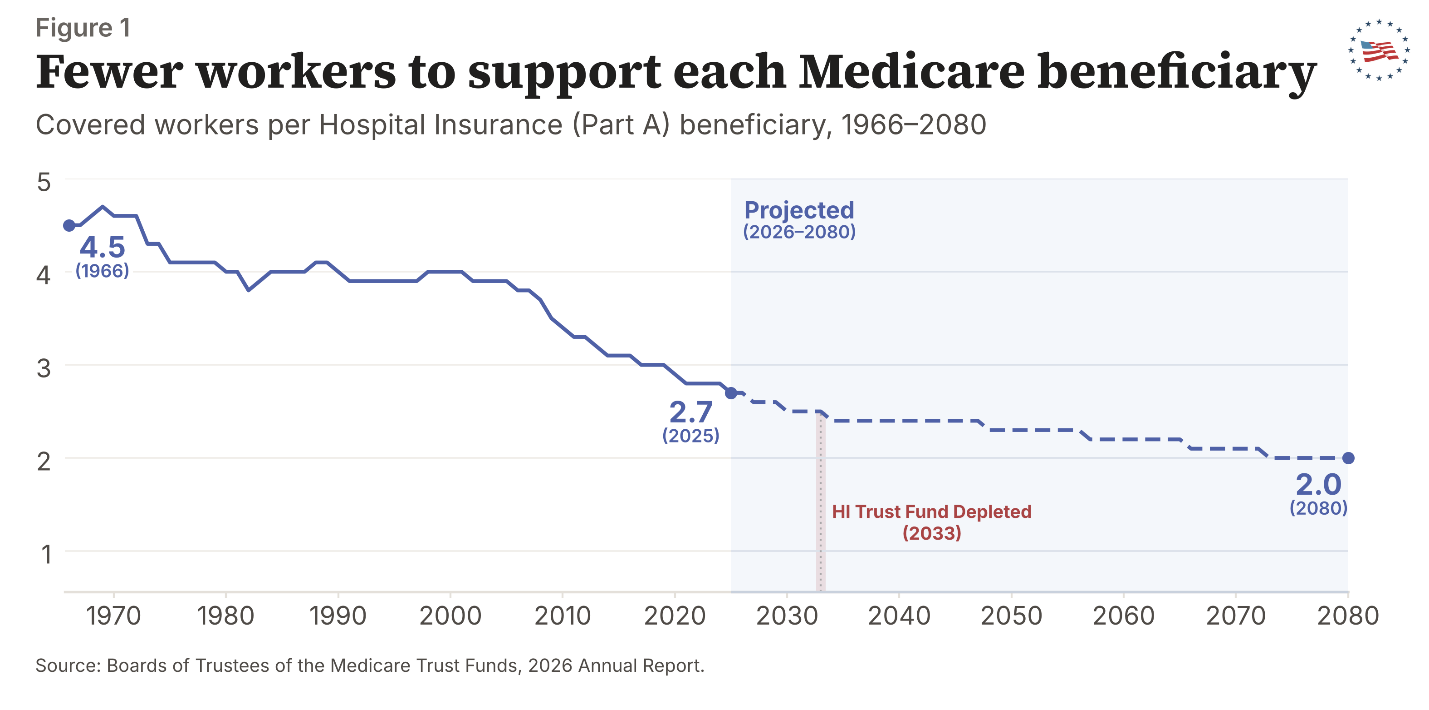
The number of beneficiaries is growing at a higher rate than the number of workers paying Medicare payroll taxes. This is because life expectancy has risen, and the U.S. total fertility rate has been around or below replacement level since the 1970s.
In 1966, there were 4.5 workers per Medicare beneficiary, compared to just 2.7 in 2025 (see Fig.1.). As that ratio is projected to continue declining, the HI Trust Fund will become depleted. This decline hurts the long-term sustainability of the program.
HI Trust Fund Insolvency
In 2027, Part A costs will exceed revenues, requiring the HI Trust Fund to draw down some of its assets to make up the difference. By 2033, the HI Trust Fund’s assets will be depleted.
Under current law, Part A payments cannot exceed trust fund reserves plus incoming revenues.
When the reserves are depleted in 2033, incoming revenue will only cover an estimated 89% of Part A’s costs.
Insolvency would require an 11% reduction in total payments to Part A health plans and providers, which could rapidly reduce beneficiaries’ access to hospital services.
Covering Medicare’s Part A shortfalls through tax hikes would require a 22% increase in the payroll tax in 2033, from 2.9% to 3.55% (the 3.8% rate would rise to 4.45%).
If Congress were to borrow to cover the gap, it would need to add $112 billion to the deficit in 2034, and larger amounts in subsequent years.
This would put upward pressure on inflation and interest rates.
Gradually align Medicare’s eligibility age with Social Security’s full retirement age of 67.
Index the Medicare eligibility age to life expectancy.
Reduce Medicare subsidies for wealthy beneficiaries.
Expand competition and consumer choice in healthcare.
Reduce improper payments, waste, fraud, and abuse.
CONCLUSION: Without major reforms to the program, Medicare’s HI Trust Fund will be depleted in 2033, threatening health care access for seniors. Congress should enact reforms to reduce costs and make the program sustainable.
Notes
About 9% of Part A revenues come from the taxation of higher-income individuals’ Social Security benefits. ↩