May marks the third consecutive month of overall job growth. March was revised up 29,000 jobs and April was revised up 64,000 jobs. This job growth directly coincides with the Supreme Court ruling President Trump’s IEEPA tariffs unconstitutional in late February.
Figure 1
Jobs Up
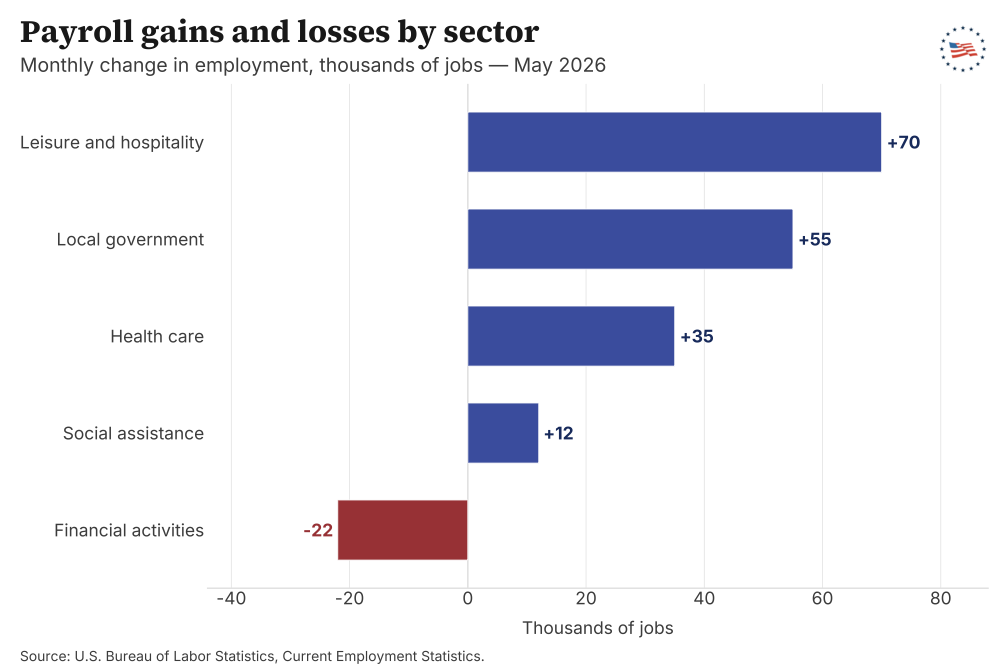
Leisure and hospitality +70,000 jobs.
Local government +55,000 jobs.
Private health care +35,200 jobs.
Jobs Down
Financial activities -22,000 jobs.
Government vs Private Sector Job Growth
Outside of government or highly government-subsidized sectors, job growth was an estimated 69,800.
Full-Time Down & Part-Time Up
Full-time jobs declined by 79,000 while part-time jobs increased by 266,000 in May.
What Else You Need to Know About May’s Job Numbers
Average hourly earnings rose by only 0.3 percent, below May’s 0.6 percent inflation rate.
Full-time employment declined by 79,000, a loss of nearly 1.2 million full-time jobs since April 2025.
The total number of people working part-time increased by 266,000 last month, while the number working part-time for economic reasons declined by 137,000.
Non-farm employment grew by only 56,000 from March 2025 to February 2026, while non-farm employment grew by 565,000 from February 2026 to May 2026.
Jobs by Sector: Monthly, May 2026
The largest job gains occurred in leisure and hospitality (+70,000), government (+52,000), and health and education (+40,000).
Primary job losses occurred in financial activities (-22,000).
The sectors which experienced the largest gains and losses are depicted in Figure 2.
Figure 2
Growth in Subsidized Sectors
Since 2023, almost all job growth has occurred in heavily subsidized sectors or government: e.g. private health care, social assistance, and (to a lesser extent) private education. These sectors are all captured in the BLS’ “health and education” supersector, which only comprises about one-fifth of total private employment.
Unsubsidized private employment has experienced minimal growth and even declined from early 2024 until February of this year. The trend reverses in March 2026 following SCOTUS striking down President Trump’s IEPPA tariffs. This phenomenon is depicted in Figure 3.
Figure 3
Unemployment Rates and Employment-to-Population
May’s unemployment rate remained unchanged at 4.3 percent.
The employment-to-population ratio—or employment rate—captures both labor force participation and unemployment by measuring the proportion of people ages 16 and older who are working.
The employment-to-population ratio increased slightly from last month’s post-COVID low to 59.2 percent. See Figure 4.
Figure 4
Bottom Line
May’s jobs report shows 3 straight months of growth after rocky results in the last few years. This positive trend is likely due to SCOTUS ruling against the Liberation Day tariffs.
However, there are still some worrying trends: fewer people are working full-time, real hourly wages declined, and the employment-to-population ratio is still concerningly low.