
Policy Memo
Topline
The U.S. physician shortfall could reach nearly 142,000 by 2035, even as at least 4,000 American medical school graduates a year fail to match into a residency. States can close part of that gap through provisional medical licensure.
Institute for Statistical Policy Analysis
The Edwin Meese III Institute for the Rule of Law
The United States is facing a severe and growing shortage of physicians, with Health Professional Shortage Areas (HPSAs) widespread across both rural and urban regions. Projections suggest the physician shortfall could range from 13,500 to nearly 142,000 physicians in the coming years, with current estimates likely understating the true level of demand in medically underserved communities. At the same time, thousands of qualified medical school graduates fail to match into residency programs each year, in large part because the number of available residency slots has not kept pace with the number of graduates.
This paper argues that expanding provisional medical licensure offers a practical state-level solution to help alleviate physician shortages. By allowing unmatched U.S. medical graduates and internationally trained physicians (ITPs) to practice under supervision, states can expand access to care without requiring federal reforms to the residency system. Evidence from states that have implemented these policies suggests that less restrictive licensure frameworks are associated with greater uptake and increased physician supply. Expanding provisional licensure would provide meaningful relief to underserved areas by utilizing medical professionals who are currently unable to practice due to regulatory constraints.
The United States of America is currently experiencing a serious shortage of physicians. Americans in many parts of the country, particularly those in rural areas, have difficulty receiving proper medical care due to a lack of access to trained medical practitioners. Many well-intentioned policy decisions have contributed to this growing problem by limiting the number of physicians who are able to become licensed. Despite numerous expansions of government spending in the healthcare sector, with federal, state, and local government now accounting for almost half of all health expenditures in the nation (Bulgac, 2025), the shortage has persisted and even grown.
There have been several policy proposals to help reduce the physician gap. One recommendation is to expand the scope of practice for pharmacists, physician assistants, former military medics and corpsmen, and licensed nurse practitioners in place of physicians for certain procedures, perhaps accompanied by reliance on AI for research and certain diagnostic evaluations (e.g., reading X-rays) (McMichael, 2025; Park, 2020). Another potential remedy would be to expand telemedicine, which would allow physicians to more easily see patients in medically underserved communities (Larkin et al., 2021). Finally, qualified American medical school graduates and experienced physicians from abroad can help close the gap between the supply and demand for physicians in the U.S. This paper expands on previous research on that last recommendation of expanding medical licensure done by Kevin Dayaratna, Ph.D., Paul J. Larkin, and John O’Shea, MD (Dayaratna & O’Shea, 2017; Dayaratna et al., 2019).
For years, the United States has had a shortage of physicians, meaning there are fewer physicians than necessary to meet the demand for medical care from the population, based on current and projected utilization. For example, the Association of American Medical Colleges (AAMC) has estimated a prior shortage of 37,000 physicians in the United States in 2021. Figure 1 provides projections by both the AAMC as well as the Health Resources and Services Administration (HRSA) going forward (GlobalData Plc., 2024, p. 64; Health Resources and Services Administration [HRSA], 2025d).
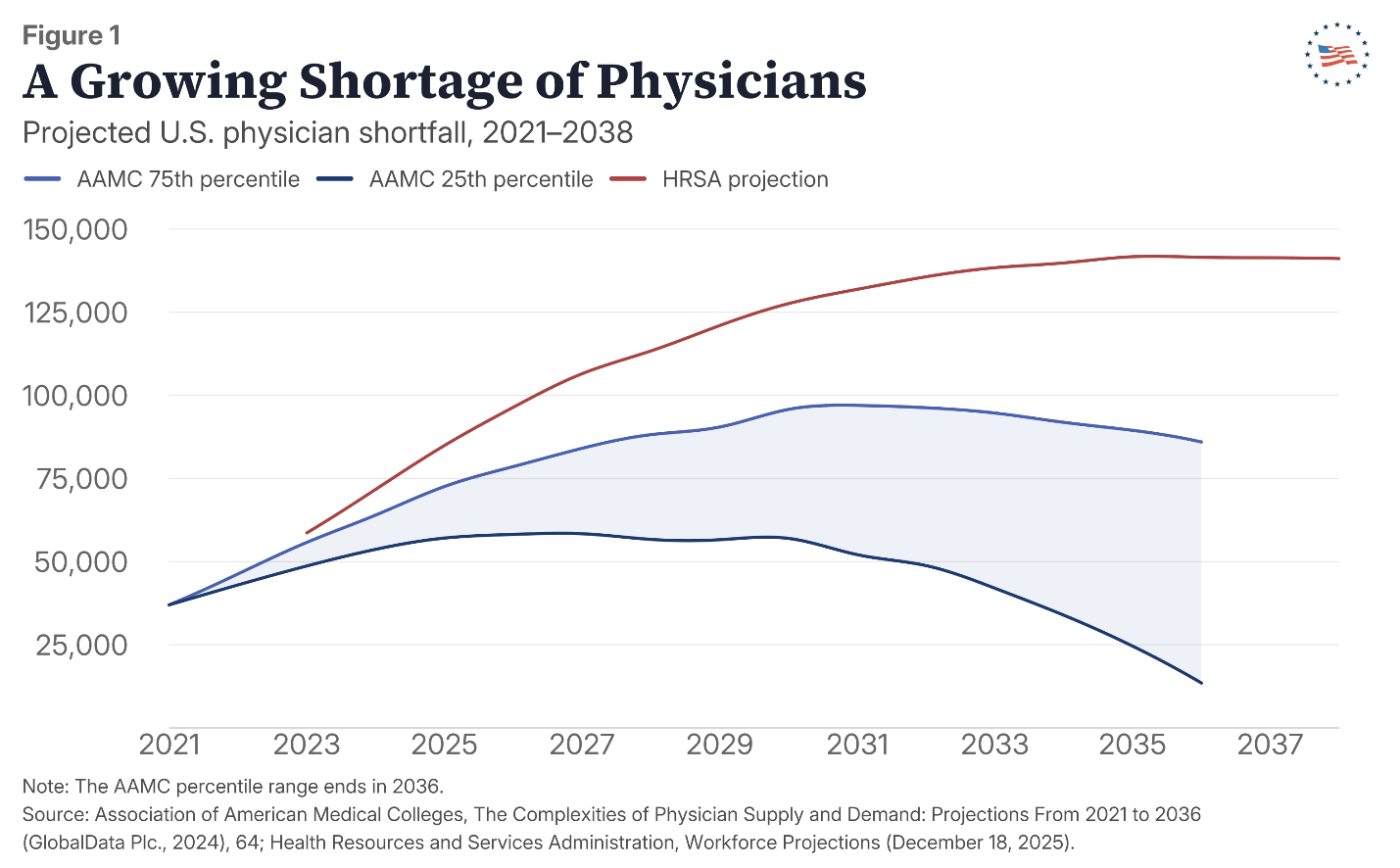
Figure 1 shows the HRSA projecting the shortage to peak in 2035 at 141,730 physicians and level off after that (HRSA, 2025d). The HRSA’s projections are likely an underestimate based on current utilization patterns that are lower in medically underserved areas; the AAMC uses similar assumptions for their estimates of physician shortfall (GlobalData Plc., 2024, p. 22; HRSA, 2025a). Unlike the AAMC's projections, the HRSA's do not assume that there will be expansions to federal funding for medical residency slots or increased substitution of physicians by registered nurses or physician assistants in the future (HRSA, 2025c).
The AAMC, on the other hand, still predicts shortages, albeit at lower levels than the HRSA. As Figure 1 illustrates, by 2030 the AAMC predicts the shortage will be between 57,000 and 95,800, and in 2036 it is predicted to decline, ranging from 13,500 to 86,000. For comparison, the AAMC estimates the total number of active physicians in the U.S. was slightly over one million in 2024 (Association of American Medical Colleges, 2024). The reason for the sizeable decline in the 25th percentile of the projected range of the AAMC model is that the model assumes that a growing number of “advanced practice” nurse practitioners and “physician associates” will expand existing physicians' working capacity and may increasingly substitute for physicians in certain functions (GlobalData Plc., 2024, pp. 4, 35-36).
Another assumption the AAMC’s 25th percentile scenario has is, based on the Consolidated Appropriations Act of 2021 (CAA2021), that the number of federally funded medical residency slots will grow at a one percent rate per year (GlobalData Plc., 2024, pp. 3, 25, 28). The CAA2021 was the first expansion of such residencies since a cap on the number of Medicare-funded residencies was established in the Balanced Budget Act of 1997, funding a total of one thousand additional medical residencies from fiscal years (FY) 2023 to 2027 (Congressional Research Service, 2025; H.R. 133, 2020, § 126). The Consolidated Appropriations Act of 2023 (CAA2023) added funding for a total of 200 residencies in behavioral health starting in FY 2026 (Congressional Research Service, 2025; H.R. 2617, 2022, 136 Stat. 5904). If federal funding for additional residencies does not grow as the AAMC expects, then the projected additional shortfall in 2036 would be an additional 41,000 full-time equivalent physicians (GlobalData Plc., 2024, pp. 3, 28). The effects of the medical residency system on physician supply will be discussed in the next section of the paper.
Regardless of the differences in estimates between the HRSA and the AAMC forecasts, there is no doubt that the nation faces a continued physician shortfall. This phenomenon is not surprising; as the population of the country ages, additional medical care will become necessary for them (GlobalData Plc., 2024, pp. 39, 43). Atop that, an increasing number of older physicians have begun to retire and will continue to do so for at least the coming decade, while there are not enough new physicians entering the workforce to replace them (Samraik, 2025; Young et al., 2025, p. 12).
Figure 2 offers a geographic representation of the severity of the provider shortage by mapping geographic primary care Health Professional Shortage Areas (HPSA) scores in each area (HRSA, 2023). The HPSA score measures both access to—and the quality of—healthcare in the area. HPSA scores range from 1 to 25, with a higher score indicating a more severe shortage and lack of access. In order to be assessed as an HPSA and given a score, an area must fall below a certain ratio of physicians to population: typically, less than one doctor for every 3,500 people, or less than one doctor per 3,000 people in unusually high-need areas (KFF, 2025). The areas marked in gray, typically in or around metropolitan areas, are not considered HPSAs because they do not fall below the HPSA provider-to-population threshold.
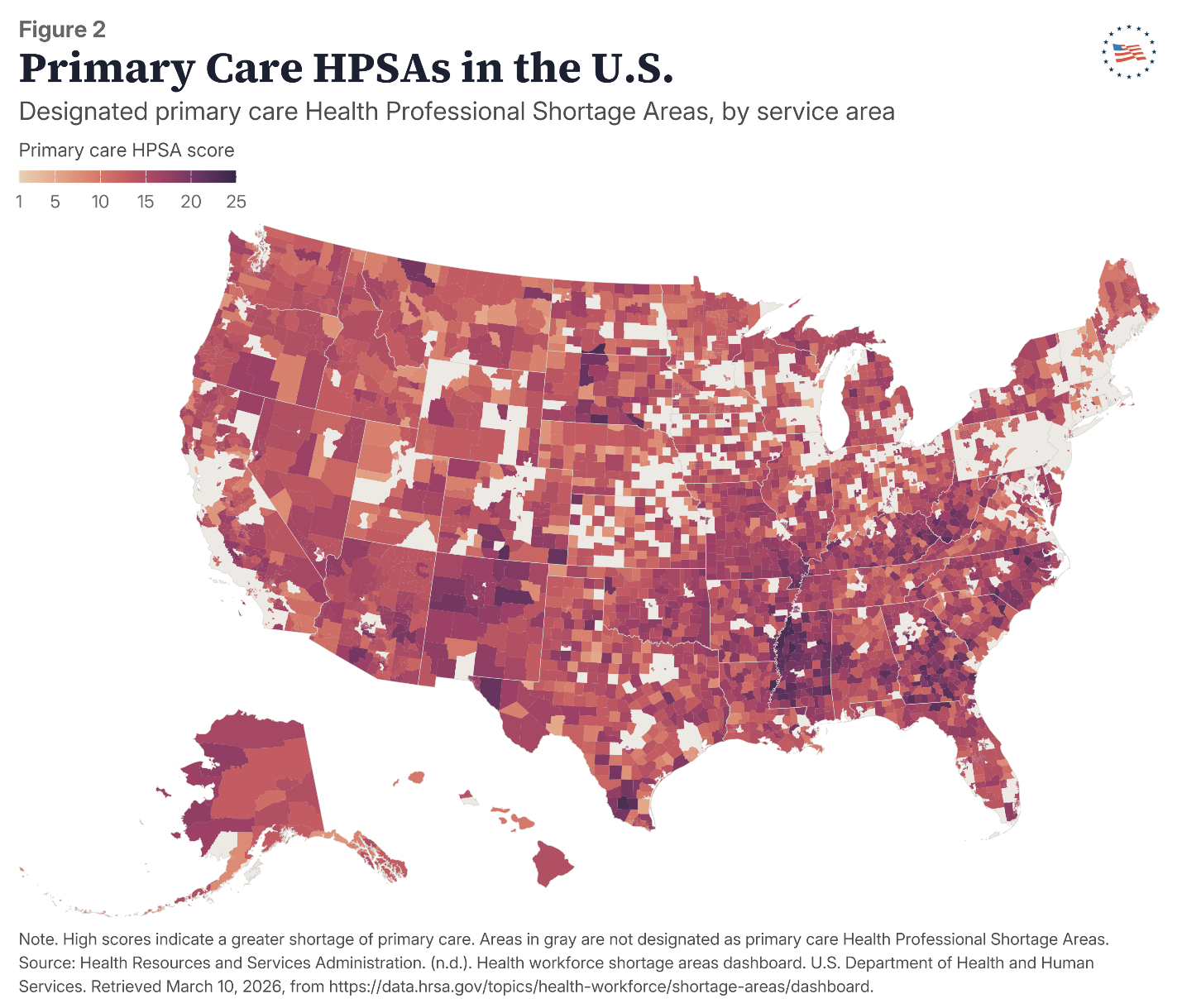
More than 92 million people live in a primary care HPSA (HRSA, 2026), and a disproportionate number of those people reside in rural areas (HRSA, 2025b; HRSA, 2026). HPSAs are widespread across the nation, but HPSAs with the highest scores are notably prevalent in the southeastern states like Georgia and Mississippi. HPSAs, however, are not exclusively confined to rural areas. In fact, almost 36 million people in “non-rural” areas live in an HPSA as of December 2025, including parts of the Brooklyn borough in New York City (HRSA, n.d.).
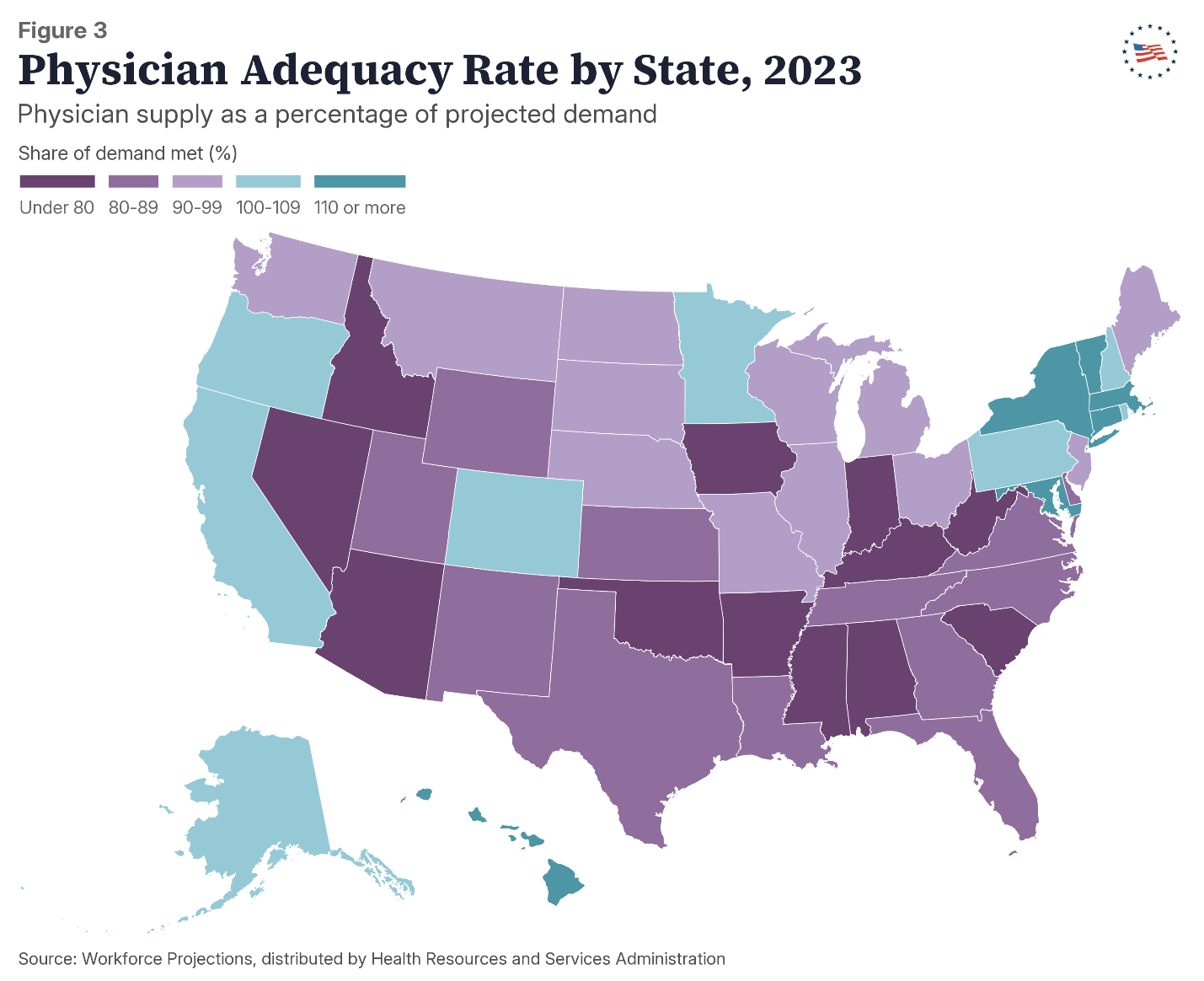
Figure 3 similarly shows what a state’s estimated physician adequacy rate was in 2023, calculated as a ratio of the HRSA’s projected supply of physicians in a state compared to the projected demand for physicians in the state. The data indicates that 36 states, generally those not in the Northeast or on the West Coast, had physician adequacy rates below 100 percent, meaning there were fewer doctors in the state than were needed. Mississippi, Oklahoma, Idaho, Alabama, and Arkansas notably had adequacy rates below 70 percent.
As the data suggests, if physician supply and demand trends continue as projected, this growing shortage may very well continue to affect Americans throughout the entire nation, including those in metro areas (HRSA, 2025d). These changes could potentially precipitate a downward spiral across the nation already being seen in rural areas where physicians, being overworked due to hospital understaffing, choose to practice elsewhere or leave the medical field entirely by transitioning into a different career or retiring early (Samraik, 2025; Siegel, 2025).
Most alarmingly, the geographic data presented in Figure 2 suggests that many Americans live in areas lacking in trained medical professionals, especially those in rural communities, and thus may struggle to receive proper emergency medical treatment from qualified physicians (Zionts, 2025), let alone routine medical treatments such as check-ups. Lacking access to physicians has serious downsides, with fewer physicians per capita being associated with increased mortality (Basu et al., 2019).
It is useful to ascertain what policies have contributed to the physician shortage. A key reason is the cap on federally funded residency slots, which artificially limits the number of graduates who can enter practice, and will be discussed in a subsequent section.
Becoming a physician in the United States involves completing a medical degree at an accredited medical school—either in the United States or abroad—and subsequently completing a residency in a desired specialty such as internal medicine, pediatrics, or surgery, among others. Through the residency process, trainees may obtain a medical license, enabling them to legally practice medicine in the state in which the license is issued, or in states that permit physicians licensed elsewhere to practice telemedicine.
After completing a residency program, trainees are eligible to sit for a board exam prepared by the American Board of Medical Specialties (ABMS). Upon passage, trainees receive certification in their chosen medical field (e.g., cardiology). They are then eligible to pursue additional graduate medical education through fellowship training in even more specialized medical fields (e.g., pediatric cardiology).
Each year, medical school graduates apply for residency positions in a process administered through the National Resident Matching Program (NRMP), commonly known as the Match (National Resident Matching Program, n.d.). Through the Match, medical graduates apply to programs of their choosing, and a computer algorithm matches the preferences of applicants with the preferences of programs. There is, however, a fixed number of residency positions available annually, and, as a result, thousands of medical school graduates are left unmatched to a residency program each year, and therefore unable to practice medicine. This phenomenon is illustrated in Figure 4, which shows the number of graduates of American medical schools, and U.S. citizen graduates of international medical schools that were not able to match into a residency.
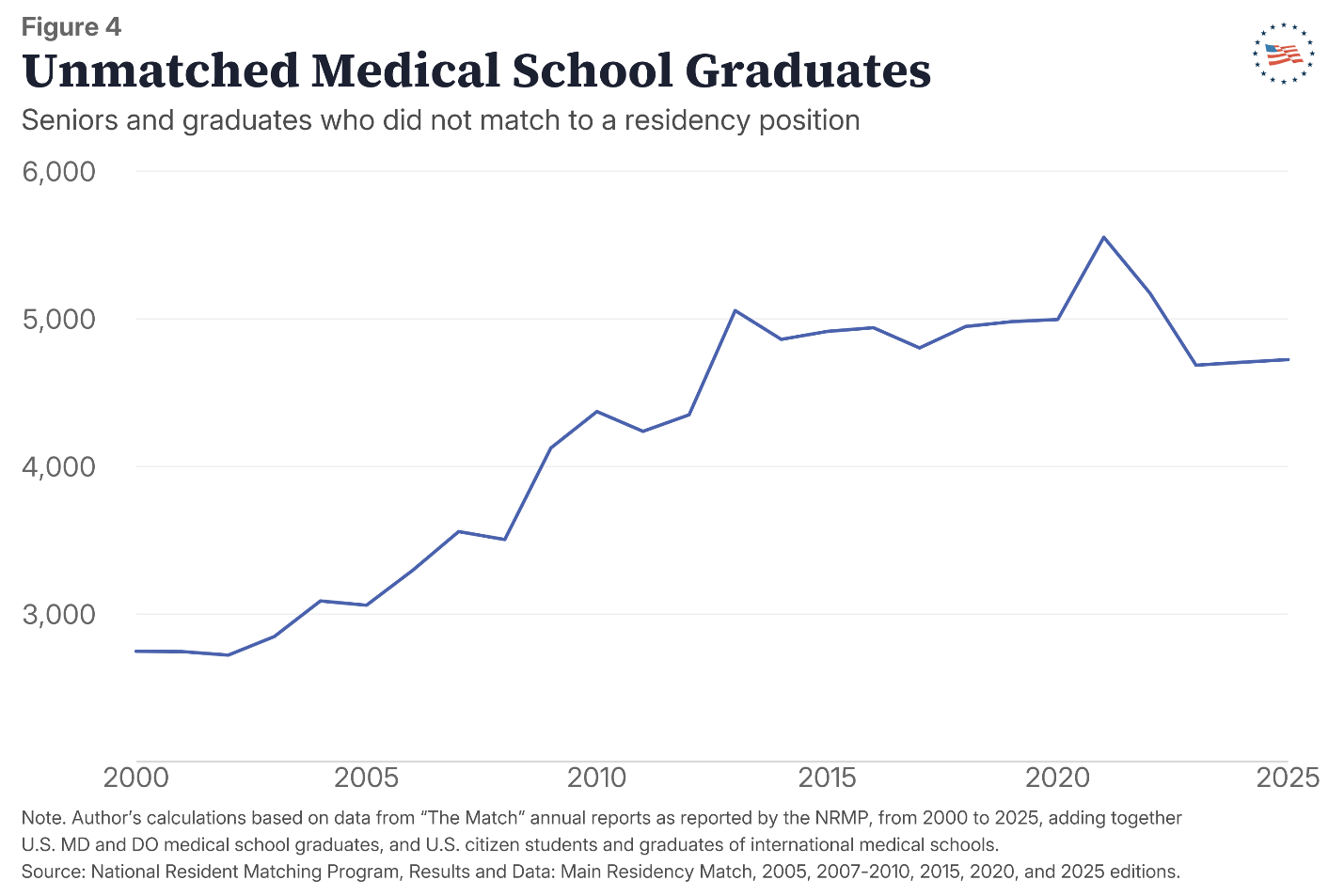
As Figure 4 shows, the number of unmatched graduates has nearly doubled in the last two and a half decades, going from 2,748 unmatched graduates in 2000 to 4,724 in 2025. Additionally, the National Resident Matching Program reported in its 2025 The Match report that there were 11,465 non-U.S. citizen international medical school graduates (IMGs) who applied for medical residencies in the United States: 6,653 of them were matched into a residency, while 4,812—or 42 percent of active non-citizen IMG applicants—failed to match into a residency program (National Resident Matching Program, 2025). In total, 9,541 applicants to medical residency programs failed to match in 2025, including non-U.S. citizens who graduated from international medical schools.
In the same period, the number of applicants matched to first-year (PGY-1) residency positions doubled, rising from 18,354 in 2001 to 37,667 in 2025, with growth accelerating after 2012, as Figure 5 shows. This expansion in residency positions is encouraging. It will not be sufficient to relieve the projected shortage, however, as the models discussed previously account for the growing number of resident physicians. Newly matched residents take three to seven years to complete training, depending on specialty, before becoming fully licensed physicians, and the shortage projections discussed above already account for this growth in residencies. As an increasing number of retirement-aged physicians leave the workforce, these additional residents will not be enough to completely close the gap.
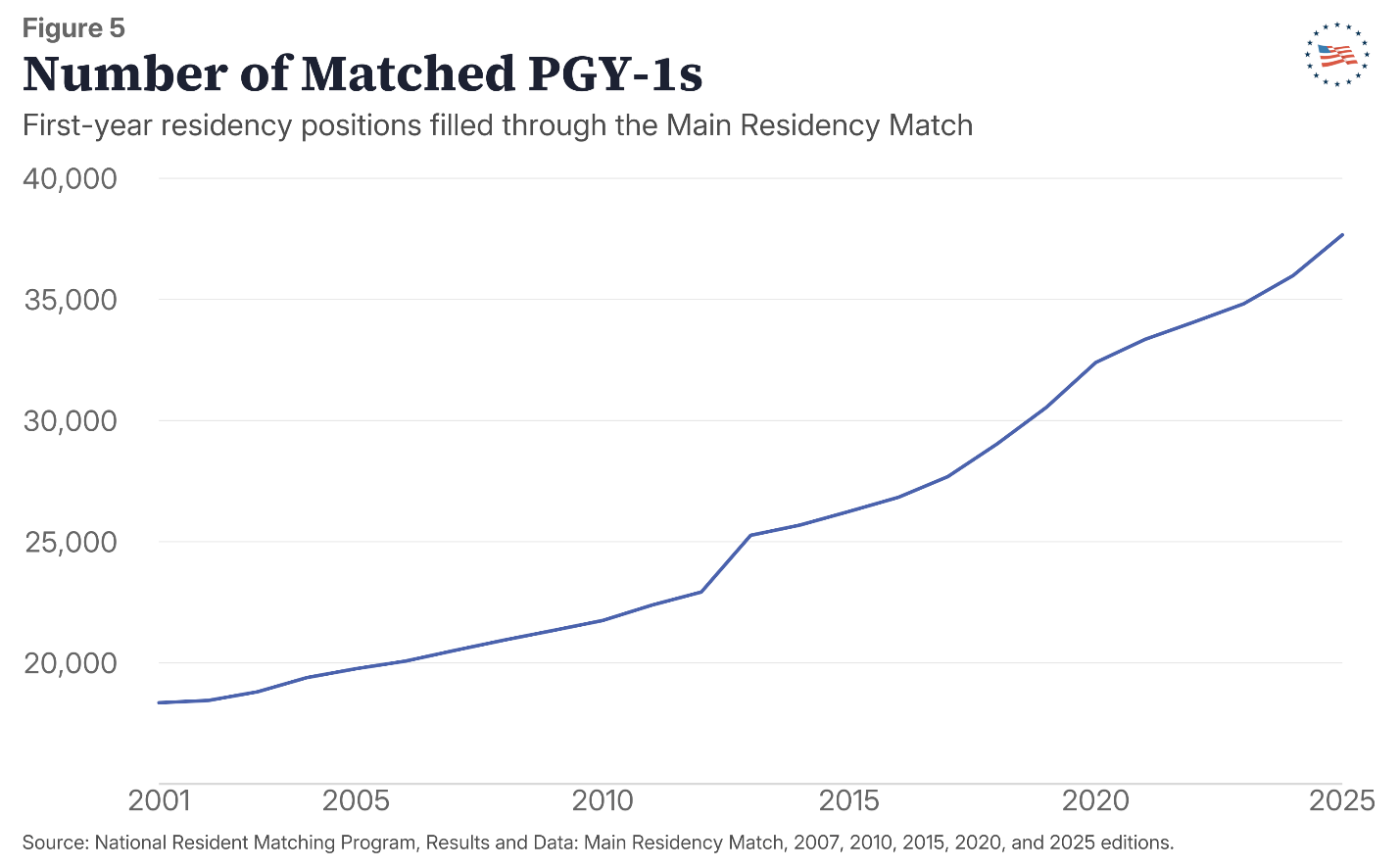
Most medical post-graduate training programs, also referred to as graduate medical education (GME), receive substantial funding from the federal government, with Medicare and Medicaid being the two largest sources of GME funding, estimated by the Congressional Research Service to total at least $29 billion in FY 2023; the Medicare program alone spent an estimated $21.2 billion in FY 2023 (Congressional Research Service, 2025).
Originally, post-graduate medical training was paid for by private entities (Rich et al., 2002). When it was first established alongside the Medicare program, Congress itself stated that federal support for GME was intended to be temporary until the community would step in (U.S. House Committee on Ways and Means, 1965, p. 32). This intention, however, did not come to pass, and the federal government has borne the brunt of the responsibility for funding GME since Medicare was signed into law in 1965.
In the Balanced Budget Act of 1997 (or the BBA), Congress later limited the number of residency slots funded by federal programs like Medicare or Medicaid (H.R. 2015, 1997). The amount of federally funded residency slots has essentially been capped at 1996 levels, partially due to fears of a physician oversupply when the BBA was signed into law (Pear, 1997). As noted above, there have only been two limited expansions in the number of slots since it was enacted (Congressional Research Service, 2025; H.R. 133, 2020, § 126). Because of these changes, growth in the number of residencies available has not kept pace with the number of students graduating from medical school (Boyle, 2020). Federally funded residency slots have increased almost entirely because of slots granted to new residency programs established after 1997 (Congressional Research Service, 2025; Lakhan, 2025).
As Figure 1 illustrates, those fears of a physician oversupply have not only failed to materialize but have also exacerbated the physician shortage. As a result of the lack of medical residency slots, thousands of medical school graduates are unable to practice medicine post-graduation and, frustratingly, have little choice except to find careers in other fields if they do not match into a residency program in subsequent years. These unmatched graduates often have to resort to alternative careers in medical research, or other often entirely unrelated careers that underutilize their education and training while still having to pay off a substantial medical school debt. An article from the Student Doctor Network offering advice to unmatched graduates suggested that they should “do anything from getting a real estate license to learning Web development in a crash course, in order to make money while waiting for a residency” (De, 2022).
Clearly, the U.S. has a large supply of underutilized medical talent. The following section discusses policies that can give unmatched graduates and doctors from abroad pathways to practice medicine to help alleviate the physician shortage.
Unmatched medical school graduates have the necessary education to begin practicing medicine as an assistant physician (AP) under the supervision of a more experienced physician. Furthermore, as this paper has demonstrated, there are not enough traditional residency slots for them to fill after they graduate. One solution is to allow these types of unmatched graduates the option to practice medicine under the supervision of a licensed physician for a short period of time (typically one to three years) while they try to match into a residency. This type of licensure requires graduation from an accredited medical school and, in most cases, the prospective AP license holder to have passed at least the first two of the three steps of the United States Medical Licensing Examination (USMLE).
Many experienced international doctors have immigrated to the United States to practice medicine, and thousands more would like to, as can be seen from the over 11,000 non-citizen IMGs who applied to match into a medical residency in the United States in 2025. An additional option could be to allow licensure pathways for these internationally trained physicians (ITPs) to practice in the United States as well. Similar pathways are offered in Australia (Medical Board of Australia, 2026), and the United States would benefit from adopting a similar approach.
ITP licensure would allow ITPs who have already undergone post-graduate medical training and have years of experience practicing medicine in their home countries to bypass the requirement to complete a duplicative residency program in the United States before they are allowed to practice medicine. ITPs must be proficient in English and may also be required to pass all three steps of the USMLE before they receive a provisional license.
ITPs, and other IMGs (U.S. citizen and non-citizen alike), looking to practice medicine in the U.S. would be required to pass at least Steps 1 and 2 of the USMLE just as American medical graduates do. Unlike APs, however, an ITP’s provisional license can be converted into a full license to practice medicine independently. To do so, ITPs are normally required to practice under the supervision of a licensed and board-certified physician for two to three years with satisfactory clinical reviews and no significant disciplinary actions. They would also need to pass Step 3 of the USMLE if they had not done so previously.
Fortunately, a number of states have sought licensure reforms to enable the utilization of such talent. Figure 6 illustrates what states have implemented such reforms, which will be discussed in more detail in the following section.
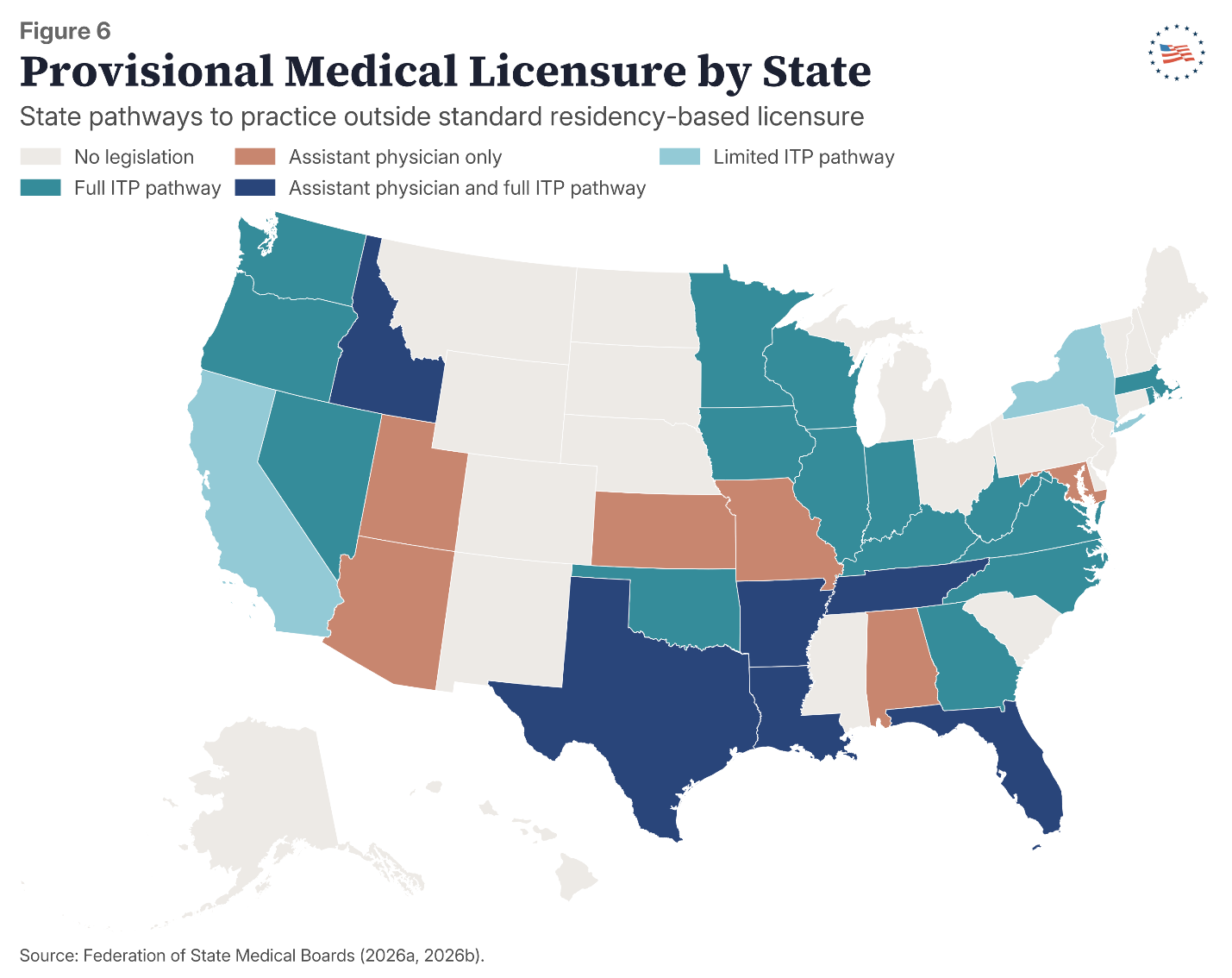
As Figure 6 illustrates, 12 states, including Arizona, Missouri, and Utah, have already established such AP pathways (Federation of State Medical Boards, 2026a). At present, 24 states have enacted “full” ITP licensure, and two have enacted “limited” ITP licensure (Federation of State Medical Boards, 2026b). In contrast to states with full ITP licensure, California and New York do not have a pathway for ITPs to receive a license to practice medicine after the term of their provisional license is complete, meaning they have limited ITP licensure. Six states have enacted both AP and full ITP licensure, with notable examples including Texas and Florida.
Idaho has also enacted both AP licensure and full ITP licensure in 2023 and 2025, respectively, and for good reason: in 2024, Idaho had 203 doctors for every 100,000 people in the state—the lowest in all 50 states (Association of American Medical Colleges, 2024). According to the HRSA’s Workforce Projections, Idaho had a 68 percent adequacy rate for physicians in 2023, ranking only ahead of Mississippi and Oklahoma, with adequacy rates of 65 percent and 67 percent, respectively, in the same year (HRSA, 2025d). It would be prudent for states in similar positions, such as Mississippi, that have or are projected to have physician shortages, to enact AP and ITP licensure legislation to remedy their shortages.
There is considerable variation in the number of provisional licenses issued in each state. A Goldwater Institute report found that, as of 2024, 97 percent of AP license holders resided in Missouri or Arizona (Goldwater Institute & Beacon Center of Tennessee, 2025). According to their analysis, there were a total of 1,220 AP licenses issued, with only one license revoked and no other disciplinary actions being found. The same report also found that only 25 percent of people who went through the process of getting an AP license were able to find a supervising doctor willing to take them on, perhaps in part due to the regulatory burdens some states imposed on hiring APs.
Despite having these laws, however, some states still have unnecessary barriers to practicing medicine. Arkansas and Kansas, in particular, have very restrictive prerequisites for their AP licensure programs, requiring prospective AP license holders to have graduated from an in-state medical school in the case of Arkansas, or specifically from the University of Kansas School of Medicine in the case of Kansas. Perhaps because of that fact, Kansas had not produced a single AP license holder by 2024, despite the state’s AP program having started back in 2015 (Goldwater Institute & Beacon Center of Tennessee, 2025). Arkansas, similarly, only issued 18 AP licenses as of 2024, while their program began in 2016 (Goldwater Institute & Beacon Center of Tennessee, 2025).
Another restriction states put in place is a “year of graduation” requirement. Missouri, for example, requires its APs to have graduated from medical school or passed Step 2 of the USMLE within the last three years of their application for an AP license. Idaho requires its “bridge-year physicians” (the state’s name for APs) to have graduated within the last year, although legislation has been introduced to increase the limit to within the past three years. While well-intentioned, these restrictions place additional barriers that prevent perfectly capable talent from entering the medical field. Any states looking to establish effective AP programs and increase their supply of physicians should not impose unnecessarily restrictive regulatory burdens and should be open to granting AP licenses to any graduate of an accredited medical school.
As Figure 6 shows, there are many states, including New Jersey, Ohio, Maine, Wyoming, and others, that have not pursued any of these policies and could very well benefit from doing so to ameliorate their physician shortages. Some other states, such as Nevada, Illinois, and Oklahoma, among others, that have pursued ITP policies could still benefit from pursuing AP policies to allow younger graduates to ameliorate the physician shortage while garnering additional experience and preparing to apply again for residency positions in a subsequent Match cycle. Additionally, a number of states, such as Arizona, Missouri, and Utah, have pursued AP licensure policies that could benefit from extending these policies to bring in experienced foreign doctors via ITP licensure.
Foreign-trained physicians might, in fact, offer unique benefits to patient care. For example, a 2017 study offered evidence that patients of international medical graduates had comparable or even slightly lower mortality than patients of U.S.-trained physicians (Tsugawa et al., 2017). While there is limited research specifically on outcomes for physicians practicing under ITP licensure, there is also no evidence suggesting that they provide inferior care. As these ITP pathways mature, future research will allow for more direct evaluation, but it is reasonable to expect that experienced physicians trained abroad will only continue to provide high-quality care.
Some may have concerns about APs practicing without residency training, which also merit consideration and should be placed in context. Medical graduates possess extensive clinical training that is at least as rigorous as that of nurse practitioners or physician assistants, who already treat patients in similar roles under current law. As such, existing evidence and comparable practice models suggest that these pathways can indeed expand access to care without compromising quality.
The nation is facing a serious and growing physician shortage in the coming years, driven in large part by an aging population and a cap on medical residencies put in place almost 30 years ago. As a result, patients living in areas most affected are receiving a lower quality of treatment from overworked physicians, leading to worse patient outcomes. States have the opportunity to help remedy the problem on the local level by offering medical school graduates who already have the education—and in the case of ITPs, the training and experience—necessary to begin practicing medicine under the supervision of an experienced physician. Expanding provisional licensure would not solve the underlying causes of the shortage, but it would offer relief to states most affected by it.
The authors would like to express their gratitude to Kat Miller for creating the fantastic figures used in this paper, and to Abigail Wagner for her assistance in researching legislation. The authors would also like to thank Faith Hall for her additional research support and proofreading the document, and Samuel Helm for his help in collecting the data used to generate some of the figures.
Association of American Medical Colleges. (2024). U.S. physician workforce data dashboard. https://www.aamc.org/data-reports/report/us-physician-workforce-data-dashboard
Basu, S., Berkowitz, S. A., Phillips, R. L., Bitton, A., Landon, B. E., & Phillips, R. S. (2019). Association of primary care physician supply with population mortality in the United States, 2005–2015. JAMA Internal Medicine, 179(4), 506–514. https://doi.org/10.1001/jamainternmed.2018.7624
Boyle, P. (2020, September 30). Medical school enrollments grow, but residency slots haven’t kept pace. Association of American Medical Colleges. https://www.aamc.org/news/medical-school-enrollments-grow-residency-slots-haven-t-kept-pace
Bulgac, G. (2025, October 29). Government healthcare spending has skyrocketed, increasing costs. Economic Policy Innovation Center. https://epicforamerica.org/federal-budget/government-healthcare-spending-has-skyrocketed-increasing-costs/
Congressional Research Service. (2025, August 19). Federal support for graduate medical education. https://www.congress.gov/crs-product/R48636
Dayaratna, K., & O'Shea, J. (2017). Addressing the physician shortage by taking advantage of an untapped medical resource [Backgrounder No. 3221]. The Heritage Foundation. https://www.heritage.org/public-health/report/addressing-the-physician-shortage-taking-advantage-untapped-medical-resource
Dayaratna, K., Larkin, P. J., & O’Shea, J. (2019). Reforming American medical licensure. Harvard Journal of Law & Public Policy, 42(1), 253–278. https://journals.law.harvard.edu/jlpp/wp-content/uploads/sites/90/2019/02/Larkin-Final.pdf
De, M. (2022, June 25). 10 things to do if you did not match into a residency position. Student Doctor Network. https://www.studentdoctor.net/2018/03/12/not-match-residency-position/
Federation of State Medical Boards. (2026a, June). States with enacted and proposed assistant physician legislation: State-by-state overview. https://www.fsmb.org/siteassets/advocacy/policies/associate-physician-legislation-by-state-key-issue-chart.pdf
Federation of State Medical Boards. (2026b, June). States with enacted and proposed licensure pathways for internationally trained physicians: State-by-state overview. https://www.fsmb.org/siteassets/advocacy/policies/states-with-enacted-and-proposed-additional-img-licensure-pathways-key-issue-chart.pdf
GlobalData Plc. (2024, March). The complexities of physician supply and demand: Projections from 2021 to 2036. Association of American Medical Colleges. https://www.aamc.org/media/75236/download
Goldwater Institute & Beacon Center of Tennessee. (2025, March 26). Removing barriers for associate physicians to expand healthcare access. https://www.goldwaterinstitute.org/policy-report/removing-barriers-for-associate-physicians-to-expand-healthcare-access/
Health Resources and Services Administration. (n.d.). Health workforce shortage areas dashboard. U.S. Department of Health and Human Services. Retrieved March 10, 2026, from https://data.hrsa.gov/topics/health-workforce/shortage-areas/dashboard
Health Resources and Services Administration. (2023, June). What is shortage designation? https://bhw.hrsa.gov/workforce-shortage-areas/shortage-designation/scoring
Health Resources and Services Administration. (2025a). Demand modeling overview. Technical documentation for HRSA’s health workforce simulation model. https://bhw.hrsa.gov/data-research/projecting-health-workforce-supply-demand/technical-documentation/modeling-demand-health-care
Health Resources and Services Administration. (2025b, September). How we define rural. https://www.hrsa.gov/rural-health/about-us/what-is-rural
Health Resources and Services Administration. (2025c). Supply modeling overview. Technical documentation for HRSA’s health workforce simulation model. https://bhw.hrsa.gov/data-research/projecting-health-workforce-supply-demand/technical-documentation/modeling-supply-health
Health Resources and Services Administration. (2025d, December 18). Workforce projections. https://data.hrsa.gov/topics/health-workforce/nchwa/workforce-projections
Health Resources and Services Administration. (2026, March 31). Designated health professional shortage areas statistics: Designated HPSA quarterly summary, second quarter of fiscal year 2026. https://data.hrsa.gov/default/generatehpsaquarterlyreport
H.R. 133. Consolidated Appropriations Act of 2021. 116th Congress. (2020). https://www.congress.gov/bill/116th-congress/house-bill/133/text
H.R. 2015. Balanced Budget Act of 1997. 105th Congress. (1997). https://www.congress.gov/bill/105th-congress/house-bill/2015
H.R. 2617. Consolidated Appropriations Act of 2023. 117th Congress. (2022). https://www.congress.gov/117/plaws/publ328/PLAW-117publ328.pdf
KFF. (2025, December 31). Primary care health professional shortage areas (HPSAs). https://www.kff.org/other-health/state-indicator/primary-care-health-professional-shortage-areas-hpsas/
Lakhan, S. E. (2025, June 13). The wrong fix: Why America doesn’t need more medical schools to solve the physician shortage. Cureus, 17(6). https://doi.org/10.7759/cureus.85935
Larkin, P. J., Fishpaw, M., & McCarthy, L. (2021). Telemedicine and occupational licensing. Administrative Law Review, 73(4), 747–786. https://www.jstor.org/stable/27234572
McMichael, B. J. (2025). The impact of nurse practitioner scope-of-practice laws on preventable hospitalizations. Journal of Health Economics, 103, 103044. https://doi.org/10.1016/j.jhealeco.2025.103044
Medical Board of Australia. (2026, January 22). Competent authority pathway. https://www.medicalboard.gov.au/Registration/International-Medical-Graduates/Competent-Authority-Pathway.aspx
National Resident Matching Program. (n.d.). National Resident Matching Program. Retrieved June 4, 2026, from https://www.nrmp.org/
National Resident Matching Program. (2025). Results and data: 2025 Main residency match. https://www.nrmp.org/wp-content/uploads/2025/05/Main_Match_Results_and_Data_20250529_FINAL.pdf
Park, J. (2020). Does expanded state scope of practice for nurse practitioners and physician assistants increase primary care utilization in community health centers? Journal of the American Association of Nurse Practitioners, 32(6), 447–458. https://www.nursingcenter.com/journalarticle?Article_ID=5572471&Journal_ID=4549846&Issue_ID=5572284
Pear, R. (1997, March 1). Doctors assert there are too many of them. The New York Times. https://www.nytimes.com/1997/03/01/us/doctors-assert-there-are-too-many-of-them.html
Rich, E. C., Liebow, M., Srinivasan, M., Parish, D., Wolliscroft, J. O., Fein, O., & Blaser, R. (2002). Medicare financing of graduate medical education. Journal of General Internal Medicine, 17(4), 283–292. https://doi.org/10.1046/j.1525-1497.2002.10804.x
Samraik, M. (2025, October 7). Increases in physician attrition rates could worsen shortages. Yale School of Medicine. https://medicine.yale.edu/news-article/increases-in-physician-attrition-rates-could-worsen-shortages/
Siegel, D. (2025, June 9). Rural physician burnout and staffing shortage impact in 2025. National Rural Health Association. https://www.ruralhealth.us/blogs/2025/06/rural-physician-burnout-and-staffing-shortage-impact-in-2025
Tsugawa, Y., Jena, A. B., Orav, E. J., & Jha, A. K. (2017). Quality of care delivered by general internists in US hospitals who graduated from foreign versus US medical schools: Observational study. BMJ (Clinical research ed.), 356, j273. https://doi.org/10.1136/bmj.j273
U.S. House Committee on Ways and Means. (1965). Social security amendments of 1965 (H.R. Rep. No. 89-213). U.S. Government Printing Office. https://www.ssa.gov/history/pdf/Downey%20PDFs/Social%20Security%20Amendments%20of%201965%20Vol%201.pdf
Young, A., Pei, X., Arnhart, K., Abraham, G. M., & Chaudhry, H. J. (2025). FSMB census of licensed physicians in the United States, 2024. Journal of Medical Regulation, 111(2), 7–17. https://doi.org/10.30770/2572-1852-111.2.7
Zionts, A. (2025, August 12). Experts say rural emergency rooms are increasingly run without doctors. KFF Health News. https://kffhealthnews.org/news/article/rural-emergency-rooms-ers-no-doctors-pas-nps-south-dakota-wyoming-montana/