Policy Memo
Topline
Fraud reduction is a top priority of the Trump Administration. With the recently announced anti-fraud Task Force led by V.P. Vance, Congress must do its part to ensure that fraud reduction is permanent and not a flash in the pan. This report lays out
Author: Rachel Greszler
How Congress Can Help the Anti-Fraud Task ForceFraud reduction is a top priority of the Trump Administration. With the recently announced anti-fraud Task Force led by V.P. Vance, Congress must do its part to ensure that fraud reduction is permanent and not a flash in the pan. This report lays out what Congress must do to statutorily limit fraud. Federal transfer payments amount to $33,200 per household and improper payments total almost $1,400 per household. This is simply unsustainable. Congress must impose “fix it or fund it yourself” accountability on state administrators.
The recent fraud uncovered in Minnesota is just the tip of the iceberg. The federally funded, state administered system is fraught with perverse incentives to overspend, under-verify, and waste taxpayer dollars.
States must have skin in the game. If states bear the fiscal consequences of payment errors, accountability will; improve and federal taxpayers will no longer pay for poor policy and waste.
Reports of widespread brazen fraud in Minnesota are a reminder of the inevitable failings of putting unaccountable government bureaucrats in charge of spending other people’s money. The billions of federal taxpayer dollars doled out to fraudsters in Minnesota are only the tip of the iceberg. The sheer magnitude of government spending—including over $4.2 trillion in transfer payments or $33,200 per U.S. household—has created a high-value target for abuse and misuse. In addition to taxpayer dollars being wasted, the fact that some people can make a living—or even get rich—by manipulating federal programs instead of working to produce something of value to others drags down the economy and exacerbates the unsustainable federal budget.
According to its own measures, the federal government issued $1.9 trillion, or $14,300 per U.S. household, in improper payments over the past decade.[1] This includes payments that were sent to the wrong people or in the wrong amount due to fraud, negligence, and errors. In 2025 alone, the federal government reported $184 billion in improper payments.[2]
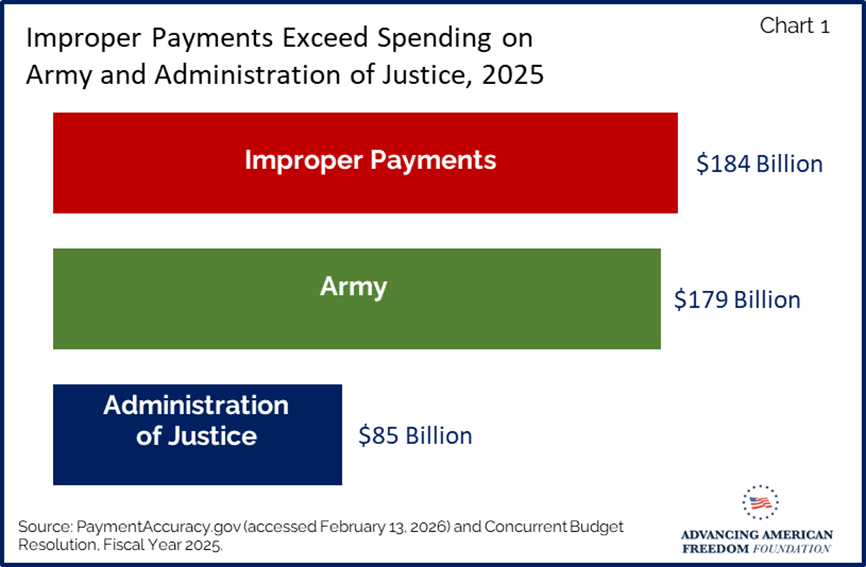
This is more than the federal government spends on the Administration of Justice ($85 billion) or the Army ($179 billion).[3] At about $1,400 per household, improper payments cost more than the average household spends on gas and groceries over eight weeks.[4]
At about $1,400 per household, improper payments cost more than the average household spends on gas and groceries over eight weeks
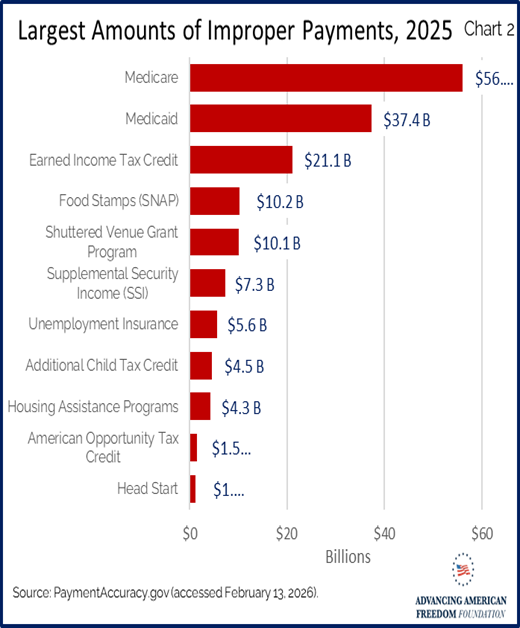
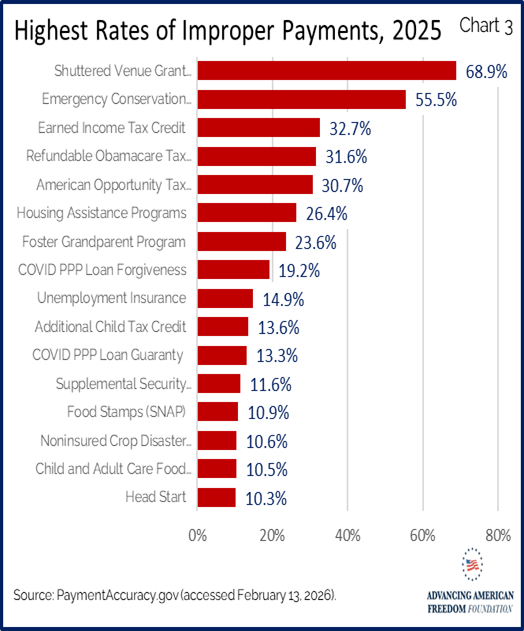
Chart 2 shows the highest dollar amounts of improper payments. At $97 billion in 2025, reported improper payments in government health insurance programs are large enough to provide health insurance to 3.6 million families or 10.4 million individuals.[5] The total $12.5 billion in reported improper payments in food assistance programs are enough to cover annual grocery costs for 1.6 million households. As shown in Chart 3, some very large federal programs regularly spend up to $1 out of every $3 dollars on improper payments.
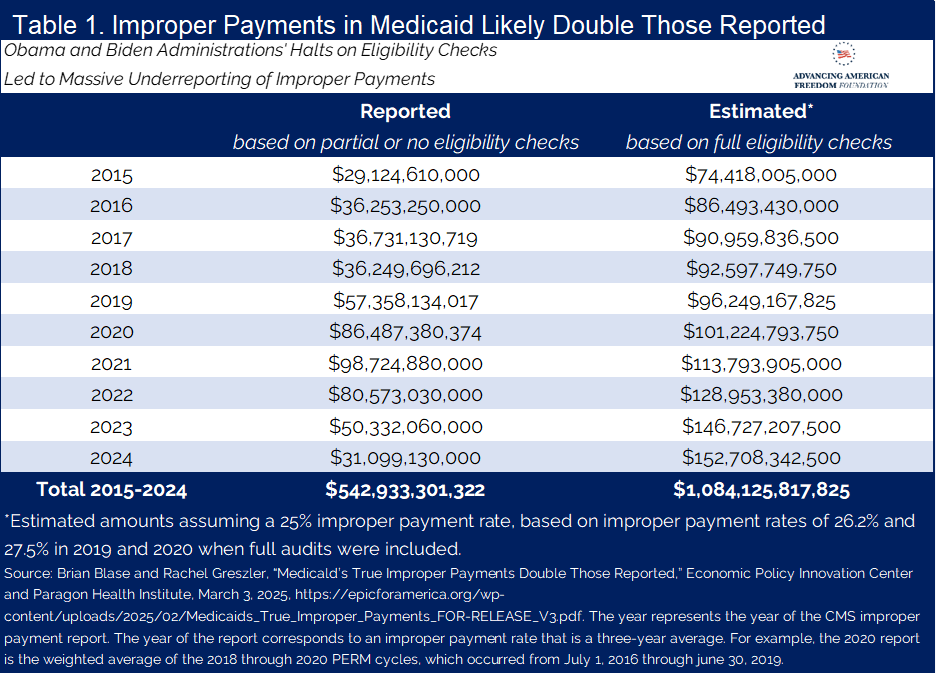
What the government reports in improper payments is almost certainly a significant understatement as the federal government only tracks improper payments in some of its programs, and in those it tracks, it misses many improper payments. For example, Brian Blase and I estimated that if the Biden and Obama Administrations had not excluded eligibility checks from states’ Medicaid audits, auditors would have found two times the amount of improper Medicaid payments over the past decade—nearly $1.1 trillion instead of the $543 billion Medicaid reported.[6]
When eligibility checks are weak or nonexistent, fraud can run rampant. The magnitude of fraud in Minnesota shows just how little of it is actually known. In the eight years between 2017 and 2024, the entire federal government reported just $51.9 billion in “known fraud” across the entire United States.[7] Yet, over the past year, federal prosecutors uncovered an alleged $9 billion or more that may have been stolen from Minnesota-run Medicaid programs alone since 2018.[8] The nonpartisan Government Accountability Office estimated that the federal government loses between $233 billion and $521 billion annually to fraud.[9] That is equivalent to between three and eight weeks of housing costs for the entire country.[10]
The federal government reported an average of $6.5 billion per year in “known fraud” in recent years. Yet, the nonpartisan Government Accountability Office estimated that the federal government loses between $233 billion and $521 billion annually to fraud. At the upper end, that is almost two months of mortgage and rent payments for the entire country.
Milton Friedman described four ways of spending money, from the most to least effective: you can spend your own money on yourself, your own money on someone else, someone else’s money on yourself, or someone else’s money on somebody else. Politicians and bureaucrats—who spend somebody else’s money on somebody else—are the least concerned about much they spend and what they get for it.[11] Noting the inherent conflict of interest when spending money that one did not earn, Dick Armey later commented, “Three groups spend other peoples’ money: children, thieves, and politicians. All three need supervision.”
When the federal government opens the spigots of federal taxpayers’ money to states, and states task unelected and job-protected bureaucrats with doling out the money, it is not surprising that integrity, efficiency, and accountability are woefully lacking.
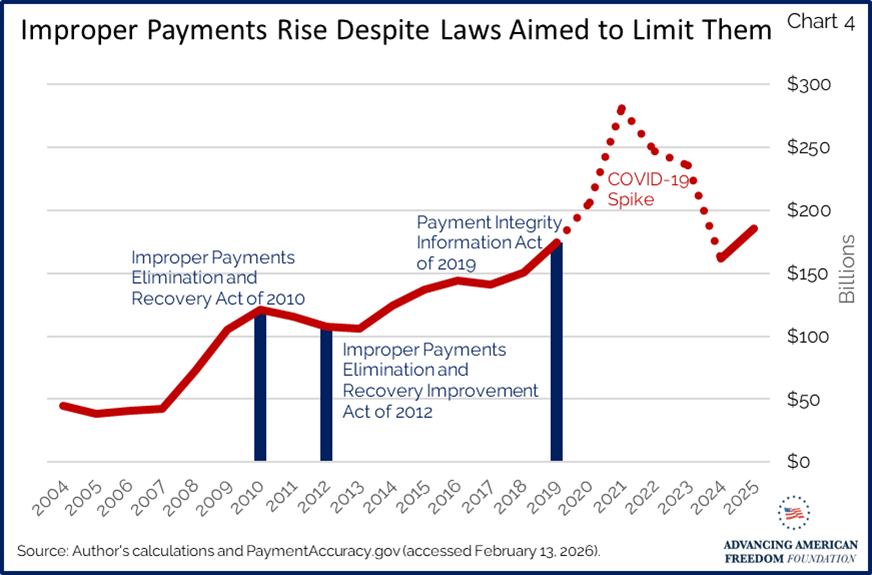
While federal lawmakers have tried to impose accountability on taxpayer spending, it has not worked. After improper payments spiked from $41 billion in 2007 to $104 billion in 2009, Congress enacted the bipartisan Improper Payments Elimination and Recovery Act of 2010 (IPERA), and then the Improper Payments Elimination and Recovery Improvement Act of 2012 (IPERIA).[12] Yet, instead of declining, improper payments continued to rise, reaching $149 billion in 2018.
In 2019, Congress replaced IPERA with the updated Payment Integrity Information Act of 2019 (PIIA).[13] The PIIA implemented common sense requirements that should have reduced improper payments. For example, it requires agencies to: analyze their risks; identify programs susceptible to improper payments; publish improper payment estimates for at risk programs; implement corrective actions and set reduction targets; and report on the results of targets and actions. Some of these metrics are published online in agency scorecards at PaymentAccuracy.gov. Yet, despite additional requirements, including for corrective actions, improper payments continued to increase, peaking at $278 billion in 2021 during the COVID-19 pandemic, and equaling $184 billion in 2025.[14]
These failures continue because of perverse incentives and a lack of accountability. Since the success of government programs is measured by how much money they spend and how many people they serve, there is little incentive to perform even basic checks. For example, Linda Miller, the former assistant director of Forensic Audits and Investigative Service at the GAO explained in 2022 congressional testimony that agencies are required to utilize the government’s Do Not Pay database prior to payment, but agencies often check that box by pinging the database and then issuing payments before the database sends back results indicating which payments should not be issued.[15]
Unlike the private sector, where people would lose jobs and companies would go out of business for such heedless abuses, not only do federal bureaucrats keep their jobs; their agencies are usually rewarded with increased budgets to cover both their legitimate costs and their wrong payments. At a minimum, Congress should hold agencies accountable for their compliance with the Payment Integrity Information Act through requests for full information, including actions taken to reduce improper payments, and through congressional hearings that require agency heads to answer for any lack of compliance and for excessive improper payments.
The second Trump Administration has focused significant resources on improving efficiency and accountability within the federal government, including cracking down on errors and outright fraud in the distribution of more than $4 trillion in annual transfer payments. Efforts by the Department of Government Efficiency (DOGE) have raised awareness (and outrage) over the lack of efficiency and accountability across much of the federal government. DOGE’s efforts have resulted in multiple legislative proposals to curb improper payments, such as the DOGE in Spending Act. DOGE has also taken unprecedented steps to improve transparency, including open sourcing access to “the largest Medicaid dataset in department history.”[16] This exposure will allow the public to search for irregularities in the data and help detect potential fraud.
In response to the widespread fraud discovered in Minnesota, the Trump Administration announced it was “unleashing a relentless assault to dismantle the massive fraud empires.” [17] Among the Administration’s many stated actions are:
While these and future efforts are providing much needed accountability to federal taxpayer spending, they cannot be guaranteed beyond the current Administration’s term. A future Administration could end many or all these new safeguards while implementing policies—such as the Biden Administration’s—that fueled a firestorm of fraud and improper payments. That is why Congress needs to enact comprehensive accountability measures that include meaningful consequences for recklessness and fraud.
The simplest way to improve accountability in federal spending is for those spending the money to have a stake in what they are spending. This is much easier to do for discretionary spending programs that require regular appropriations than for mandatory spending programs that run on autopilot.
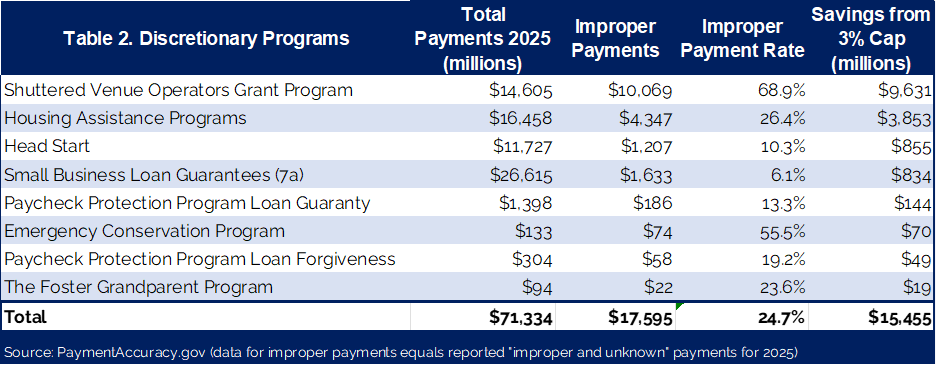
When passing congressional appropriations bills, lawmakers should specify a maximum allowable improper payment rate (such as three percent) for each program and subtract excess improper payments from the following year’s appropriations.[20] Congress could apply this process program by program, or across entire agencies.
Table 2 provides a few examples of some of the many programs for which Congress should impose improper payment rate caps and reduce subsequent funding by the amount of improper payments over the caps. Based on the most recent improper payment rates in those programs, the table also provides estimated savings that would be achieved with a three percent cap on improper payments.
In addition to the above specified programs for which the government tracks improper payments, there are many other programs in which improper payments are not currently tracked and reported, such as the : Low Income Home Energy Assistance Program (LIHEAP); Community Development Block Grant (CDBG); State Energy Program; Weatherization Assistance Program; Drinking Water and Clean Water State Revolving Funds; Broadband Equity, Access, and Deployment (BEAD) Program; HOME Investment Partnerships Program; Emergency Solutions Grants; Housing Trust Fund; and the Continuum of Care Program.
In most cases, these programs should be tracking and reporting improper payments, but they are failing to do so. The Payment Integrity Information Act of 2019 requires that programs with “significant” improper and unknown payments—defined as either $10 million and 1.5 percent of program payments, or $100 million regardless of the rate—must conduct statistically valid measurements of improper and unknown payments, publish those amounts and plans to reduce improper payments on Paymentaccuracy.gov, and, if a program is not compliant, the agency must submit a plan to Congress to bring it into compliance.
Congress must hold these non-compliant, programs accountable by ensuring that they are measuring and reporting improper payments and taking action to reduce them. In so doing, Congress can also apply a limit, such as three percent, on improper payments, with any levels above that resulting in an equivalent loss of funding for the subsequent year.
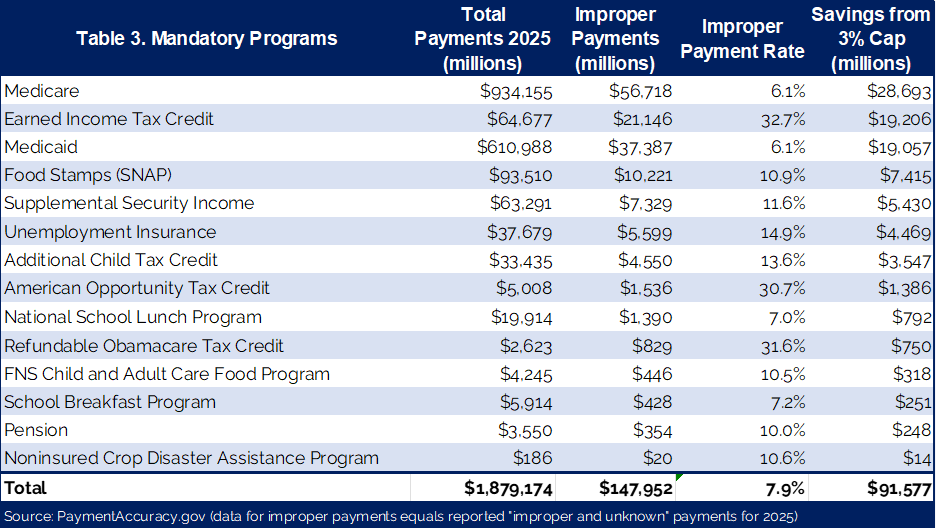
Mandatory or entitlement programs do not require annual appropriations from Congress. Their spending instead depends on the number of people who claim and receive benefits. The automatic nature of mandatory spending tends to lead to even higher improper payment rates. Table 3 highlights some of the mandatory spending programs, their total payments, improper payments, and savings that could have accrued if the federal government were able to limit improper payments to 3 percent.
For most federal entitlement or mandatory spending programs, Congress cannot withhold funding in response to excess improper payments if doing so would prevent individuals who are entitled to benefits from receiving them. Yet, there are some ways that the federal government can require states to pay for the costs of their failures in issuing improper payments. This is easiest to do when states already pay for part of an entitlement program. A few of those instances are outlined below.
In cases in which states administer federal entitlements but do not share in any of the costs, Congress would have to enact legislation that either: 1) directly requires states to pay the federal government back for excessive improper payments in entitlement programs (by making funding conditional upon agreement to repay excessive improper payments); or 2) indirectly imposing excessive improper payment amounts back onto states by simultaneously restricting other discretionary federal funding.
While it is harder to impose accountability on states’ administration of mandatory entitlement programs, existing laws provide opportunities for the federal government to further limit improper payments in state-administered programs. In some instances, this requires the Administration to enforce existing requirements or to restrict or repeal lax agency regulations that encourage misuse, abuse, and high improper payments. Congressional oversight to ensure compliance with existing law is also necessary. In other instances, new laws are necessary to ensure the integrity and accountability of federal taxpayer dollars.
Medicaid costs are shared between the federal government and state governments, with the federal government paying a Federal Match Percentage, or FMAP, that varies by state and type of beneficiary. On average, the FMAP for traditional Medicaid enrollees (children, pregnant women, low-income seniors, and individuals with disabilities) is 57 percent, and the FMAP for expansion enrollees (able-bodied, working-age adults) is 90 percent. In fiscal year 2025, total Medicaid spending was estimated to equal $998 billion, including $645 billion from the federal government and $353 billion from state governments.[21]
Already, the Medicaid statute specifies that if a state’s erroneous payments based on eligibility errors exceed three percent, “then the [HHS] Secretary shall make no payment” for erroneous payments above three percent.[22] Yet, the federal government has consistently granted “good faith” waivers to the states, even as improper payment rates were 26.2 percent and 27.5 percent in the last two years in which states conducted full audits.[23]
The federal government has consistently granted “good faith” waivers to the states, even as improper payment rates were 26.2 percent and 27.5 percent in the last two years in which states conducted full audits.
Beginning in 2030, the One Big Beautiful Bill imposes limits on “good faith” waivers currently granted for improper payments over three percent. Specifically, states will not be able to receive waivers for improper payments that are the result of them enrolling ineligible individuals, paying for ineligible services, and failing to verify eligibility.
These limitations will result in significant savings for federal taxpayers. While the CBO estimated that this provision would save taxpayers about $7.5 billion over the 2030-2034 period, it could save significantly more depending on how improper payments are measured and how strictly the current and future Administrations enforce the limits.
While the savings on improper payments from the One Big Beautiful Bill will not kick in until 2030, the Administration already has the authority to direct HHS to limit its use of “good faith” waivers. The Administration should consider having HHS phase down its use of good faith waivers, for example, by limiting good faith waivers to six percent improper payments in 2027, five percent in 2028, and four percent in 2029. This would help ensure that states take the necessary actions to get close to the law’s three percent improper payment limit that will begin in 2030.
In Medicaid (and other programs), measurement methods fall short of and often massively underestimate true improper payments. Actions by the Obama and Biden Administrations directly caused massive underreporting of improper payments by excluding eligibility errors—the primary source of improper payments—from the estimates. While the Trump Administration has included eligibility errors, there are still problems.
For example, about three-quarters of all Medicaid enrollees operate through Managed Care Organizations (MCOs), with the federal government sending a per-person capitation payment (essentially an insurance premium) to the MCOs.[24] Improper payment estimates for MCOs only check whether individuals were eligible for Medicaid; they disregard the accuracy or inaccuracy of payments sent by MCOs to providers. Moreover, while Medical Loss Ratio (MLR) requirements are meant to ensure that at least 85 percent of capitation payments go to actual care instead of health insurance companies’ administrative costs and profits, many states fail to enforce the MLR requirements and close to half of states’ MLR filings were incomplete.[25] Regardless of incomplete or unverifiable reports, states suffer no consequences.
As recommended by Niklas Kleinworth and Brian Blase of the Paragon Health Institute, policymakers should: implement better reporting standards on MLR, spending, and enrollment data; require proper, market-based rate setting; and strictly enforce reporting requirements by including penalties for noncompliance.[26]
Another way to impose accountability on states for improper Medicaid payments would be to incorporate improper payments into the FMAP formula, reducing the FMAP percentage in accordance with a state’s improper payment rate. For example, if a state has a 12 percent improper Medicaid payment rate, its traditional FMAP percentage would be reduced from 57 percent to 48 percent (12 percent minus a 3 percent cap), and its expansion FMAP would be reduced from 90 percent to 81 percent.[27]
If based on comprehensive and accurate improper payment measurements, tying FMAPS to improper payment rates could easily save taxpayers tens of billions, and potentially $100 billion or more per year. For example, my analysis with Brian Blase estimated that states issued $152.7 billion in improper Medicaid payments in 2024. Thus, a three percent improper payment cap could have saved taxpayers up to $134 billion in improper Medicaid payments in 2024.[28]
Food stamps, or SNAP, is a federally-funded and state-administered program that provides debit cards—reloaded monthly—for individuals and families to use on most food and beverages at certain grocery and convenience stores. While states do not fund the benefits, they pay 50 percent of SNAP administrative costs. In recent years, administrative costs have totaled $6.6 billion, or about seven percent of SNAP benefits.
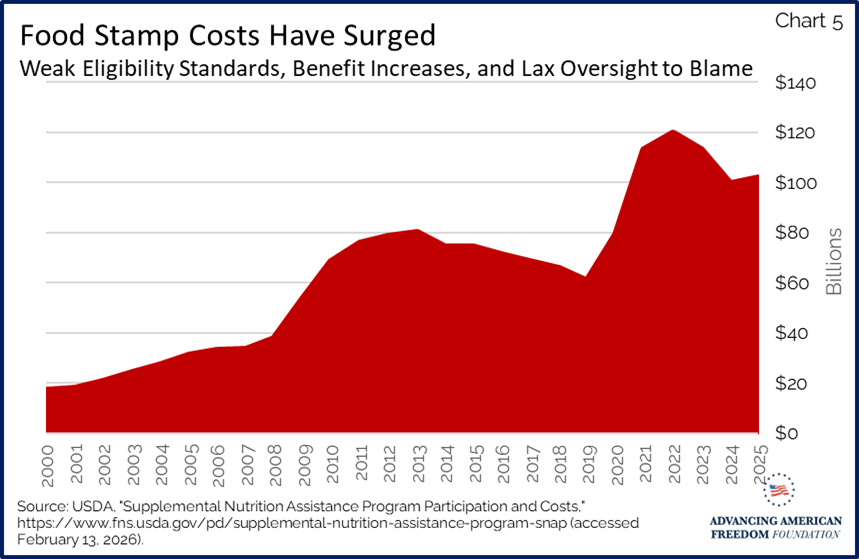
As a need-based welfare program, SNAP benefits should rise and fall with the unemployment rate, but both the number of SNAP recipients and the amount of SNAP spending have exploded despite low unemployment. The U.S. spent more on SNAP benefits in 2025 ($102 billion) when the unemployment rate averaged 4.3 percent than it did in 2011 ($68 billion) when the unemployment rate averaged 9.6 percent.[29]
The U.S. spent more on SNAP benefits in 2025 ($102 billion) when the unemployment rate averaged 4.3 percent than it did in 2011 ($68 billion) when the unemployment rate averaged 9.6 percent.
This expansion in SNAP spending is the result of increased benefit levels, expanded interpretations of broad based categorical eligibility (BBCE), and a roughly five-fold increase in improper payments.[30]
Broad Based Categorical Eligibility (BBCE) allows states to deem households eligible for food stamps based on the receipt of a nominal TANF benefit (such as a brochure or access to an 800 number).[31] Through this alternative eligibility process, states skip the federal government’s net income test and asset limit test and increase the gross income limits from 130 percent to 200 percent of the poverty rate.
Currently, only seven states follow the federal government’s Food Stamp eligibility standards while all of the others apply the expansive BBCE standard. According to a report by the U.S. Department of Agriculture, BBCE allowed 5.6 million individuals who were otherwise not eligible under federal standards to nonetheless receive food stamps.[32]A report by the Foundation for Government Accountability (FGA) estimated that eliminating BBCE would save federal taxpayers $100 billion and state taxpayers and additional $10 billion between 2026 and 2035.[33]
While BBCE has allowed millionaires and households with six-figures assets to legally qualify for Food Stamps, BBCE also exacerbates illegal improper payments because it eliminates eligibility checks for many households.[34] The FGA estimated that states that use BBCE have one-third higher improper payment rates than those that do not, but that is only what the states measure and report.[35] The USDA’s Office of the Inspector general found that BBCE causes states to significantly understate their improper payment rates because households that receive Food Stamps because of BBCE are not included in the Quality Control process used to determine improper payment rates.[36] In other words, households that are most likely to have been issued improper payments due to BBCE are assumed to have zero improper payments.
The Trump Administration’s USDA is reportedly working on a regulation to limit BBCE based on receipt of substantial cash TANF benefits instead of nominal non-cash benefits. This, as well as increasing the amount by which states can increase the income limit, would significantly reduce both technically improper payments as well as unintended, gratuitous payments to individuals not in need.
Congress should eliminate BBCE for Food Stamps to protect and preserve the program for those who truly need it. The No Welfare for the Wealthy Act of 2025 (H.R. 416) would accomplish this by requiring households to meet the current federal income and asset standards for Food Stamps.[37]
Beginning in 2028, states with improper or payment error rates over six percent will be required to pay between five percent and 15 percent of their SNAP benefits.[38] To prevent states from avoiding accountability by undercounting their error rates, Congress and the Administration must ensure consistent and valid Quality Control estimates that include full eligibility checks of all sampled households, including those who qualify under BBCE.
Under current law, if a state’s payment error rate is greater than 105 percent of the weighted average of all states’ improper payment rates for two years in a row, then the USDA is to establish a “liability amount” for that state, equal to 10 percent of their improper payments in excess of a 6 percent tolerance level.[39] The USDA Secretary shall then designate up to 50 percent of the liability amount[40] to be classified as “at risk.” If, in the following fiscal year, a state has a liability amount established (because it’s improper payment rates have been above average for two years in a row), then the “State agency shall pay to the Secretary the at-risk amount.” [41] If the state fails to make the payment within a reasonable period of time, then, “the Secretary may reduce any amount due to the State agency under any other provision” of the federal government’s administrative cost-sharing provisions.[42]
In practice, if a state’s improper payment rate was 15 percent (which exceeds 105 percent of the national average), then they have a liability amount of nine percent (15 percent minus the six percent tolerance level). Up to half of that—4.5 percent—shall be designated as the state’s at-risk amount. If the state’s total payments were $2 billion (roughly the average of all states), 15 percent improper payments would equal $300 million. The state’s liability amount would equal ten percent of the portion of their improper payments above the 6 percent tolerance level ($300 million minus $120 million tolerance), or $180 million times 10 percent equals $18 million. With a liability amount of $18 million, the at-risk amount equals up to half of that, or $9 million.[43]
Based on the law, any state that has an improper payment rate that is over 105 percent of the national average for three or more years in a row should be paying their at-risk amount back to the USDA. According to a 2018 report from the Congressional Research Service:
From FY2005 to FY2014, 42 of 53 state agencies have exceeded the liability level at least once, but only 9 state agencies have ever been compelled to actually repay an at-risk penalty amount to USDA-FNS. This is because most states improve their state payment error rates within one or two years and avoid being required to make a payment to USDA-FNS. Over these 10 years, these 9 states repaid about $1.5 million to USDA-FNS.[44]
It is unclear if any states have had to repay at-risk amounts since 2014.
The Administration should ensure that the maximum at-risk amounts are assessed each year. And Congress should consider amending this provision to apply liability and at-risk amounts to all states with improper payment rates above the tolerance level (instead of just those with higher-than-average improper payment rates), and should consider increasing the liability and at-risk amounts to between 50 and 100 percent of the state’s improper payments over the tolerance level.[45] This would allow the federal government to recoup up to 100 percent of Food Stamp Administrative expenses for states with very high improper payment rates.
While this change is small compared to the improper payment limitations imposed by the One Big Beautiful Bill beginning in 2028, fully enforcing this provision in the meantime could modestly improve accountability.
Unemployment Insurance (UI) was established by the Social Security Act of 1935. The federal government sets baseline statutory requirements for benefits and administration, and if states comply with federal standards, the federal government pays for states’ administrative costs using the revenues it collects from the Federal Unemployment Tax Act (FUTA). FUTA is a six percent tax, assessed on employers, that applies to the first $7,000 of all workers’ wages. If states are in compliance with federal requirements, the federal government credits employers back for up to 90 percent of their FUTA, effectively reducing the rate from six percent to 0.6 percent. [46]
State governments administer their UI systems, and state-level taxes on employers (separate from the FUTA) finance regular UI benefits. During periods of recession and high unemployment, extended benefits kick in to provide, for example, an additional 13 weeks or more of UI benefits. Extended benefit costs are typically split equally between federal and state governments. However, during the Great Recession and the COVID-19 pandemic, Congress passed legislation and later extended benefits such that the federal government paid for 100 percent of extended benefits, and individuals could receive UI benefits for between 79 and 92 weeks.
During the COVID-19 pandemic, the federal government not only paid for substantial extensions in the duration of UI benefits, but also increased benefit levels by $600 per week such that two-thirds of workers could receive more from UI benefits than they could from working.[47] Since the federal government also extended eligibility for UI benefits to essentially anything related to the COVID-19 pandemic (meaning workers did not have to lose their jobs through no fault of their own, but could quit them), and allowed applicants to self-certify their eligibility, UI claims surged to unprecedented levels.
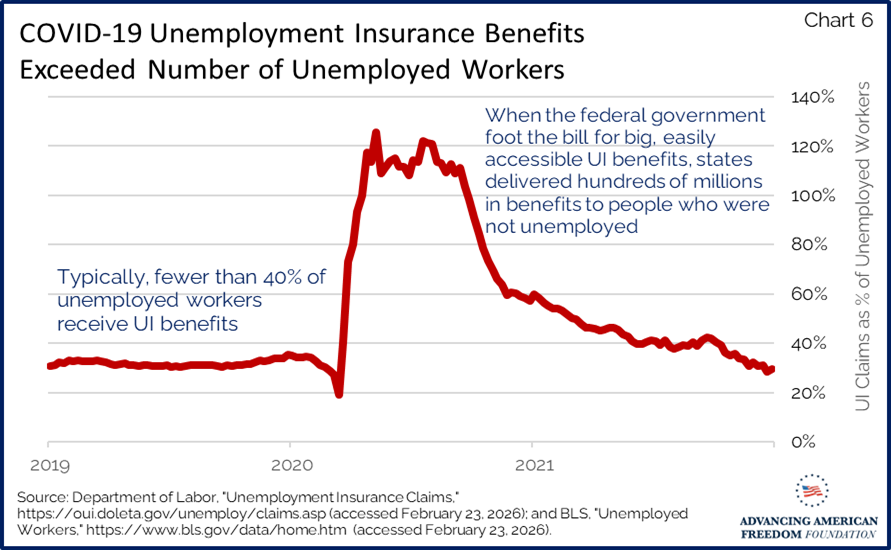
This led to far more people receiving UI benefits than were actually unemployed. Typically, fewer than 40 percent of people who are unemployed receive UI benefits, but during the COVID-19 pandemic, the number of people receiving UI benefits exceeded the number of unemployed people for 23 consecutive weeks.
My analysis found that federal taxpayers paid for at least $357 billion of unemployment benefits that went to individuals who were not unemployed.[48] That included international organized crime rings and individuals as bold as rapper “Nuke Bizzle,” who created a music video bragging about stealing UI benefits, with lines like “You gotta sell cocaine. I just file a claim,” and “I done got rich off EDD.”[49]
My analysis found that federal taxpayers paid for at least $357 billion of unemployment benefits that went to individuals who were not unemployed.
The EDD is California’s Employment Development Department, which issued UI benefits. It was among the worst offenders of enabling fraud in federal pandemic UI benefits. For example, the EDD issued UI benefits in the names of 35,000 prisoners and sent out 38 million pieces of mail containing individuals’ Social Security numbers during the pandemic despite the California state auditor advising the EDD to cease sending mail with Social Security numbers more than a year prior.[50]
While states currently bear responsibility for improper payments within their normal UI systems, there is only partial accountability for expanded benefits and no accountability when the federal government establishes extraordinary UI benefits. Congress should pass legislation that imposes accountability on states whenever states receive federal funds to pay for extended or extraordinary UI benefits. That should include a cap—somewhere between three percent and six percent—on the amount of allowable improper payments before states become fully responsible for their improper payments.
For extended benefits when costs are ordinarily shared between the federal and state governments, the state share should increase in direct proportion to the state’s improper payment rate if that rate exceeds a federal threshold. For example, if a state has a 10 percent improper payment rate and the federal threshold is four percent, the state would pay for 56 percent of extended benefits (six percent more than normal), or six percent of extraordinary benefits that would otherwise be 100 percent federally funded.
The Department of Labor’s Office of the Inspector General estimated an improper payment rate of at least 21.5 percent for pandemic UI benefits, while noting that the actual rate was likely much higher—potentially 35.9 percent or more.
In total, the federal government spent $888 billion in pandemic UI benefits.[51] The Department of Labor’s Office of the Inspector General estimated an improper payment rate of at least 21.5 percent for pandemic UI benefits, while noting that the actual rate was likely much higher—potentially 35.9 percent or more.[52] Those estimates suggest at least $191 billion to $319 billion in improper pandemic UI payments. If states been responsible for all amounts over four percent, that could have saved federal taxpayers roughly $155-$280 billion.
While the federal government currently pays for the lion’s share of welfare spending, this has not always been the case. Prior to the New Deal, state and local governments alongside religious and charitable organizations were the primary providers of welfare services. There are at least three reasons to consider a fundamental shift in welfare finance, restoring primary funding to state and local governments.[53]
The notion that the federal government needs to bankroll welfare benefits because states cannot afford to pay for them on their own is upside-down. State finances are actually far superior to the federal government’s. The main difference is that while the federal government has chosen to recklessly and consistently spend beyond its means, 49 states have self-imposed balanced budget requirements. Consequently, state and local governments’ $3.6 trillion in total debt is less than one-tenth the federal government’s $39 trillion debt.[54]
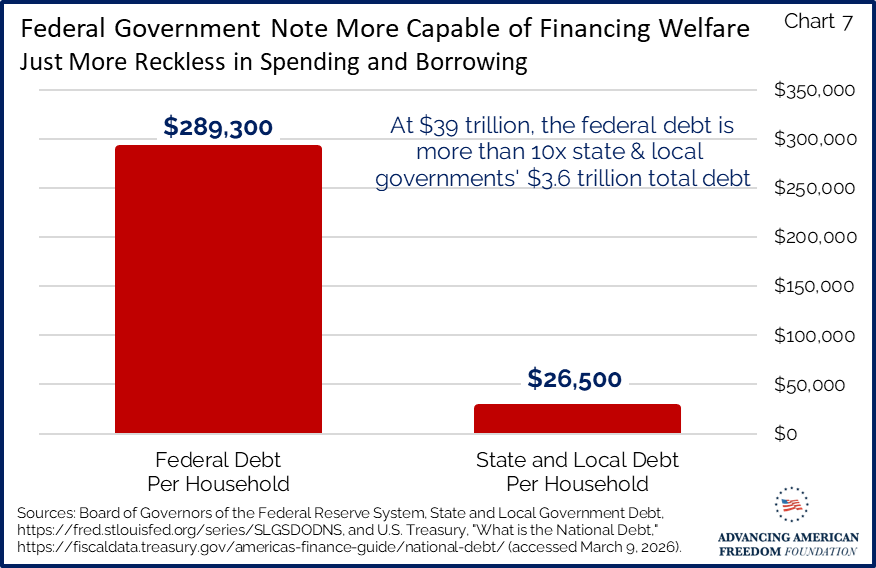
The federal government’s existing debt and unsustainable fiscal trajectory are arguably America’s greatest threats as they limit the federal government’s ability to protect our national security and to respond to economic shocks or another global pandemic. With federal debt already over the tipping point leading to reduced economic growth and annual interest payments on the debt exceeding $1 trillion (surpassing national defense), the U.S. could be dangerously close to a fiscal crisis.
Shifting significant portions of current federal spending to the states—which have drastically less debt and significantly more responsible budget practices—could restore the federal government’s bleak finances and revitalize the federal government’s core capabilities.
It is logical that states should be the primary sources of welfare spending because they are the primary determinants of policies that affect the need for welfare programs. If states: have poor education systems that fail to prepare students for future job; enact excessive minimum wages that increase unemployment; levy high taxes that reduce disposable incomes; or impose burdensome regulations that deter businesses from setting up shop in the state, they should not be rewarded with more federal funding to pay for the consequences of their bad policies.
Based on the Cato Institute’s Index of Freedom in the 50 States and Census Bureau data on state finances, states with the least overall freedom received $878, or 29 percent more in federal funds per capita in 2023 than the 10 states with the most overall freedom. On average, states received $3,625 per capita in intergovernmental transfers in 2023; funding to the ten most free states averaged $3,025 per capita while funding to the ten least free states averaged $3,902.
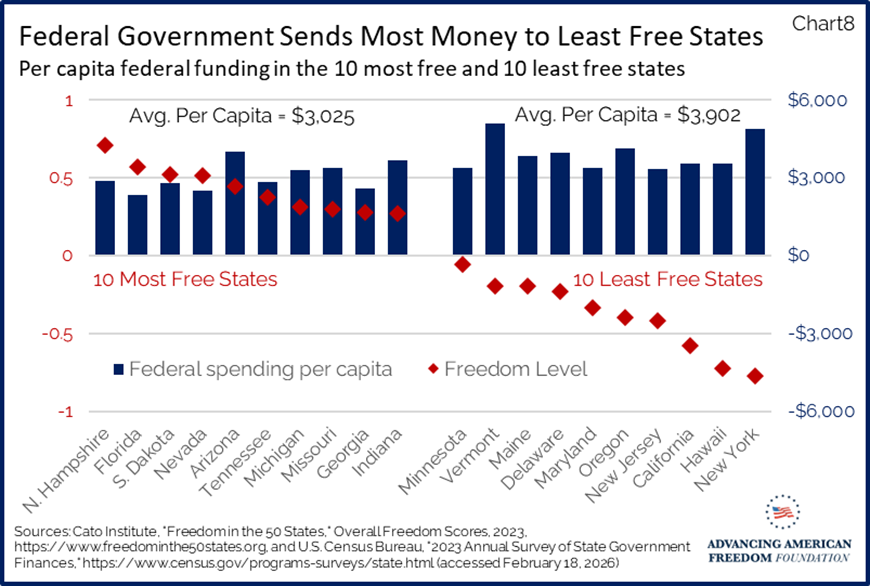
The federal government should not be in the business of making up for bad state policies by redistributing federal taxpayer dollars from states that prioritize personal and economic freedom to those that restrict them.
The tragedy of the commons is an economic concept that describes instances in which individuals, acting in their own self-interest, overuse and unnecessarily deplete shared resources. A similar “tragedy of the Treasury” occurs when state politicians have the incentive to maximize the flow of federal dollars into their states, capitalizing on loose eligibility checks and lax oversight, because the costs are spread to all federal taxpayers while the economic and political benefits are concentrated locally.
As witnessed in Minnesota, reckless delivery of fraudulent payments appeared to be all gain and no pain. Federal benefits boosted incomes and economic activity in the state and there was initially no consequence for improper payments. The only way to reduce this perverse incentive is to align fiscal responsibility with spending decisions. Ultimately, states should be using revenues collected from their own taxpayers to serve their own residents.
Even if federal funding to the states lacks accountability, defenders of federally funded welfare programs argue that the redistributive structure is necessary because states with the highest percentage of people in need are likely to have a smaller tax base to finance welfare programs.
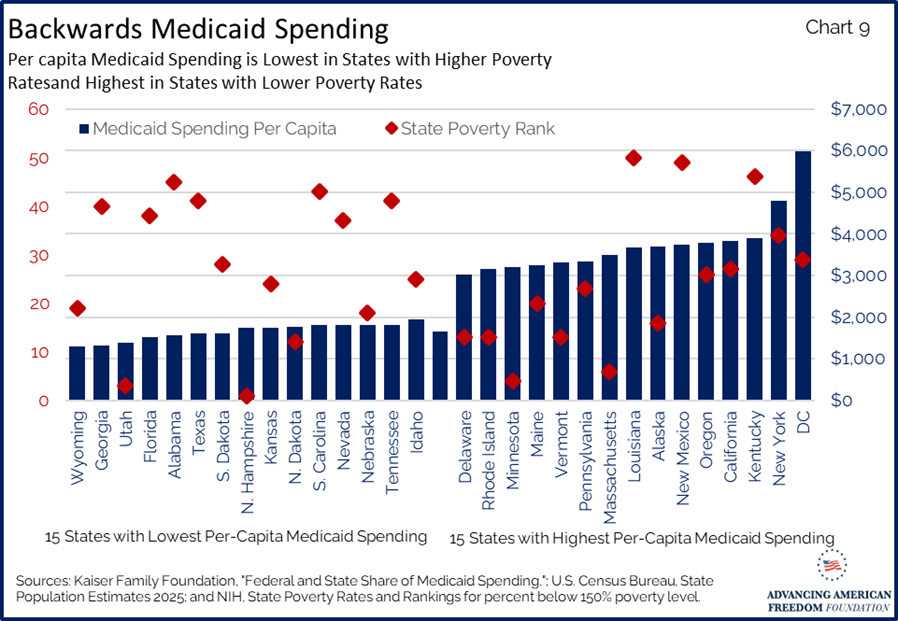
If that were true, welfare spending should be the highest (on a per capita basis) in states with the highest poverty rates. Yet, the opposite is true. As Chart 8 shows, the 15 states that have the lowest levels of Medicaid spending—$1,650 per capita, on average—have slightly higher poverty rankings[55] than the 15 states that have the highest levels of Medicaid spending—$3,740 per capita, on average.
Perverse incentives for states to maximize federal welfare dollars flowing into their states and the resulting failure to focus welfare benefits on those most in need make the federal government a poor broker of welfare spending.
The primary purposes of the federal government are to provide a strong national defense, uphold the Constitution and the rule of law, and to protect individual liberty and property rights. The expansion of the federal government far beyond these purposes, including over $4.2 trillion in spending per year ($33,200 per household) on transfer payments unrelated to these primary purposes, has invited fraud and improper payments that waste taxpayer dollars and threaten the federal government’s ability to perform its core duties.
The recent fraud uncovered in Minnesota is only the tip of the iceberg. The Government Accountability Office estimates that the U.S. loses between $233 billion and $521 billion annually to fraud.[56] While much fraud goes undetected, the federal government has reported over $1.9 trillion in improper payments over the past decade, including $185 billion or $1,400 per household in 2025 alone. That is only what the federal government measures and reports. The true figure is almost certainly significantly higher.
While much fraud goes undetected, the federal government has reported over $1.9 trillion in improper payments over the past decade……Detached from the costs, shielded from the consequences, and rewarded for increasing spending rather than safeguarding taxpayers’ dollars, it is no surprise that federal grants to the states invite fraud, errors, and abuse.
Improper payments are an inevitable consequence of the tragedy of the Treasury whereby politicians and unelected bureaucrats can spend other people’s money with little regard to who receives it or what they get for it. Detached from the costs, shielded from the consequences, and rewarded for increasing spending rather than safeguarding taxpayers’ dollars, it is no surprise that federal grants to the states invite fraud, errors, and abuse.
Existing law provides some avenues to improve accountability, and the One Big Beautiful Bill makes major improvements by requiring states to pay for most of their errors in the Food Stamp and Medicaid programs, beginning in 2028 and 2030. There is significantly more that federal policymakers can and should do, such as: strengthening congressional oversight and enforcement to ensure compliance with the Payment Integrity Information Act; requiring states to accurately measure and report improper payments; imposing an improper payment cap (such as three percent) on discretionary programs and reducing next year appropriations by the amount over the cap; conditioning federal entitlement funding on states’ agreement to reimburse excessive improper payments; and restricting lax eligibility provisions that invite abuse.
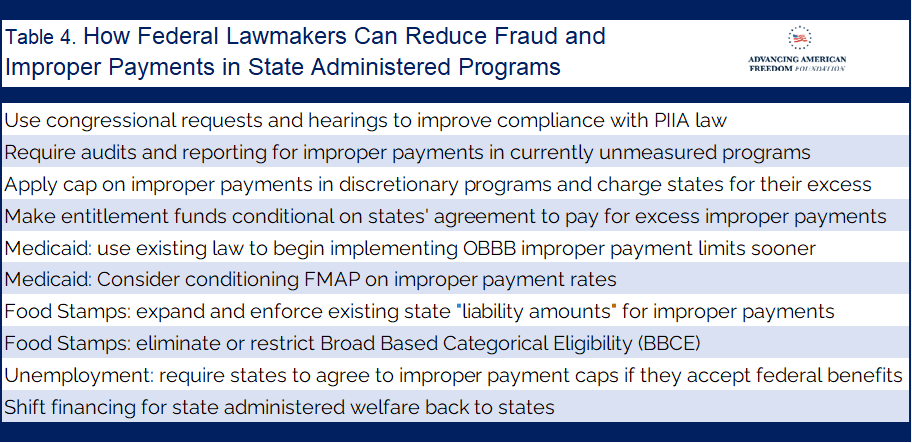
Beyond improving accountability within the current federal-funding structure, shifting welfare financing back to the states would restore discipline. The total of all state and local debt is less than ten percent of the federal debt, which is nearing fiscal crisis levels. If states bear the fiscal consequences of their policy choices and payment errors, incentives align, accountability improves, and federal taxpayers are no longer forced to subsidize both poor policy and preventable waste.
[1] PaymentAccuracy.gov. (accessed February 13, 2026).
[2] All improper payments included in this report equal “improper and unknown” payments and rates as reported on PaymentAccuracy.gov, minus all Department of War wage and travel compensation payments. These payments are netted out for consistency as no other departments report improper payments related to employee compensation or travel expenses.
[3] Ibid and: H. Con. Res. 14, Concurrent Resolution on the Budget—Fiscal Year 2025, Committee on the Budget, U.S. House of Representatives, February 18, 2025, https://www.govinfo.gov/content/pkg/CRPT-119hrpt4/html/CRPT-119hrpt4.htm (accessed February 23, 2026; Deltek, “Congress Passes FY 2025 Appropriations – Top Federal Departments and Agencies,” March 18, 2025, https://iq.govwin.com/neo/marketAnalysis/view/Congress-Passes-FY-2025-Appropriations–Top-Federal-Departments-and-Agencies/8287 (accessed February 23, 2026).
[4] BLS, “Consumer Expenditures, 2024,” December 19, 2025, https://www.bls.gov/news.release/pdf/cesan.pdf (accessed February 23, 2026).
[5] Ibid, and: Paymentaccuracy.gov; Kaiser Family Foundation, “2025 Employer Health Benefits Survey,” October 22, 2025, https://www.kff.org/health-costs/2025-employer-health-benefits-survey/ (accessed February 23, 2026).
[6] Brian Blase and Rachel Greszler, “Medicald’s True Improper Payments Double Those Reported,” Economic Policy Innovation Center and Paragon Health Institute, March 3, 2025, https://epicforamerica.org/wp-content/uploads/2025/02/Medicaids_True_Improper_Payments_FOR-RELEASE_V3.pdf (accessed January 29, 2026).
[7] PaymentAccuracy.gov (accessed January 31, 2025).
[8] Alyssa Chen and Michelle Griffith, “U.S. Attorney: Fraud likely exceeds $9 billion in Minnesota-run Medicaid services,” Minnesota Reformer, December 18, 2025, https://minnesotareformer.com/2025/12/18/u-s-attorney-fraud-likely-exceeds-9-billion-in-minnesota-run-medicaid-services/ (accessed February 17, 2026).
[9] GAO, “Fraud Risk Management: 2018-2022 Data Show Federal Government Loses an Estimated $233 Billion to $521 Billion Annually to Fraud, Based on Various Risk Environments,” GAO-24-105833, April 16, 2024, https://www.gao.gov/products/gao-24-105833 (accessed February 25, 2026).
[10] BLS, “Consumer Expenditures, 2024.”
[11] Milton Friedman, “The Four Ways to Spend Money,” Free to Choose Network, https://www.youtube.com/watch?v=XsRk9RThGt0 (accessed January 29, 2026).
[12] Public Law 111-204, Improper Payments Elimination and Recovery Act of 2010, 124 Stat. 2224, July 22, 2010, https://www.congress.gov/111/plaws/publ204/PLAW-111publ204.pdf (accessed March 9, 2026); and Public Law 112-248, Improper Payments Elimination and Recovery Improvement Act of 2012, 126 Stat. 2390, January 10, 2013 https://www.congress.gov/112/plaws/publ248/PLAW-112publ248.pdf (accessed March 9, 2026).
[13] Public Law 116-117, Payment Integrity Information Act of 2019, 134 Stat. 113, March 2, 2020, https://www.congress.gov/116/plaws/publ117/PLAW-116publ117.pdf (accessed January 29, 2026).
[13] PaymentAccuracy.gov.
[15] Linda Miller, testimony before the Committee on Oversight and Government Reform, U.S. House of Representatives, March 31, 2022, https://docs.house.gov/meetings/GO/GO24/20220331/114566/HHRG-117-GO24-Wstate-MillerL-20220331.pdf (accessed January 29, 2026).
[16] DOGE HHS, “Today the HHS DOGE team open sourced the largest Medicaid dataset in department history..,” X, February 13, 2026, https://x.com/DOGE_HHS/status/2022370909211021376 (accessed February 18, 2026).
[17] The White House, “Here’s What the Trump Administration Is Doing to Crush Minnesota’s Fraud Epidemic,” January 2, 2026, https://www.whitehouse.gov/articles/2026/01/heres-what-the-trump-administration-is-doing-to-crush-minnesotas-fraud-epidemic/ (accessed February 18, 2026).
[18] Ibid.
[19] Ibid.
[20] The budgeting process should prevent agencies and programs from building in work-arounds that would allow them to recoup what they lost in funding as a result of their improper payments.
[21] Estimate based on FY 2024 reported totals and an estimated 8.6% increase in Medicaid spending in FY 2025: Kaiser Family Foundation, “Federal and State Share of Medicaid Spending,” FY 2024, https://www.kff.org/medicaid/state-indicator/federalstate-share-of-spending/?dataView=1¤tTimeframe=0&sortModel=%7B%22colId%22:%22Location%22,%22sort%22:%22asc%22%7D (accessed January 29, 2026), and “State Medicaid Officials Project Flat Enrollment Post Unwinding but Increased Spending and Budget Pressures, as States Prepare for Impact of Federal Medicaid Policy Changes,” November 13, 2025, https://www.kff.org/medicaid/state-medicaid-officials-project-flat-enrollment-post-unwinding-but-increased-spending-and-budget-pressures-as-states-prepare-for-impact-of-federal-medicaid-policy-changes/ (accessed January 29, 2026).
[22] 42 U.S.C. § 1396b(u).
[23] Rachel Greszler and Brian Blasé, “Medicald’s True Improper Payments Double Those Reported.”
[24] Niklas Kleinworth and Brian Blase, “Preserve and Improve Medicaid, State Action to Protect the Most Vulnerable and Taxpayers,” Paragon Health Institute, December 2005, https://paragoninstitute.org/wp-content/uploads/2025/12/Preserve_and_Improve_Medicaid_Kleinworth_Blase_RELEASE_V1.pdf (accessed March 4, 2026).
[25] HHS, Office of Inspector General, “CMS Has Opportunities to Strengthen States’ Oversight of Medicaid Managed Care Plans’ Reporting of Medical Loss Ratios,” September 2022, https://oig.hhs.gov/oei/reports/OEI-03-20-00231.asp (accessed March 4, 2026). — PAGE 22 —
[26] Niklas Kleinworth and Brian Blase, “Preserve and Improve Medicaid.”
[27] Lawmakers could phase in these state accountability conditions, for example, by reducing the FMAP by only one-third of the difference in year one, by two-thirds of the difference in year two, and by the full difference in years three and beyond
[28] Even based on the Biden Administration’s woefully deficient improper payment measurements that reported $31.1 billion in improper Medicaid payments in 2024, an accountability-based FMAP could have saved taxpayers $12.8 billion.
[29] BLS, “Unemployment Rate,” https://www.bls.gov/data/home.htm#employment (accessed February 13, 2026); USDA, “Supplemental Nutrition Assistance Program Participation and Cost,” https://fns-prod.azureedge.us/sites/default/files/resource-files/snap-annualsummary-1.pdf (accessed February 13, 2026).
[30] PaymentAccuracy.gov.
[31] BBCE regulations were permitted and encouraged through Clinton and Obama regulations. See: Matthew Dickerson, “Categorical Eligibility Allows Legalized Fraud,” Economic Policy Innovation Center, February 5, 2026, https://epicforamerica.org/federal-budget/categorical-eligibility-allows-legalized-food-stamp-fraud/ (accessed February 14, 2026).
[32] U.S. Department of Agriculture, “Trends in USDA SNAP Participation Rates: FY 2020 and 2022, Food and Nutrition Service, https://www.fns.usda.gov/research/snap/national-participation-rates/fy20and22 (accessed February 14, 2026)
[33] Michael Greibok, “Broad-Based Categorical Eligibility in Food Stamps is Fraud by Design and States Should Ban It,” December 12, 2025, https://thefga.org/research/categorical-eligibility-in-food-stamps-is-fraud-by-design/ (accessed February 14, 2026).
[34] Matthew Dickerson, “Categorical Eligibility Allows Legalized Fraud.”
[35] Ibid.
[36] USDA, “FNS Quality Control Process for SNAP Error Rate,” Office of the Inspector General, September 2015, https://usdaoig.oversight.gov/sites/default/files/reports/2025-09/27601-0002-41.pdf (accessed February 14, 2026).
[37] No Welfare for the Wealthy Act of 2025, H.R. 416, 119th Congress, First Session.
[38] States with improper payment rates between 6.0 percent and 7.99 percent must pay for 5 percent of their SNAP benefits; states with payment error rates between 8.0 percent and 9.99 percent must pay 10 percent; and states with payment error rates of 10 percent or higher must pay for 15 percent of their SNAP benefits. Public Law 119-21 (2025), https://www.congress.gov/bill/119th-congress/house-bill/1/text.
[39] 7 U.S.C. § 2025(c)-(e)
[40] The Secretary shall also require that up to half of the state’s liability amount be used for investments to improve the state’s administration of Food Stamps.
[41] 7 U.S.C. § 2025(e).
[42] 7 U.S.C. § 2025(e).
[43] The at-risk amount to be paid back to HHS should not exceed the state’s share of administrative costs. Administrative costs average about 6 percent, and states pay 50 percent of administrative costs in fiscal year 2026, and 75 percent of administrative costs in fiscal years 2027 and beyond.
[44] Congressional Research Service, “Errors and Fraud in the Supplemental Nutrition Assistance Program (SNAP),” March 28, 2018 to September 30, 2018, https://www.everycrsreport.com/reports/R45147.html (accessed February 14, 2026).
[45] This would shift up to the entirety of a state’s SNAP administrative costs onto the state.
[46] The maximum FUTA tax is $420 per employee (6 percent times $7,000 in wages), which is reduced to $42 so long as states are in compliance with federal requirements.
[47] Peter Ganong, Pascal J. Noel, and Joseph S. Vavra, “US Unemployment Insurance Replacement Rates During the Pandemic,” NBER Working Paper No. 27216, May 2020, https://www.nber.org/papers/w27216 (accessed February 15, 2026).
[48] Rachel Greszler, “Excessive Pandemic Unemployment Benefits Are a Warning Against Unemployment Program Expansions,” Heritage Foundation Backgrounder, July 13, 2021, https://www.heritage.org/jobs-and-labor/report/excessive-pandemic-unemployment-benefits-are-warning-against-unemployment (accessed February 15, 2026).
[49] K. Lloyd Billingsley, “Nuke Bizzle, Unemployment Fraud, and AB-5: Julie Su’s Concerning Record,” March 9, 2023, https://www.independent.org/article/2023/03/09/unemployment-fraud-ab5-julie-su/ (accessed February 15, 2026).
[50] Rachel Greszler, “Excessive Pandemic Unemployment Benefits Are a Warning Against Unemployment Program Expansions.”
[51] Department of Labor Office of the Inspector General, “OIG Oversight of the Unemployment Insurance Program,” last updated June 5, 2025, https://www.oig.dol.gov/doloiguioversightwork.htm (accessed February 15, 2026).
[52] Ibid.
[53] Another reason not detailed in the text is that state and local governments are better-equipped to tailor their work and welfare supports to the needs of their populations. Utah’s One-Door model of welfare and workforce supports avoids the federal welfare programs maze and benefits trap through a fully-coordinated system aimed at restoring individuals to work and independence. See: Rachel Greszler and Rachel Sheffield, “With Bipartisan Measure, Congress Could Expand Successful ‘One Door’ Policy on Welfare, Workforce,” February 11, 2024, https://www.dailysignal.com/2024/02/11/this-bipartisan-measure-provides-opportunity-for-congress-to-expand-successful-one-door-policy-on-welfare-and-workforce/ (accessed February 21, 2026).
[54] Board of Governors of the Federal Reserve System, “State and Local Government Debt,” https://fred.stlouisfed.org/series/SLGSDODNS (accessed February 18, 2026), and: U.S. Treasury, “What is the National Debt,” https://fiscaldata.treasury.gov/americas-finance-guide/national-debt/ (accessed March 9, 2026).
[55] Poverty rankings are assigned values of 1 to 51 across the 50 states and DC, according to the percent of the population that has income below 150 percent of the federal poverty level. Author’s calculations based on data from: Kaiser Family Foundation, “Federal and State Share of Medicaid Spending,”2024, https://www.kff.org/medicaid/state-indicator/total-medicaid-spending/ (accessed February 5, 2026); U.S. Census Bureau, State Population Estimates 2025; and NIH, “Poverty Table- Persons Below 150 Percent Poverty,” https://hdpulse.nimhd.nih.gov/data-portal/home (accessed February 5, 2026).
[56] GAO, “Fraud Risk Management: 2018-2022 Data Show Federal Government Loses an Estimated $233 Billion to $521 Billion Annually to Fraud, Based on Various Risk Environments.”