TOPLINE:
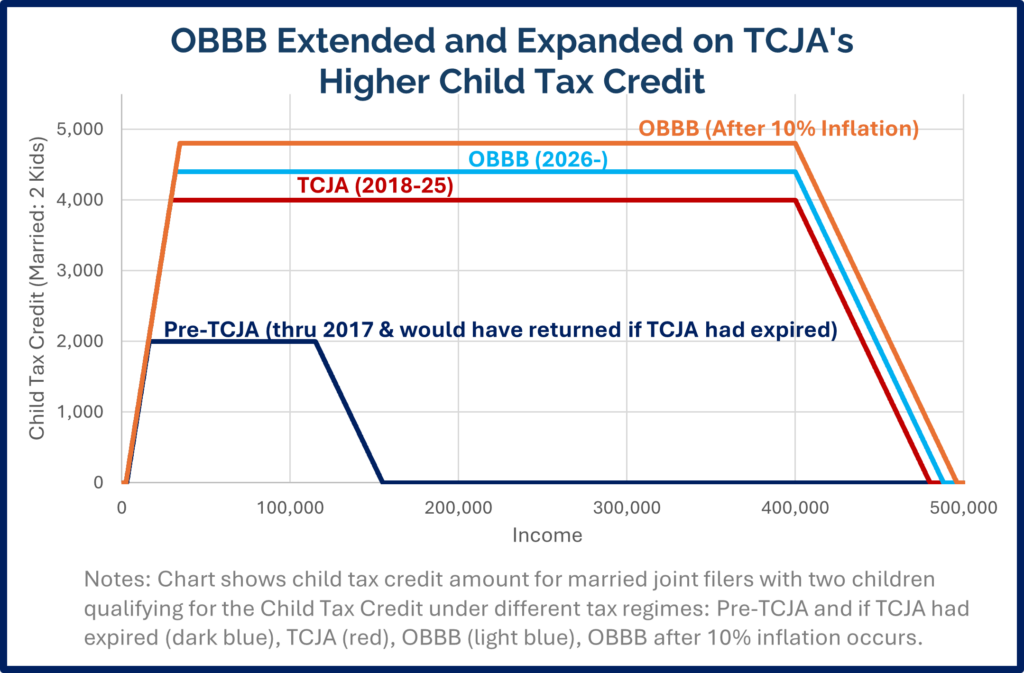
The One Big Beautiful Bill (OBBB) permanently extended the 2017 Tax Cuts and Jobs Act’s (TCJA’s) Child Tax Credit changes, including its doubling of the credit amount and less restrictive phase-in and phase-out. OBBB also added $200 more to the credit and added an automatic inflation adjustment to the credit amount.
BACKGROUND:
Prior to the 2017 tax bill, the tax code allowed individuals to claim a $1,000 tax credit per qualifying child ages 16 and under. The credit was partially refundable, meaning that some taxpayers with no net income tax liability could claim part (or in some cases all) of the credit amount, getting a tax “refund” that was greater than the income taxes they paid during the year. The Child Tax Credit effectively began phasing in for taxpayers with at least $3,000 of earned income and phased in at a rate of 15% for earned income above that amount until maxing out at $1,000 per child. The Child Tax Credit then began phasing out at a 5% rate for income beyond a threshold of $75,000/$110,000 (single/married joint filers).
For the tax years 2018 through 2025, TCJA:
- Doubled the Child Tax Credit amount from $1,000 to $2,000;
- Set the refundable portion of the credit to $1,400 in 2018 but also included an inflation adjustment that allowed this amount to increase to $1,700 by 2025;
- Lowered the start of the phase-in of the refundable credit from $3,000 to $2,500 of earned income; and
- Raised the income threshold at which the Child Tax Credit began to phase-out from $75,000/$110,000 to $200,000/$400,000.
What OBBB Did:
- Prevented the Child Tax Credit from reverting from $2,000 to $1,000 upon the expiration of TCJA at the end of 2025.
- Further increased the Child Tax Credit amount to $2,200 (per child).
- Added an annual cost-of-living adjustment to periodically increase the child tax credit amount in $100 increments (subject to rounding).
- Permanently extended TCJA’s $1,700 refundable portion of the credit (with cost-of-living adjustments).
- Required that parents have a valid Social Security Number to be eligible for the credit to reduce fraud and avoid the credit being claimed by illegal immigrants.
Why It Matters?
- More than 50 million Americans claim the Child Tax Credit each year.
- JCT estimated the Child Tax Credit Changes will reduce taxes and increase outlays by $817 billion from 2026-2034.
- The Child Tax Credit’s size and refundability leads many Americans to receive income tax refunds that exceed their taxes paid. About 40% of Americans pay zero (or negative) federal income tax in a typical year (that figure hit 57% in 2021, when federal stimulus checks were issued en masse).
Where Can I Find Changes?
OBBB Section 70104; 26 U.S.C. § 24(h)-(i).
BOTTOMLINE:
It makes sense for the tax code to have a Child Tax Credit or some other mechanism to reduce taxes for larger families, given the level of progressivity in the U.S. tax brackets. The strain on families’ financial resources increases as the number of mouths to feed increases. However, the Child Tax Credit is now large enough that the tax code is more favorable to taxpayers with children than to those without, all else being equal. Adding to the Child Tax Credit beyond OBBB’s changes would go too far. Many childless young couples want to have children one day—the tax code shouldn’t be biased against them in the meantime.
In theory, the Internal Revenue Service exists to collect tax revenue, not to administer benefits. Refundable tax credits like the Earned Income Tax Credit, the refundable portion of the Child Tax Credit, and various recent stimulus payments administered by the IRS have blurred that distinction as some taxpayers’ tax “refund” checks dwarf the taxes they pay.
This memo is part of the One Big Beautiful Booklet, a collection of more than 60 memos that examine and summarize the major aspects of the One Big Beautiful Bill – the signature legislative achievement of President Trump and the 119th Congress.